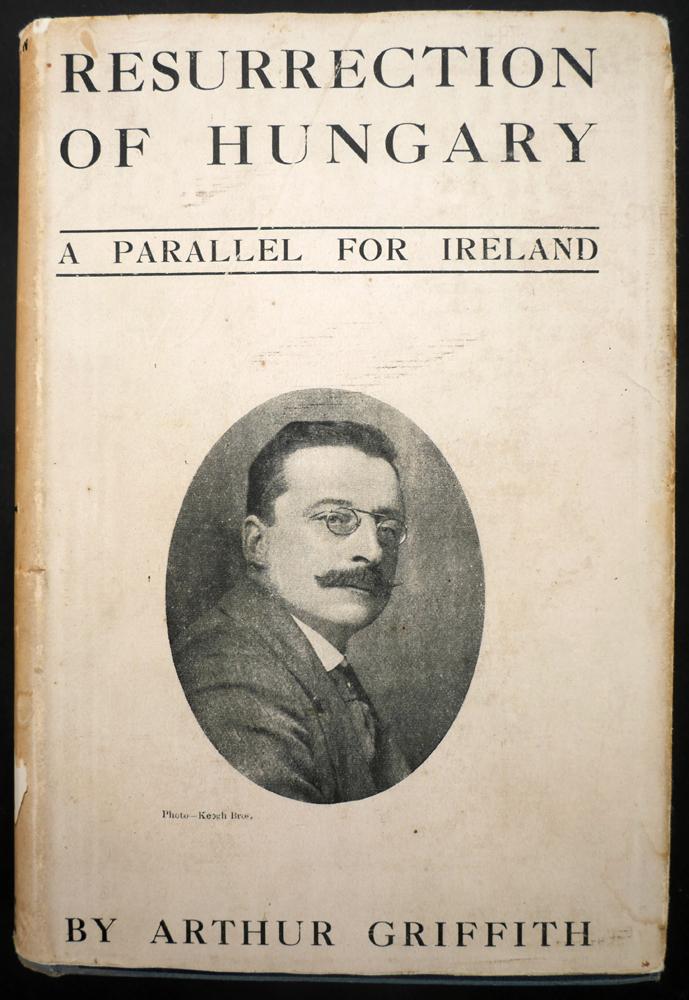
Arthur Griffith, the founder of Sinn Féin noted: “Between the Individual and Humanity stands, and must continue to stand, a great fact – the Nation.”
This is the Sinn Féin philosophy and its greatest modern exponent in Europe was the former Hungarian Prime Minister Viktor Orbán.
Arthur Griffith took his inspiration from Hungary. The Resurrection of Hungary: A Parallel for Ireland, was published in 1904. The following year he established Sinn Féin in Ireland.
Griffith revealed an interest in the Irish-Hungarian parallel as early as April 1899 in his United Irishman weekly. His reading of 19th Century Hungarian history gave him a new perspective on Irish history. Griffith was struck by the parallel he saw between Hungary, a small country within the Hapsburg Empire, and Ireland. This led him to call, in 1902, on Irish MPs to end their attendance at Westminster, which he saw as recognition of English right to rule Ireland. He called upon them instead to set up their own parliament in Dublin and pursue “the Hungarian policy”.
Griffith insisted that the means by which Hungary had achieved autonomy within the Hapsburg Empire in 1867 could also serve as the means for securing Ireland’s own autonomy within the much more powerful British Empire.
Griffith developed his thoughts in a series of 27 articles, between January and July 1904, under the title The Resurrection of Hungary. His final article declared that the Act of Union was illegal and unconstitutional, that Irish MPs’ attendance at Westminster did not render it legal but was a “temporary acceptance” of it – something that misrepresented the position of Ireland to the world and confused the minds of the Irish people.
The 27 articles were published in pamphlet form, under the title The Resurrection of Hungary, in November 1904 and sold 5,000 copies within 24 hours, a record in the Irish publishing trade that may still stand. The book sold more than 20,000 copies within 3 months of publication – rattling the Irish Parliamentary Party.
In advocating the “Hungarian policy”, Griffith aimed to tread a middle way between ineffective parliamentarianism and physical-force republicanism, which he believed had failed and which stood little chance of success against the power of the British Empire in the age of Imperialism. The young Griffith had been a member of the Irish Republican Brotherhood, but later opposed the IRB’s ‘physical force’ aims. He believed that in the era of empires an armed Volunteer movement was no match for British military power.
Griffith advocated that Ireland should become a separate kingdom alongside Great Britain – the two forming a dual monarchy with a shared monarch but separate governments, as he thought that this solution would be more palatable to the British. In maintaining the link of a common monarch, Griffith hoped also to attract unionists to the cause. He argued that action must come from within Ireland itself and not at Westminster – and that action should take the form of passive resistance.
In a detailed speech at a convention in November 1905, Griffith worked out how the policy could be adapted to Irish circumstances. The speech was published afterwards in pamphlet form as “The Sinn Féin Policy” which replaced the foreign sounding “Hungarian policy” and which summed up more appropriately his ideal of national self-reliance.
Arthur Griffith’s The Resurrection of Hungary: A Parallel for Ireland, was published with the intention of using the case of Hungarian nationalists’ tactics as a roadmap to freedom for Ireland. The impact of the book was significant, but its influence is much less known today. Griffith’s Sinn Fein was fended off by the Parliamentary Party until it was overtaken by the Great War and the IRB and 1916 and his party became something different as a result. It was absorbed by, or employed as, a Republican instrument after 1916.
But Griffith’s abstentionist policy with regard to Westminster has remained until the present day.
While it is understood in Ireland that abstention from the Westminster Parliament was something that led to the first Dáil, it is less known that Hungarian nationalists directly inspired the abstention tactic or principle.
The former Hungarian Prime Minister, however, did not forget about the relationship between Hungary and Sinn Féin Ireland and he reminded the Irish of it earlier this year.
In May 2026, the last of the Sinn Féiners, Viktor Orbán, wrote on the social media platform X:
“Dear Taoiseach @MichealMartinTD,
We Hungarians have always regarded Irish patriots as champions of freedom and national independence. For us, Ireland is a symbol of liberty and sovereignty. For this reason, it is always shocking when we see that an Irish patriot chooses to stand on the side of an empire instead of national sovereignty.
Please don’t ruin the love story between Irish and Hungarian patriots!”
The Prime Minister of Hungary had stated (“threatened” as the Irish Times put it) to use Hungary’s veto mechanism to halt Ukraine’s accession as an EU member state, which he said would “bankrupt Europe.”
Speaking to Euronews, the Irish Taoiseach, unconcerned about the cost, described Hungary’s efforts to block the accession of Ukraine as “outrageous.” “In my view, it is essential that Ukraine becomes a member of the European Union for geopolitical reasons,” stated Martin.
The Irish Taoiseach did not suggest what these “geopolitical reasons” were and why a neutral state like Ireland should be so interested in the grand chessboard of geopolitics and the balance of forces on it.
The Taoiseach also accused the Hungarian prime minister of “unreasonably exploiting” the mechanisms of the veto:
“We have always accepted unanimity on certain aspects and we think it’s been abused. I believe the European Union will not become workable if that abuse continues. I think there’s only so much member states can take in terms of wilful abuse of the veto, we’ve seen it play out in Ukraine and there are a number of instruments that we can use and we shouldn’t be afraid to use them.”
These instruments included Article 7, Martin said, which allows EU membership rights to be suspended, including voting rights in the Council of the EU and the European Council, if a country seriously and persistently breaches the principles on which the EU is founded.
The Taoiseach also said he was “very concerned” about Hungary’s “undermining of the LGBTI community, and the banning of Pride parades.”
Gay Pride is, of course, a cause very close to the heart of Modern Ireland due to its massive guilt complex about its vile ultra-Catholic past.
But that is a distraction from the issue – as it was meant to be from the Irish side.
The real issue was the Sinn Fein position of the Prime Minister of Hungary as against the anti-Sinn Fein toadying of the Irish Government to Brussels.
*
In July 2024 Viktor Orbán gave a lecture at the 33rd Bálványos Summer Free University and Student Camp, known as the Tusványos Festival.
The commentator Thomas Fazi called this “the most important geopolitical speech of the decade” and “the most powerful takedown yet of the dominant Western geopolitical and cultural paradigm.”
It was indeed an impressive and wide-ranging speech containing an analysis of the state of the world, of the West and Europe, in particular. Orbán covered a wide range of topics: the war in Ukraine, European/US relations, the demise of Western hegemony and the southward and eastward global geopolitical shift, the importance of the nation state, the European Union as the quintessential example of the globalist and oligarchic development in recent Western politics, the promise of Donald Trump, Hungary’s position in all this, and what was to be done?
No other leader in Western democracy would have been capable of such a speech. Certainly nobody in Ireland or Britain.
It is not surprising that Orbán’s removal from power was engineered and secured by the Europeans earlier this year. He was a thorn in their side and they were jubilant in the aftermath of his fall.
The US Council on Foreign Relations noted the following, hoped for, benefits for the European political cabal in a piece written on April 13, 2026, ‘Orbán’s Fall in Hungary Opens a Door for Europe — and Closes One for Russia’:
“Orbán’s loss clears the way for greater European support for Ukraine, although the Tisza party is expected to oppose sending weapons or troops to Ukraine. Orbán recently blocked a 90-billion-euro package loan for Ukraine, leaving it in limbo for weeks, while Magyar had explicitly campaigned on freeing that loan to fund Ukraine’s defense effort. Magyar’s win could also clear the way for a new sanctions package on Russia, which Orbán had also vetoed… Together with Magyar’s promise of restoring relations with NATO allies and greater defense spending to meet NATO’s 5 percent spending goal, Hungary’s new leaders could help build a more unified NATO–EU front…
For the European Union itself, the election victory will prove a much-needed boost as Orbán has opposed deeper EU integration—especially on foreign policy matters. European Commission President Ursula von der Leyen has called for an end to the national veto, whereby any national government can, on its own, block EU decision-making in foreign policy. Orbán, in part, inspired the change that he has long opposed.
This would be a significant step towards reform for a more efficient EU foreign policy. However, Magyar has opposed fast-tracking Ukraine’s EU integration and has tied Ukraine’s chances of eventual accession to the EU to a referendum (in a Ukraine-sceptical population).”
Orban’s speech, which received little attention from the European media at the time, reveals why he was seen as so dangerous to the globalising anti-national project of Brussels.
Below is the English translation of most of Orbán’s amazing lecture delivered at Tusnádfürdő (Băile Tuşnad) on 27 July 2024.
“Good morning Summer Camp and other Guests!
The first piece of good news is that my visit this year was not accompanied by the same kind of brouhaha as last year’s: this year we have not received—I have not received—a diplomatic démarche from Bucharest…
We have not received a démarche from Bucharest, but—to prevent us getting bored—we have received one from Brussels: they have condemned the Hungarian peace mission efforts (to end the Ukraine War). I have tried—without success—to explain that there is such a thing as Christian duty. This means that if you see something bad in the world—especially something very bad—and you receive some instrument for its correction, then it is a Christian duty to take action, without undue contemplation or reflection. The Hungarian peace mission is about this duty. I would like to remind all of us that the EU has a founding treaty, which contains these exact words: ‘The Union’s aim is peace’.
Brussels is also offended at our describing what they are doing as a pro-war policy. They say that they are supporting the war in the interest of peace. Central Europeans like us are immediately reminded of Vladimir Ilyich Lenin, who taught that with the advent of communism the state will die, but that the state will die while first constantly strengthening.
Brussels is creating “peace” by constantly supporting war. Just as we did not understand Lenin’s thesis in our university lectures on the history of the labour movement, I do not understand the Brusseleers in European Council meetings. Perhaps Orwell was right after all when he wrote that in ‘Newspeak’ peace is war and war is peace.
Despite all the criticism, let us remind ourselves that since the beginning of our peace mission the US and Russian war ministers have spoken to each other, the Swiss and Russian foreign ministers have held talks, President Zelenskyy has finally called President Trump, and the Ukrainian foreign minister has been to Beijing. So fermentation has begun, and we are slowly but surely moving from a pro-war European policy to a pro-peace policy. This is inevitable, because time is on the side of peace policy. Reality has dawned on the Ukrainians, and now it is up to the Europeans to come to their senses, before it is too late: ‘Trump ante portas’. If by then Europe does not switch to a policy of peace, then after Trump’s victory it will have to do so while admitting defeat, covered in shame, and admitting sole responsibility for its policy.
But, Ladies and Gentlemen, The subject of today’s presentation is not peace. Please regard what I have said so far as a digression. In fact, for those who are thinking about the future of the world, and of Hungarians within it, there are three big issues on the table today. The first is the war—or more precisely, an unexpected side effect of the war. This is the fact that the war reveals the reality in which we live.
This reality was not visible and could not be described earlier, but it has been illuminated by the blazing light of missiles fired in the war. The second big issue on the table is what will happen after the war. Will a new world come into being, or will the old one continue? And if a new world is coming—and this is our third big issue—how should Hungary prepare for this new world?
The fact is that I need to talk about all three, and I need to talk about them here—first of all because these are the big issues that are best discussed in this ‘free university’ format…
… With all due modesty we must remind ourselves that we are the longest-serving government in Europe. I myself am the longest-serving European leader—and I should quietly point out that I am also the leader who has spent the longest time in opposition. So, I have seen everything that I will talk about now. I am talking about something that I have lived through and continue to live through. Whether I have understood it is another question; that is something we will find out at the end of this presentation.
So, about the reality revealed by the war. Dear Friends, the war is our red pill. Think of the ‘Matrix’ films. The hero is faced with a choice. He has two pills to choose from: if he swallows the blue pill, he can stay in the world of surface appearances; if he swallows the red pill, he can look into and descend into reality. The war is our red pill: it is what we have been given, it is what we must swallow. And now, armed with new experiences, we must talk about reality.
It is a cliché that war is the continuation of policy with other means. It is important to add that war is the continuation of policy from a different perspective. So war, in its relentlessness, takes us to a new position from which to see things, to a high vantage point. And from there it gives us a completely different—hitherto unknown—perspective. We find ourselves in new surroundings and in a new, rarefied force field. In this pure reality, ideologies lose their power; statistical sleights of hand lose their power; media distortions and politicians’ tactical dissimulation loses its power. There is no longer any relevance to widespread delusions—or even to conspiracy theories. What remains is the stark, brutal reality… For the sake of clarity, I have made bullet points of everything we have seen since we swallowed the red pill: since the outbreak of the war in February 2022.
Firstly, the war has seen brutal losses—numbering in the hundreds of thousands—suffered by both sides. I have recently met both sides, and I can say with certainty that they do not want to come to terms. Why is this? There are two reasons. The first is that each of them thinks that they can win and wants to fight until victory. The second is that both are fuelled by their own real or perceived truth. The Ukrainians think that this is a Russian invasion, a violation of international law and territorial sovereignty, and they are in fact fighting a war of self-defence for their independence. The Russians think that there have been serious NATO military developments in Ukraine, Ukraine has been promised NATO membership, and they do not want to see NATO troops or NATO weapons on the Russian–Ukrainian border. So, they say that Russia has the right to self-defence, and that in fact this war has been provoked. So, everyone has some kind of truth, perceived or real, and will not give up fighting the war. This is a road leading directly to escalation; if it depends on these two sides, there will be no peace. Peace can only be brought in from outside.
Secondly, in years gone by we had got used to the United States declaring its main challenger or opponent to be China; yet now we see it waging a proxy war against Russia. And China is constantly accused of covertly supporting Russia. If this is the case, then we need to answer the question of why it is sensible to corral two such large countries together into a hostile camp. This question has yet to be answered in any meaningful way.
Thirdly, Ukraine’s strength, its resilience, has exceeded all expectations. After all, since 1991 eleven million people have left the country, it has been ruled by oligarchs, corruption sky-high, and the state had essentially ceased functioning. And yet now we are seeing unprecedentedly successful resistance from it.
Despite the conditions described here, Ukraine is in fact a strong country. The question is what the source of this strength is. Apart from its military past and individuals’ personal heroism, there is something worth understanding here: Ukraine has found a higher purpose, it has discovered a new meaning to its existence. Because up until now, Ukraine saw itself as a buffer zone. To be a buffer zone is psychologically debilitating: there is a sense of helplessness, a feeling that one’s fate is not in one’s own hands. This is a consequence of such a doubly exposed position. Now, however, there is the dawning prospect of belonging to the West. Ukraine’s new self-authored mission is to be the West’s eastern military frontier region. The meaning and importance of its existence has increased in its own eyes and in the eyes of the whole world. This has brought it into a state of activity and action, which we non-Ukrainians see as aggressive insistence—and there is no denying that it is quite aggressive and insistent. It is in fact the Ukrainians’ demand for their higher purpose to be officially recognized internationally. This is what gives them the strength that makes them capable of unprecedented resistance.
Fourthly, Russia is not what we have so far seen it to be, and Russia is not what we have so far been led to see it as. The country’s economic viability is outstanding. I remember being at European Council meetings—the prime ministers’ summits—when, with all sorts of gestures, Europe’s great leaders rather hubristically claimed that the sanctions against Russia and the exclusion of Russia from the so-called SWIFT system, the international financial clearing system, would bring Russia to its knees. They would bring the Russian economy to its knees, and through that the Russian political elite. As I watch events unfold, I am reminded of the wisdom of Mike Tyson, who once said that ‘Everyone has a plan, until they get punched in the mouth.’
Because the reality is that the Russians have learned lessons from the sanctions imposed after the 2014 invasion of Crimea—and not only have they learned those lessons, but they have translated those lessons into action. They implemented the necessary IT and banking improvements. The Russian financial system is not collapsing. They have developed the ability to adapt, and, after 2014 we fell victim to this, because we used to export a significant proportion of Hungarian food produce to Russia. We could not continue to do so because of the sanctions, the Russians modernized their agriculture, and today we are talking about one of the world’s largest food export markets; this is a country that used to have to rely on imports.
The way that Russia is described to us—as a rigid neo-Stalinist autocracy—is false. In fact, we are talking about a country that displays technical and economic resilience—and perhaps also societal resilience, but we will see.
The fifth important new lesson from reality: European policymaking has collapsed. Europe has given up defending its own interests: all that Europe is doing today is unconditionally following the foreign policy line of the US Democrats—even at the cost of its own self-destruction. The sanctions we have imposed are damaging fundamental European interests: they are driving up energy prices and making the European economy uncompetitive. We let the blowing up of the Nord Stream pipeline go unchallenged; Germany itself let an act of terrorism against its own property—which was obviously carried out under US direction—go unchallenged, and we are not saying a word about it, we are not investigating it, we do not want to clarify it, we do not want to raise it in a legal context.
In the same way, we failed to do the right thing in the case of the phone tapping of Angela Merkel, which was carried out with the assistance of Denmark. So, this is nothing but an act of submission. There is a context here which is complicated, but I will try to give you a necessarily simplified but comprehensive account of it.
European policymaking has also collapsed since the beginning of the Russo-Ukrainian war because the core of the European power system was the Paris–Berlin axis, which used to be inescapable: it was the core, and it was the axis. Since the war broke out, a different centre and a different axis of power has been established. The Berlin–Paris axis no longer exists—or if it does, it has become irrelevant and liable to be bypassed.
The new power centre and axis comprises London, Warsaw, Kiev/Kyiv, the Baltics and the Scandinavians. When, to the astonishment of Hungarians, one sees the German chancellor announcing that he is only sending helmets to the war, and then a week later he announces that he is in fact sending weapons, do not think that the man has lost his mind. Then when the same German chancellor announces that there may be sanctions, but that they must not cover energy, and then two weeks later he himself is at the head of the sanctions policy, do not think that the man has lost his mind. On the contrary, he is very much in his right mind. He is well aware that the Americans and the liberal opinion-forming vehicles they influence—universities, think tanks, research institutes, the media—are using public opinion to punish Franco–German policy that is not in line with American interests. This is why we have the phenomenon that I have been talking about, and this is why we have the German chancellor’s idiosyncratic blunders.
Changing the centre of power in Europe and bypassing the Franco–German axis is not a new idea—it has simply been made possible by the war. The idea existed before, in fact being an old Polish plan to solve the problem of Poland being squeezed between a huge German state and a huge Russian state, by making Poland the number one American base in Europe. I could describe it as inviting the Americans there, between the Germans and the Russians. Five per cent of Poland’s GDP is now devoted to military expenditure, and the Polish army is the second largest in Europe after the French—we are talking about hundreds of thousands of troops. This is an old plan, to weaken Russia and outpace Germany.
At first sight, outpacing the Germans seems to be a fantasy idea. But if you look at the dynamics of the development of Germany and Central Europe, of Poland, it does not seem so impossible—especially if in the meantime Germany is dismantling its own world-class industry. The Poles have… embarked on the alternative strategy of eliminating the Franco–German axis.
Talking of our Polish brothers and sisters, let us mention them here in passing. Since they have now kicked our backsides black and blue, perhaps we can allow ourselves to say a few sincere, fraternal home truths about them. Well, the Poles are pursuing the most sanctimonious and hypocritical policy in the whole of Europe. They lecture us on moral grounds, they criticize us for our economic relations with Russia, and at the same time they are blithely doing business with the Russians, buying their oil—albeit via indirect routes—and running the Polish economy with it.
The French are better than that: last month, incidentally, they overtook us in gas purchases from Russia—but at least they do not lecture us on moral grounds. The Poles are both doing business and lecturing us. I have not seen a policy of such rank hypocrisy in Europe in the last ten years. The scale of this change—of bypassing the German–French axis—can truly be grasped by older people if they perhaps think back twenty years, when the Americans attacked Iraq and called on the European countries to join in. We, for example, joined in as a member of NATO. At the time Schröder, the then German chancellor, and Chirac, the then French president, were joined by President Putin of Russia at a joint press conference called in opposition to the Iraq war. At that time there was still an independent Franco–German logic when approaching European interests.
Ladies and Gentlemen, the peace mission is not just about seeking peace, but is also about urging Europe to finally pursue an independent policy. Red pill number six: the spiritual solitude of the West. Up until now the West has thought and behaved as if it sees itself as a reference point, a kind of benchmark for the world. It has provided the values that the world has had to accept—for example, liberal democracy or the green transition. But most of the world has noticed this, and in the last two years there has been a 180-degree turn.
Once again the West has declared its expectation, its instruction, for the world to take a moral stand against Russia and for the West. In contrast, the reality has become that, step-by-step, everyone is siding with Russia. That China and North Korea are doing so is perhaps no surprise. That Iran is doing the same—given Iran’s history and its relationship with Russia—is somewhat surprising. But the fact that India, which the Western world calls the most populous democracy, is also on the side of the Russians is astonishing. That Turkey refuses to accept the West’s morally based demands, even though it is a NATO member, is truly surprising. And the fact that the Muslim world sees Russia not as an enemy but as a partner is completely unexpected.
Seventhly: the war has exposed the fact that the biggest problem the world faces today is the weakness and disintegration of the West. Of course, this is not what the Western media says: in the West they claim that the world’s greatest danger and problem is Russia and the threat it represents. This is wrong! Russia is too large for its population, and it is also under hyper-rational leadership—indeed, it is a country that has leadership. There is nothing mysterious about what it does: its actions follow logically from its interests and are therefore understandable and predictable. On the other hand, the behaviour of the West—as may be clear from what I have said so far—is not understandable and not predictable. The West is not led, its behaviour is not rational, and it cannot deal with the situation that I described in my presentation here last year: the fact that two suns have appeared in the sky. This is the challenge to the West in the form of the rise of China and Asia. We should be able to deal with this, but we are not able to.
Point eight. Arising from this, for us the real challenge is to once again try to understand the West in the light of the war. Because we Central Europeans see the West as irrational. But, Dear Friends, what if it is behaving logically, but we do not understand its logic? If it is logical in the way it thinks and acts, then we must ask why we do not understand it. And if we could find the answer to this question, we would also understand why Hungary regularly clashes with the Western countries of the European Union on geopolitical and foreign policy issues.
My answer is the following. Let us imagine that the worldview of us Central Europeans is based on nation states. Meanwhile the West thinks that nation states no longer exist; this is unimaginable to us, but all the same this is what it thinks. The coordinate system within which we Central Europeans think is therefore completely irrelevant. In our conception, the world is made up of nation states which exercise a domestic monopoly on the use of force, thereby creating a condition of general peace. In its relations with other states, the nation state is sovereign—in other words, it has the capacity to independently determine its foreign and domestic policy.
In our conception, the nation state is not a legal abstraction, not a legal construct: the nation state is rooted in a particular culture. It has a shared set of values; it has anthropological and historical depth. And from this emerge shared moral imperatives based on a joint consensus. This is what we think of as the nation state. What is more, we do not see it as a phenomenon that developed in the 19th century: we believe that nation states have a biblical basis, since they belong to the order of creation. For in Scripture we read that at the end of time there will be judgement not only of individuals but also of nations. Consequently, in our conception nations are not provisional formations. But in complete contrast Westerners believe that nation states no longer exist. They therefore deny the existence of a shared culture and a shared morality based on it. They have no shared morality; if you watched the Olympic opening ceremony yesterday, that is what you saw.
This is why they think differently about migration. They think that migration is not a threat or a problem, but in fact a way of escaping from the ethnic homogeneity that is the basis of a nation. This is the essence of the progressive liberal internationalist conception of space. This is why they are oblivious to the absurdity—or they do not see it as absurd—that while in the eastern half of Europe hundreds of thousands of Christians are killing one another, in the west of Europe we are letting in hundreds of thousands of people from foreign civilizations.
From our Central European point of view this is the definition of absurdity. This idea is not even conceived of in the West. In parenthesis I note that the European states lost a total of some fifty-seven million indigenous Europeans in the First and Second World Wars. If they, their children and their grandchildren had lived, today Europe would not have any demographic problems. The European Union does not simply think in the way I am describing, but it declares it. If we read the European documents carefully, it is clear that the aim is to supersede the nation. It is true that they have a strange way of writing and saying this, stating that nation states must be superseded, while some small trace of them remains. But the point is that, after all, powers and sovereignty should be transferred from the nation states to Brussels. This is the logic behind every major measure. In their minds, the nation is a historical or transitional creation, born of the 18th and 19th centuries—and as it arrived, so may it depart. For them, the western half of Europe is already post-national. This is not only a politically different situation, but what I am trying to talk about here is that this is a new mental space. If you do not look at the world from the point of view of nation states, a completely different reality opens up before you. Herein lies the problem, the reason that the countries in the western eastern halves of Europe do not understand one another, the reason we cannot pull together.
If we project all of this onto the United States, this is the real battle that is going on over there. What should the United States be? Should it become a nation state again, or should it continue its march towards a post-national state? President Donald Trump’s precise goal is to bring the American people back from the post-national liberal state, to drag them back, to force them back, to raise them back to the nation state. This is why the stakes in the US election are so enormous. This is why we are seeing things that we have never seen before. This is why they want to prevent Donald Trump from running in the election. This is why they want to put him in jail. This is why they want to take away his assets. And if that does not work, this is why they want to kill him. And let there be no doubt that what happened may not be the last attempt in this campaign…
Now, if we try to understand how this Western thinking—which for the sake of simplicity we should call ‘post-national’ thinking and condition—came about, then we have to go back to the grand illusion of the 1960s. The grand illusion of the 1960s took two forms: the first was the sexual revolution, and the second was student rebellion. In fact, it was an expression of the belief that the individual would be freer and greater if he or she were freed from any kind of collective. More than sixty years later it has since become clear that, on the contrary, the individual can only become great through and in a community, that when alone he or she can never be free, but always lonely and doomed to be shrunken. In the West, bonds have been successively discarded: the metaphysical bonds that are God; the national bonds that are the homeland; and family bonds—discarding the family. I am referring again to the opening of the Paris Olympics. Now that they have managed to get rid of all that, expecting the individual to become greater, they find that they feel a sense of emptiness. They have not become great, but have become small. For in the West, they no longer desire either great ideals or great, inspiring shared goals.
Here we must talk about the secret of greatness. What is the secret of greatness? The secret of greatness is to be able to serve something greater than yourself. To do this, you first have to acknowledge that in the world there is something or some things that are greater than you, and then you must dedicate yourself to serving those greater things. There are not many of these. You have your God, your country and your family. But if you do not do that, but instead you focus on your own greatness, thinking that you are smarter, more beautiful, more talented than most people, if you expend your energy on that, on communicating all that to others, then what you get is not greatness, but grandiosity. And this is why today, whenever we are in talks with Western Europeans, in every gesture we feel grandiosity instead of greatness. I have to say that a situation has developed that we can call emptiness, and the feeling of superfluity that goes with it gives rise to aggression. Hence the emergence of the ‘aggressive dwarf’ as a new type of person.
To sum up, what I want to say to you is that when we talk about Central Europe and Western Europe, we are not talking about differences of opinion, but about two different worldviews, two mentalities, two instincts, and hence two different arguments. We have a nation state, which forces us towards strategic realism. They have post-nationalist dreams that are inert to national sovereignty, do not recognize national greatness, and have no shared national goals. This is the reality we have to face.
And finally, the last element of reality is that this post-national condition that we see in the West has a serious—and I would say dramatic—political consequence that is convulsing democracy. Because within societies there is growing resistance to migration, to gender, to war and to globalism. And this creates the political problem of the elite and the people—of elitism and populism. This is the defining phenomenon of Western politics today. If you read the texts, you do not need to understand them, and they do not always make sense anyway; but if you read the words, the following are the expressions you will find most often. They indicate that the elites are condemning the people for drifting towards the Right. The feelings and ideas of the people are labelled as xenophobia, homophobia and nationalism. In response, the people accuse the elite of not caring about what is important to them, but of sinking into some kind of deranged globalism. Consequently, the elites and the people cannot agree with each other on the question of cooperation. I could mention many countries.
But if the people and the elites cannot agree on cooperation, how can this produce representative democracy? Because we have an elite that does not want to represent the people and is proud of not wanting to represent them; and we have the people, who are not represented. In fact, in the Western world we are faced with a situation in which the masses of people appearing with college degrees no longer form less than 10 per cent of the population, but 30 to 40 per cent. And because of their views these people do not respect those who are less educated—who are typically working people, people who live from their labour. For the elites, only the values of graduates are acceptable, only they are legitimate.
This is the viewpoint from which the results of the European Parliament elections can be understood. The European People’s Party garnered the votes of ‘plebeians’ on the Right who wanted change, then took those votes to the Left and made a deal with the left-wing elites who have an interest in maintaining the status quo. This has consequences for the European Union. The consequence is that Brussels remains under the occupation of a liberal oligarchy. This oligarchy has it in its grip. This left-liberal elite is in fact organising a transatlantic elite: not European, but global; not based on the nation state, but federal; and not democratic, but oligarchic. This also has consequences for us, because in Brussels the ‘3 Ps’ are back: ‘prohibited, permitted and promoted’. We belong to the prohibited category. The Patriots for Europe have therefore been prohibited from receiving any positions. We live in the world of the permitted political community. Meanwhile our domestic opponents—especially the newcomers to the European People’s Party—are in the strongly promoted category.
And perhaps one last, tenth point, is about how Western values—which were the essence of so-called ‘soft power’—have become a boomerang. It has turned out that these Western values, which were thought to be universal, are demonstratively unacceptable and rejected in ever more countries around the world. It has turned out that modernity, modern development, is not Western, or at least not exclusively Western—because China is modern, India is becoming increasingly modern, and the Arabs and Turks are modernising; and they are not becoming a modern world on the basis of Western values at all. In the meantime, Western soft power has been replaced by Russian soft power, because now the key to the propagation of Western values is LGBTQ. Anyone who does not accept this is now in the ‘backward’ category as far as the Western world is concerned. I do not know if you have been watching, but I think it is remarkable that in the last six months pro-LGBTQ laws have been passed by countries such as Ukraine, Taiwan and Japan. But the world does not agree. Consequently, today Putin’s strongest tactical weapon is the Western imposition of LGBTQ and resistance to it, opposition to it. This has become Russia’s strongest international attraction; thus, what used to be Western soft power has now been transformed into Russian soft power—like a boomerang.
All in all, Ladies and Gentlemen, I can say that the war has helped us to understand the real state of power in the world. It is a sign that in its mission the West has shot itself in the foot, and is therefore accelerating the changes that are transforming the world.
What comes next? It needs to be shorter, Zsolt Németh says. So the second presentation is about what follows from this. First, intellectual courage is needed here. So you have to work with broad brushstrokes, because I am convinced that the fate of the Hungarians depends on whether they understand what is happening in the world, and whether we Hungarians understand what the world will be like after the war. In my opinion a new world is coming. We cannot be accused of having a narrow imagination or of intellectual inertia, but even we—and I personally, when I have spoken here in recent years—have underestimated the scale of the change that is happening and that we are living through.
Dear Friends, Dear Summer Camp, we are in a change, a change is coming, that has not been seen for five hundred years. This has not been apparent to us because in the last 150 years there have been great changes in and around us, but in these changes the dominant world power has always been in the West. And our starting point is that the changes we are seeing now are likely to follow this Western logic. By contrast, this is a new situation. In the past, change was Western: the Habsburgs rose and then fell; Spain was up, and it became the centre of power; it fell, and the English rose; the First World War finished off the monarchies; The British were replaced by the Americans as world leaders; then the Russo–American Cold War was won by the Americans. But all these developments remained within our Western logic.
This is not the case now, however, and this is what we must face up to; because the Western world is not challenged from within the Western world, and so the logic of change has been disrupted. What I am talking about, and what we are facing, is actually a global system change. And this is a process that is coming from Asia. To put it succinctly and primitively, for the next many decades—or perhaps centuries, because the previous world system was in place for five hundred years—the dominant centre of the world will be in Asia: China, India, Pakistan, Indonesia, and I could go on. They have already created their forms, their platforms, there is this BRICS formation in which they are already present. And there is the Shanghai Cooperation Organisation, in which these countries are building the new world economy. I think that this is an inevitable process, because Asia has the demographic advantage, it has the technological advantage in ever more areas, it has the capital advantage, and it is bringing its military power up to equilibrium with that of the West. Asia will have—or perhaps already has—the most money, the largest financial funds, the largest companies in the world, the best universities, the best research institutes, and the largest stock exchanges. It will have—or already has—the most advanced space research and the most advanced medical science. In addition, we in the West—even the Russians—have been well shepherded into this new entity that is taking shape. The question is whether or not the process is reversible—and if not, when it became irreversible. I think it happened in 2001, when we in the West decided to invite China to join the World Trade Organization—better known as the WTO. Since then this process has been almost unstoppable and irreversible.
President Trump is working on finding the American response to this situation. In fact, Donald Trump’s attempt is probably the last chance for the US to retain its world supremacy. We could say that four years is not enough, but if you look at who he has chosen as Vice President, a young and very strong man, if Donald Trump wins now, in four years his Vice President will run. He can serve two terms, and that will total twelve years. And in twelve years a national strategy can be implemented. I am convinced that many people think that if Donald Trump returns to the White House, the Americans will want to retain their world supremacy by maintaining their position in the world. I think that this is wrong. Of course, no one gives up positions of their own accord, but that will not be the most important goal. On the contrary, the priority will be to rebuild and strengthen North America. This means not only the US, but also Canada and Mexico, because together they form an economic area. And America’s place in the world will be less important. You have to take what the President says seriously: ‘America First, everything here, everything will come home!’ This is why the capacity to raise capital from everywhere is being developed. We are already suffering as a result: the big European companies are not investing in Europe, but are investing in America, because the ability to attract capital seems to be on the horizon. They are going to squeeze the price of everything out of everyone. I do not know whether you have read what the President said. For example, they are not an insurance company, and if Taiwan wants security, it should pay. They will make us Europeans, NATO, and China pay the price of security; and they will also achieve a trade balance with China through negotiations, and change it in favour of the US. They will trigger massive US infrastructure development, military research, and innovation. They will achieve—or perhaps have already achieved—energy self-sufficiency and raw material self-sufficiency; and finally they will improve ideologically, giving up on the export of democracy. America First. The export of democracy is at an end. This is the essence of the experiment America is conducting in response to the situation described here.
What is the European response to global system change? We have two options.
The first is what we call ‘the open-air museum’. This is what we have now. We are moving towards it. Europe, absorbed by the US, will be left in an underdeveloped role. It will be a continent that the world marvels at, but one which no longer has within it the dynamic for development.
The second option, announced by President Macron, is strategic autonomy. In other words, we must enter the competition of global system change. After all, this is what the USA does, according to its own logic. And we are indeed talking about 400 million people. It is possible to recreate Europe’s capacity to attract capital, and it is possible to bring capital back from America. It is possible to make major infrastructure developments, especially in Central Europe—the Budapest–Bucharest TGV and the Warsaw–Budapest TGV, to mention what we are involved in. We need a European military alliance with a strong European defence industry, research and innovation. We need European energy self-sufficiency, which will not be possible without nuclear energy. And after the war, we need a new reconciliation with Russia.
This means that the European Union must surrender its ambitions as a political project, the Union must strengthen itself as an economic project, and the Union must create itself as a defence project. In both cases—the open-air museum or if we join the competition—what will happen is that we must be prepared for the fact that Ukraine will not be a member of NATO or the European Union, because we Europeans do not have enough money for that. Ukraine will return to the position of a buffer state. If it is lucky, this will come with international security guarantees, which will be enshrined in a US–Russia agreement, in which we Europeans may be able to participate. The Polish experiment will fail, because they do not have the resources: they will have to return to Central Europe and the V4. So let us wait for the Polish brothers and sisters to return. The second presentation is over. There is only one left. This is about Hungary.
What should Hungary do in this situation? First of all, let us record the sad fact that five hundred years ago, at the time of the last global system change, Europe was the winner and Hungary the loser. It was a time when, thanks to geographical discoveries, a new economic space opened up in the western half of Europe—one in which we were completely unable to participate. Unfortunately for us, at the same time a civilizational conflict also kicked down our door, with Islamic conquest arriving in Hungary, making us a war zone for many years. This resulted in a huge loss of population, leading to resettlement—the consequences of which we can see today. And unfortunately, we did not have the capacity to break out of this situation on our own. We could not liberate ourselves by our own efforts, and so for several centuries we had to be annexed to a Germanic Habsburg world.
Let us also remind ourselves that five hundred years ago the Hungarian elite fully understood what was happening. They understood the nature of the change, but they did not have the means that would have enabled them to prepare the country for that change…
This is important, because now we must clarify our relationship to the new global system change. We have two possibilities: Is this now a threat for Hungary, or an opportunity for Hungary? If it is a threat, then we must pursue a policy of protecting the status quo: we must swim along with the United States and the European Union, and we must identify our national interests with one or both branches of the West. If we see this not as a threat but as an opportunity, we need to chart our own development path, make changes and take the initiative. In other words, it will be worth pursuing a nationally-oriented policy. I believe in the latter, I belong to the latter school: the current global system change is not a threat, not primarily a threat, but rather an opportunity.
If, however, we want to pursue our independent national policy, the question is whether we have the necessary boundary conditions. In other words, would we be in danger of being trodden on—or, rather, being trampled on. So, the question is whether or not we have the boundary conditions for our own path in our relations with the USA, the European Union and Asia.
In short, I can only say that developments in the US are moving in our favour. I do not believe that we will get an economic and political offer from the United States that will create a better opportunity for us than membership of the European Union. If we do get one, we should consider it. Of course, the Polish trap is to be avoided: they have bet a lot on one card, but there was a Democratic government in America; they have been helped in their strategic Polish national goals, but the Poles are subject to the imposition of a policy of democracy export, LGBTQ, migration and internal social transformation which actually risks the loss of their national identity. So, if there is an offer from America, we need to consider it carefully.
If we look at Asia and China, we have to say that there the boundary conditions exist—because we have received an offer from China. We have received the maximum offer possible, and we will not get a better one. This can be summarized as follows: China is very far away, and for them Hungary’s membership of the European Union is an asset. This is unlike the Americans, who are always telling us that perhaps we should get out. The Chinese think that we are in a good place here—even though EU membership is a constraint, because we cannot pursue an independent trade policy, as EU membership comes with a common trade policy. To this, the Chinese say that this being the case, we should participate in each other’s modernization. Of course, when lions offer an invitation to a mouse, one must always be alert, because after all reality and relative sizes do matter. But this Chinese offer to participate in each other’s modernization—announced during the Chinese president’s visit in May—means that they are willing to invest a large proportion of their resources and development funds in Hungary, and that they are willing to offer us opportunities to participate in the Chinese market.
What is the consequence for EU–Hungary relations if we consider our membership of the EU as a boundary condition? As I see it, the western part of the European Union is no longer on course to return to the nation state model. Therefore, they will continue to navigate in what to us are unfamiliar waters. The eastern part of the Union—in other words us—can defend our condition as nation states. That is something we are capable of. The Union has lost the current war. The US will abandon it. Europe cannot finance the war, it cannot finance the reconstruction of Ukraine, and it cannot finance the running of Ukraine.
In parenthesis, while Ukraine is asking us for more loans, negotiations are underway to write off the loans it has previously taken out. Today the creditors and Ukraine are arguing over whether it should repay 20 per cent or 60 per cent of the debt it has taken on. This is the reality of the situation. In other words, the European Union has to pay the price of this military adventure. This price will be high, and it will affect us adversely. As a boundary condition, the consequence for us—for Europe—is that the European Union will acknowledge that the Central European countries will remain in the European Union, while remaining on nation-state foundations and pursuing their own foreign policy objectives. They may not like it, but they will have to put up with it—especially as the number of such countries will increase.
All in all, therefore, I can say that the boundary conditions exist for independent nationally oriented policy towards America, Asia and Europe. These will define the limits of our room for manoeuvre. This space is wide—wider than it has been at any time in the last five hundred years. The next question is what we need to do to use this space to our advantage. If there is a global system change, then we need a strategy that is worthy of it…
So the essence of the grand strategy for Hungary—and now I will use intellectual language—is connectivity. This means that we will not allow ourselves to be locked into only one of either of the two emerging hemispheres in the world economy. The world economy will not be exclusively Western or Eastern. We have to be in both, in the Western and in the Eastern. This will come with consequences. The first. We will not get involved in the war against the East. We will not join in the formation of a technological bloc opposing the East, and we will not join in the formation of a trade bloc opposing the East. We are gathering friends and partners, not economic or ideological enemies. We are not taking the intellectually much easier path of latching on to someone, but we are going our own way. This is difficult—but then there is a reason that politics is described as an art.
The second chapter in the grand strategy is about spiritual foundations. At the core of this is the defence of sovereignty. I have already said enough about foreign policy, but this strategy also describes the economic basis of national sovereignty…
It is important that, according to the strategy, we must remain a production hub: we must not switch to a service-oriented economy. The service sector is important, but we must retain the character of Hungary as a production hub, because only in this way can there be full employment in the domestic labour market. We must not repeat the West’s mistake of using guest workers to do certain production work, because over there members of host populations already consider certain types of work to be beneath them. If this were to happen in Hungary, it would induce a process of social dissolution that would be difficult to halt. And, for the defence of sovereignty, this chapter also includes the building of university and innovation centres.
The third chapter identifies the body of the grand strategy: the Hungarian society that we are talking about. If we are to be winners, this Hungarian society must be solid and resilient. It must have a solid and resilient social structure. The first prerequisite for this is halting demographic decline. We started well, but now we have stalled. A new impetus is needed. By 2035 Hungary must be demographically self-sustaining. There can be no question of population decline being compensated for by migration. The Western experience is that if there are more guests than hosts, then home is no longer home. This is a risk that must not be taken. Therefore, if after the end of the war we can draw up a peace budget, then to regain the momentum of demographic improvement the tax credit for families with children will probably need to be doubled in 2025—in two steps not one, but within one year. ‘Sluice gates’ must control the inflow from Western Europe of those who want to live in a Christian national country. The number of such people will continue to grow. Nothing will be automatic, and we will be selective. Up until now they have been selective, but now we are the ones who will be selective… The Hungarian village system must be preserved. An urban level of services also needs to be provided by us in villages. The financial burden of this must be borne by towns and cities. We will not create megacities, we will not create big cities, but we want to create towns and rural areas around towns, while preserving the historical heritage of the Hungarian village.
Finally, there is the crucial element of sovereignty, with which we have arrived here on the banks of the River Olt. We have reduced this to a minimum, fearing that otherwise Zsolt might take the microphone from us. This is the essence of the protection of sovereignty, which is the protection of national distinctiveness. This is not assimilation, not integration, not blending in, but the maintenance of our own particular national character. This is the cultural basis of the defence of sovereignty: language preservation and avoiding a state of ‘zero religion’. Zero religion is a state in which faith has long disappeared, but there has also been the loss of the capacity for Christian tradition to provide us with cultural and moral rules of behaviour that govern our relationship to work, money, family, sexual relations, and the order of priorities in how we relate to one another. This is what Westerners have lost. I think that this state of zero religion comes about when same-sex marriage is recognized as an institution with a status equal to that of marriage between men and women. That is a state of zero religion, in which Christianity no longer provides a moral compass and guidance. This must be avoided at all costs. And so when we fight for the family, we are not just fighting for the honour of the family, but for the maintenance of a state in which Christianity at least still provides moral guidance for our community.
Ladies and Gentlemen, finally, this Hungarian grand strategy must not start from ‘Little Hungary’. This grand strategy for Hungary must be based on national foundations, it must include all areas inhabited by Hungarians, and it must embrace all Hungarians living anywhere in the world…
First of all, for a grand strategy to succeed, we need to know ourselves very well. Because the policy we want to use to make a strategy a success must be suited to our national character. To this, of course, we can say that we are diverse. This is particularly true for Hungarians. But there are nevertheless shared essential features, and this is what the strategy must target and fix on. And if we understand this, then we do not need compromises or consolidation, but we need to take a firm stand. I believe that, in addition to diversity, the essence—the shared essence that we must grasp and on which we must build the Hungarian grand strategy—is the freedom which must also be built inwards: we must not only build the freedom of the nation, but we must also aim for the personal freedom of Hungarians. Because we are not a militarized country like the Russians or the Ukrainians. Nor are we hyper-disciplined like the Chinese. Unlike the Germans, we do not enjoy hierarchy. We do not enjoy upheaval, revolution and blasphemy like the French. Nor do we believe that we can survive without our state, our own state, as the Italians tend to think. For Hungarians order is not a value in itself, but a condition necessary for freedom, in which we can live undisturbed lives. The closest thing to the Hungarian sense and meaning of freedom is the expression summing up an undisturbed life: ‘My house, my home, my castle, my life, and I will decide what makes me feel comfortable in my own skin.’ This is an anthropological, genetic and cultural characteristic of Hungarians, and the strategy must adapt to it. In other words, it must also be the starting point for politicians who want to carry the grand strategy to victory.
This process we are talking about—this global system change—will not take place in a year or two, but has already begun and will take another twenty to twenty-five years, and therefore during these twenty to twenty-five years it will be the subject of constant debate. Our opponents will constantly attack it. They will say that the process is reversible. They will say that we need integration instead of a separate national grand strategy. So they will constantly attack it and work on diverting it. They will constantly question not only the content of the grand strategy, but also the need for it. This is a fight that must now be committed to, but here one problem is the timeframe. Because if this is a process spanning twenty to twenty-five years, we have to admit that as we are not getting any younger, we will not be among those who finish it.
The implementation of this grand strategy—especially the final phase—will certainly not be done by us, but mostly by young people who are now in their twenties and thirties. And when we think about politics, about how to implement such a strategy in political terms, we have to realize that in future generations there will essentially be only two positions—just as there are in our generation: there will be liberals and there will be nationalists. And I have to say that there will be liberal, slim-fit, avocado-latte, allergen-free, self-satisfied politicians on one side, and on the other side there will be streetwise young people of nationalist sympathies, with both feet firmly on the ground. Therefore, we need to start recruiting young people—now, and for us. The opposition is constantly being organized and deployed to the battlefield by the liberal zeitgeist. They have no need for recruitment efforts, because recruitment happens automatically. But our camp is different: the national camp will only come out at the sound of a trumpet, and can only rally under a flag that has been raised high. This is also true of young people. Therefore, we need to find courageous young fighters with nationalist sentiments. We are looking for courageous young fighters with a national spirit.
Thank you for your kind attention.”
Orbán, Hungary and Sinn Fein: Some writings from the Irish Nationalist Right
Viktor Orbán, the last of the Sinn Féiners, is beyond the Pale and thought processes of Modern Ireland. He is a cardboard cut out villain for the Modern Taoiseach and his progressive colleagues in Europe who progress Europe toward war – a war that only nations can effectively fight, if it comes to the bit.
It is only the marginal Irish Nationalist Right who ever had anything interesting to say about Viktor Orbán, Hungary and Arthur Griffith’s Sinn Fein.
Modern Sinn Fein, of course, denounce the Irish Nationalist Right as “fascist” or “far-right” which suggests they have nothing really to say about them. They are, for Sinn Fein, an unwelcome intrusion into the Irish political scene, preventing their hoovering up of various malcontents for electoral purposes. Sinn Fein has been recently all about absorbing the discontent elements in Ireland and using them to break the grip of the Civil War parties on the Southern State. But the Civil War parties have combined in coalition – rather as happened in the 1930s in the fascist movements – to see off the radical threat from Sinn Fein. And the Irish economy has been doing too well to produce enough malcontents.
At the same time Sinn Fein has adopted ultra-liberal positions on various social issues aimed at forming a progressive front against Dublin and the Unionists in the North. But can progressive Modern Ireland be out progressed by Sinn Fein when traditional Ireland is beginning to show its contempt for ultra-liberalism?
Sinn Fein have taken their eye off the ball and off the Irish working class and it has begun to drain away from the party toward the Right.
Modern Sinn Fein shows little interest in Irish history or indeed the history of its own movement. It probably views Arthur Griffith, its founder, as just another reactionary, despite retaining his abstentionist innovation – the thing that really makes Sinn Fein distinct from the SDLP in the North.
Sinn Fein condemns the Irish Right as pro-Unionist and anti-National.
While some of the Irish Right are undoubtedly anti-Muslim/anti-Palestinian and could-be anti-migrant pogromists as well as making common cause with similar types in the North, it would be unwise to dismiss them all as “pro-British,” “Unionist” or “fascist.”
They have, after all, been doing a lot more thinking about the founder of Sinn Fein than modern Sinn Fein have. And they have been drawn to Viktor Orbán as a nationalist role model – being much more aware of the connection between Hungary, Griffith’s Sinn Fein and Ireland than Modern Sinn Fein, which really has no history.
Benjamin Disraeli said in his Edinburgh speech of 1867:
“Change is inevitable in a progressive country. Change is constant; and the great question is, not whether you still resist change, which is inevitable, but whether that change shall be carried out in deference to the manners, the customs, the laws and the traditions of a people, or …in deference to abstract principles and arbitrary and general doctrines.”
The wisdom of these words indicates that Sinn Fein are barking up the wrong tree in its advocation of globalising, cosmopolitan ultra-liberalism in recent years.
Of course, the party has been known to adopt parts of the contemporary and transient political atmosphere to muster support ever since the departure of Dev in the 1920s. As such it has had a Corporativist, Fascist, Catholic, Socialist, Marxist, and now Ultra-Liberal flavour at various times.
So should any of this be taken seriously or is it just about Sinn Fein mongering for State power? Whatever! The only fixed principle it has, aside from Irish unity which it shares with all of Nationalist Ireland, is that of its founder, Arthur Griffith – abstentionism from foreign parliaments.
The Irish Nationalist Right seem to be of the view that the Irish National orientation should be European rather than toward the Global South. They dismiss Ireland’s anti-imperialist stance as pretentious. Time will tell if they are right. Let us see what Sinn Fein offer the Brits for reunification of the island.
The fall of Orbán is a blow for the Irish Nationalist Right. But I doubt that is the end of the European Right if Germany, France, Italy and the UK are anything to go by. The EU will undoubtedly be plugging the dyke for some time to come.
It should be noted that Viktor Orbán was Israel’s staunchest and most reliable ally in the European Union, often blocking EU sanctions and critical resolutions against Benjamin Netanyahu’s government.
That does not make him different to Arthur Griffith, who himself was a strong Zionist/Anti-Semite.
The reader might be surprised to see Zionist and Anti-Semite banded together. But these 2 things were completely consistent in the age in which Griffith lived. The Jews were viewed in Europe, and in Britain, as a reckless and dangerous force in international affairs and the thought emerged – encouraged by Zionists – that the problem was their unnatural position outside a territorial nation. The solution to this was the establishment of a Jewish national state through the Balfour Declaration.
I am unaware if Griffith or Sinn Fein ever commented upon this event.
To finish, here are some selections of Irish Right thinking on Orbán, Hungary, Arthur Griffith’s Sinn Fein and modern Ireland.
The first is by Tomás Ó Raghallaigh, writing in The Burkean on 27/01/2019, in an article headlined The Resurrection of Hungary: A Modern Parallel for Ireland. Ó Raghallaigh wrote:
“Historians will mark the 2015 decision of Viktor Orbán’s government to construct border protection along its frontiers as seminal in post-Cold War European history, possibly akin to the fall of the Berlin Wall. While done largely in compliance with EU law and specifically to assist implementing the Dublin regulation of processing asylum claims, the decision was met with vituperative rhetoric from western democracies resulting a period of de-facto isolation for the Hungarian leader.
In retrospect we can see the merit of this decision. Germany responded to the resolution of Budapest by offering to take migrants directly, setting in motion a wave of populism that arguably tipped Brexit over the electoral edge and set the stage for an era of populist destabilisation across the EU. The European vision of an increasingly borderless Europe crashed against the rocks during the migrant crisis and began negotiating its own decline almost immediately after.
Orbán, once an anathema to the liberal order, is increasingly becoming the norm not just in Eastern Europe but across Southern Europe. It is fast becoming a question of which countries remain liberal, and not which are becoming illiberal, with Right-wing parties taking power from Austria to Italy. The generation that governs Eastern Europe matured during the fall of Soviet communism and are familiar with the coming and going of global orders in a way which Western leaders are not.
Liberalism promised them economic growth through market-based reforms in the aftermath of the Soviet collapse and largely delivered, yet now the retreat from political liberalism is all too flagrant. Orbán is a nationalist idol today, but once was a George Soros funded scholar earlier in his life. He embodies this volte-face and is ahead of the curve if currents trends continue.
The honeymoon period enjoyed by western liberalism following the fall of the USSR has been limping on since the Great Crash of 2008, with Eastern Europe very much conscious that Brussels is a paper tiger when forced to implement diktats. With the international ascendancy of China and other non-liberal models of governance, governments across Europe are increasingly cogent that liberalism is not the only ideology in town, but potentially a transient political phase now near exhaustion.
What is emerging in Hungary could be a European prototype for a post-liberal nationalist state confident in asserting its ethnic and religious nature and with a keen interest in re-shaping neighbouring countries in its image.
In the case of Ireland, geopolitically wedged between and partitioned by the two powers of the EU and the UK, Brexit poses some unusual circumstances and brings out contradictions within Irish public life. For the best part of 40 years Ireland has marketed itself as straddling the two worlds: an English-speaking EU springboard for multinationals.
The emergence into the international sphere through the EU and burying of the hatchet with Britain allegedly denoted Ireland’s maturity as well as our ticket to economic prosperity. Should the UK opt for a No-Deal, Brexit could tear apart the economic and political ecosystem that has sustained Ireland economically for the past 40 years. Ireland may face a crisis pitting against each other the more Anglophile elements and the more Europhile elements of its business and political communities, reshaping Irish politics in its wake.
The fixation on Brexit is natural considering Ireland’s position, but perhaps minor in the face of the crises potentially coming down the road with the wider EU27. The liberal centre ground that has supported Europe the past 20 years is faltering and major structural issues in the Union remain unresolved.
While Ireland has taken great care to castigate anti-globalist leaders from Trump to Orbán, there is little consideration as to what happens if and when these leaders become the leading force in European and Western political life permanently. A more protectionist and chauvinistic ‘Europe of Nations’ could undo the current game plan for Irish economic security. A sudden unravelling of the EU or euro currency through populism or an economic calamity is all too possible in 2019, yet a fear that barely registers within Irish political discussion.
In short: Ireland’s government, intelligentsia, and business community are loyal to an order that is rapidly losing potency. The upcoming May elections across the EU could very well herald the formal end of the liberal centre and pose a greater problem then the headaches engendered by Brexit.
The rising tide of illiberalism taking charge of the EU could even force Irish intelligentsia nominally so proud of Irish involvement with the European project to think twice – in a similar fashion to how the more traditionally anglophile elements in Irish public life became cynical of the UK following Brexit. While on the face of it absurd, such a turn is not impossible should nationalists take charge of the EU or the institution itself capsizes under its own weight.
As typified in recent commentary by Willie Kealy condemning right wing populism, Irish court opinion is wilfully negligent of the tide across Europe – much happier to pull punches with smug polemics than begin to prepare for the illiberal future that is emerging.
While they exist as dialectical opposites today, Ireland and Hungary experienced a rather similar process of liberalisation over the past few decades. Ireland as the economically backward clerical state and Hungary as the Soviet backwater, both accepted liberalism. However, the latter has since come to resist it.
To Hungarian elites, liberalism is a means to an end to rebuild the nation economically following the vandalism of communism – one which can be disposed of when appropriate to do so. For Ireland we appear to be more doctrinaire in our liberalism, pimping the country out to multinationals and happily implementing progressive values in the social sphere.
A century ago a much underrated theorist of our revolutionary period, Arthur Griffith, outlined in ‘The Resurrection of Hungary (1904)’ a nationalist strategy of undermining British Rule through abstentionism, and establishing economic protectionism to nurture a new state. This was styled off the Magyar people under Ferenc Deák who established their own parliament separate from Austria by merely ignoring Vienna’s orders.
While trivial at the time and forgotten today, the text set a road map for the 1919 Dáil. Perhaps Irish anti-globalists can take a leaf from the example of modern Hungary in its simplistic refusal to implement EU diktats. Certainly, the manner in which Orbán hampered outsider civil society bodies could be an example to us in an Ireland at the mercy of the well-oiled NGO industry who push the envelope on liberalisation measures around immigration and social issues.
It would be understandable to look towards Brexit with a degree of envy as an Irish anti-globalist. However, the Brexit project has largely miscarried, being left in the hands of Tory infighting. Naturally the Hungary option has its issues, requiring state control before going toe to toe against globalist forces, but long-term achieves more results.
More often than not the Irish struggle for nationhood has been compared to that of anti-colonial struggles in Palestine and Cuba. This styling was expedient from the 1950s onwards in an era of decolonisation where it was convenient to align Irish separatism with third-world movements. In an era where anti-colonial struggles have largely extinguished themselves, Orbán appears to be a promising new role model.
While maligned as a xenophobic relic, Orbán has positioned Hungary at the forefront of a rising tide of illiberalism in Europe under the banner of the Visegrad organisation. As such, Hungary is better situated than Varadkar’s Ireland, which is likely to come undone post-Brexit with its rock-solid faith in globalism and the benevolence of European solidarity.”
*
A second piece from the Irish Right is by a writer called “Culture Crusade” in an essay entitled Ireland and the Hungary Connection: Reviewing and Reviving a Historical Parallel published in April 2024. “Culture Crusade” argued:
“Ireland can and should appropriate the tenets of Hungarian foreign policy for her own ends, and retain interconnectedness with the global economy, but become assertive for her own national interests rather than hiding under the proverbial skirt of Brussels or Washington (or being shoved under the skirt of London if I may finish this unfortunate analogy.) Geopolitical realities for Hungary have a huge bearing on foreign policy and economics, but what lessons could a windswept island in the North Atlantic take from a landlocked central European state? Firstly, Ireland may be an island nation, but it also has a compromised security derived from territorial loss after the 1922 Anglo-Irish treaty. This and extremely close geographical proximity to a traditional adversary in England constitute Ireland’s own geopolitical malaise that has some similarities to Hungary. Island-wide use of a natural sea border and a cohesive naval defence are made difficult, if not impossible, by the existence of two states sharing one island, which at times have differing friend/enemy distinctions. A large body of water is a wonderful defensive asset only if the inhabitants surrounded by it are on the same page politically and have a sufficiently serious naval force to defend said waters. Currently, Ireland possesses neither and without which the surrounding seas take on a different role as a defensive liability. Military vessels can be carried on such watery highways to undefended Irish shores as rapidly as any tank battalions from Moscow can break into the Hungarian plains. Hungary has managed to make the most of its position through a multi-vector approach to foreign policy, and just as importantly, strong leadership.
The very term ‘strong leadership’ amongst the European right increasingly connotes Hungarian Prime Minister Viktor Orbán, who has proven to be perhaps the most astute European political leader in recent times. After decades under the Soviet thumb, Hungary has emerged as a powerful nationalist voice of reason in Europe. Orbán and his Fidesz party have done much to arrest the demographic decline of their nation, passing many pro-natalist policies and tax incentives for young families. He has also locked horns with international finance and their NGO pawns growing roots in Budapest, famously forcing George Soros’s Open Society Foundation out of the country in 2018.
Orbán’s policies have proven remarkably effective at dismantling much of the operational presence of globalist organisations in the country, a feat that has seen little replication by other nationalist leaders in Europe. Hungarian audacity has also shown Brussels to be a paper tiger through a successful track record of repelling migrant and refugee resettlements and its outright refusal to follow many EU dictates. In truth, Orbán is effective because both he and Hungary have been inoculated against much of the current egalitarian and globalist agitprop. Their survival through communist privation has equipped them with the necessary cultural antibodies. Having experienced life under foreign occupation and ideological oppression, this unapologetically nationalist generation of Hungarians is resolute in opposing the Brussels’ growing attempts to erode their country’s national identity and enforce a utopian ideology.
This fortifying process is not something that the liberal West has endured and, as a result, has a less robust civilizational immune system. As Tomislav Sunic’s aphorism goes, ‘Communism rots the body, but Liberalism rots the soul’, but oblivious to the wisdom of this adage, Western Europe, as the product of the liberal side of the Iron Curtain, is still prone to blindly following the pied piper of egalitarian dogma…
Griffith saw in the Magyar nation a fellow European nation that exuded all the virtues of Ireland while sharing the same tumultuous and tragic aspects of her history. Through the centuries, the myriad rhymes between both histories cannot be doubted, even if national narratives have diverged in recent times. The past for Hungarians remains a source of glory and power drawn upon to embolden its fight for sovereignty in the modern age, and though Irish nationalism has traditionally done the same, there is a lamentable strain in modern Ireland which increasingly facilitates historical hermeneutics of national victimhood and little else. As antidote, the Hungarian sentiment can prove useful for Irish nationalists in wrestling with its history, which, shorn of its complexity under the hegemony of an anti-national left, has allowed —uncharitably cast— slave morality to fester in some corners of the national psyche… A rekindling of these European parallels and historical relationships will prove vital in reimagining the possibilities for the Irish nation. As Hungary shows us, Irish destiny can be as a small but significant global player that refuses to compromise on sovereignty.”
Alas, the last of the Sinn Féiners has departed the scene, Stage Right.

