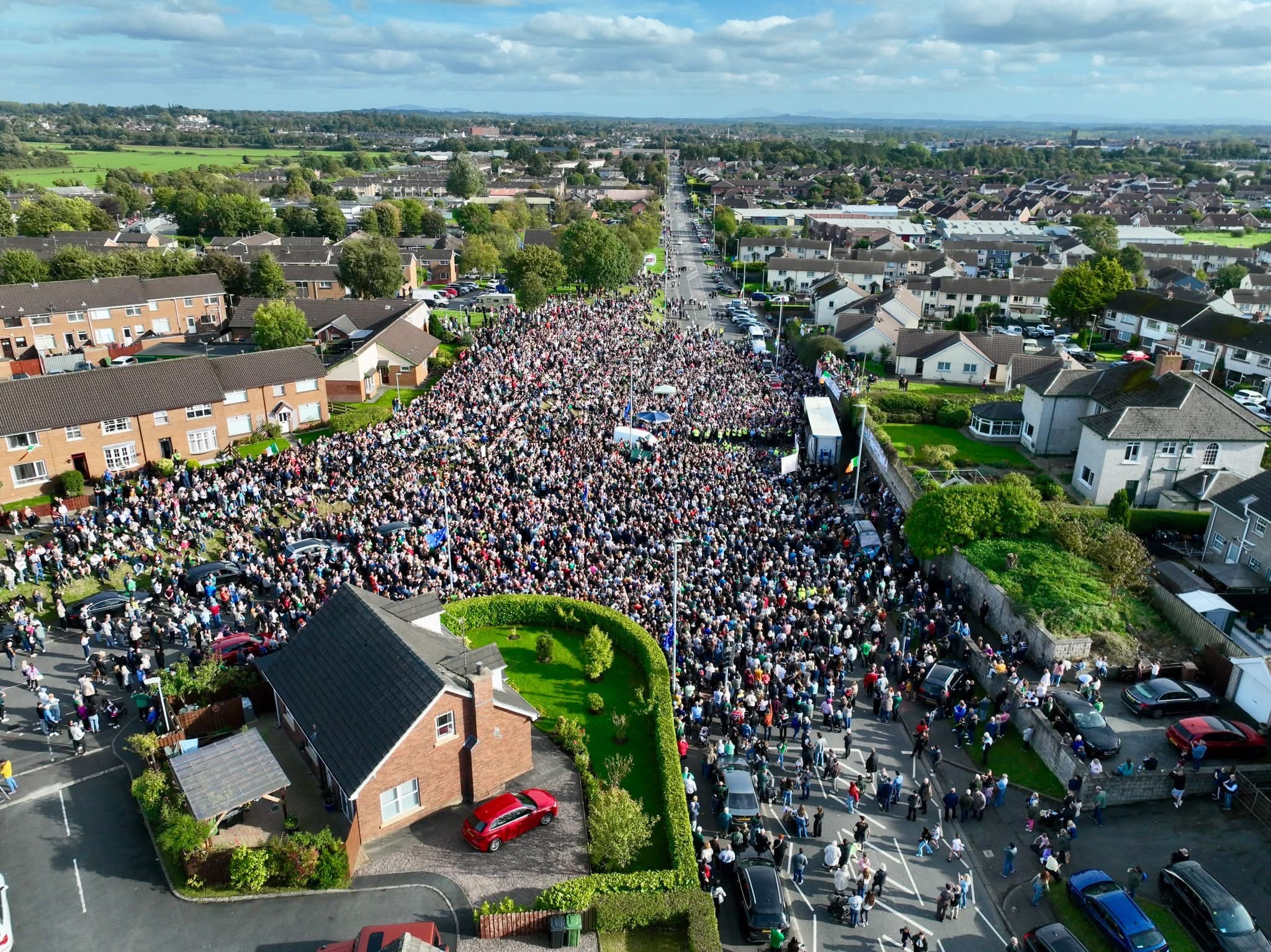
It looks like some Ulsterish elements have decided upon a replay at Drumcree and a “once more to the brink dear friends” event.
John Finucane MP summed up the collective will of the Catholic community in relation to that when he announced: “No Going Back!” Nationalists duly flooded into the Garvaghy Road in defence of that position and in support of the residents.
If this was an attempt to muster the Protestants in support of the Orangemen of Portadown and then mustered, into the polling booths next May, it should be said that Ulsterism has never really understood that the rise of Sinn Fein parallels closely the Drumcree/Garvaghy Road conflict of the 1990s.
They should have been aware that Drumcree/Garvaghy Road, more than anything else, is the litmus test of the equalising of power between the two communities within ‘Northern Ireland’, because it was here that battle decided the issue in the late 1990s at the transition between Peace Process and Good Friday Agreement of 1998.
The Garvaghy Road was no sham fight for the Catholic community. It was a determining event of substantial importance.
The Orange, which was founded and built on triumphing over the Papists in County Armagh 3 centuries ago, and which existed on the mantra of “Croppies Lie Down” found the Croppies on their feet and standing firm for the first time.
After the IRA ceasefire of 1994 the first test of the new situation and developing Peace Process was an agreement over a contentious Orange parade from Drumcree Church that insisted on “going home” down a route that was traditional in the sense that it showed things would always remain the same in Ulster. It was unwanted and resented as a fundamental sign of their traditional second-class citizenship by the local Catholic residents of the Garvaghy Road.
The Orange did not have to “walk home” to Portadown down the Garvaghy Road. There was a more direct route, as the crow flies, that avoided the Fenian masses, available to them. But to show a sign of compromise would be tantamount to acknowledging that power relations had altered locally and in the province generally. And the Orange, whose very existence was predicated upon the victory of Orange over Green and “This we will Maintain” could do little but engage in battle, as their forefathers had done, against the native they had subdued between the 17th and the 18th Century.
In July 1995, the RUC decided the Portadown District Orange Lodge could not march along the Garvaghy Road on its traditional return journey from a service in Drumcree Parish Church to its hall in Portadown centre.
The DUP Leader, the Reverend Ian Paisley, claimed of the stand-off that had developed along the Garvaghy Road:
“If we don’t win this battle, all is lost. It is a matter of life or death. It is a matter of Ulster or Irish Republic. It is a matter of freedom or slavery.”
Talks brokered by the Catholic and Protestant primates, Cardinal Cathal Daly and Archbishop Robert Eames, led to an agreement that the Orangemen could pass in silence, with just one banner and no accompanying bands, and would not march on the Garvaghy Road on the following day, the 12th July.
Ian Paisley, leader of the DUP, and David Trimble, the new leader of the Ulster Unionist Party, joined the march and held their hands in the air in a triumphalist gesture as they did what resembled “a victory jig” with the Orange down the road.
Trimble later claimed that he only took Paisley’s hand to prevent the DUP leader from getting all the media praise, but large graffiti went up across the Province saying ‘Well done, David’ at the UUP Leader’s success at making the Croppies lie down again.
The meaning of the Paisley/Trimble triumph was, however, clear to all. Whatever happened in the peace negotiations Prods would remain top dogs over Fenians. Peace would be a Republican surrender and things would return to normal, to the days before 1969.
Unionists threatened to withdraw from the Peace Process if the Orangemen were not allowed down the Garvaghy Road. The Sunday Times revealed that the Grand Master of the Grand Lodge of Ireland, the Reverend Martyn Smyth, had prepared a plan to paralyse Northern Ireland if the parade was not allowed down the Road. Blockades spread across the Six Counties and after five days, with Belfast International Airport blockaded there was the killing of a Catholic taxi driver in Lurgan – lured to his death.
During the standoffs in 1995, 1996, 1997 and 1998 thousands of Orangemen and their supporters, including well-known loyalist celebrity paramilitaries like Johnny Adair and Billy Wright, gathered at Drumcree and put the Garvaghy Road under siege for several days. Numerous roads were blocked across the province and checkpoints set up which the RUC made little effort to interfere with. Hundreds of Catholics were burnt out of their houses and more than a dozen were killed by Ulster militants.
The concentrated power of the Protestant community was applied to achieve the annual objective of getting Orange feet on the Garvaghy Road until the massacre of the Quinn family in Ballymoney in 1998, when mainstream Unionism began to disassociate itself from what they had helped call forth and their united front collapsed.
The annual events at Drumcree between 1995 and 1998 were very important in mobilising the Catholic community and this signified an altering in the balance of power between the Protestant and Catholic communities that had been proceeding in other areas of life but now was applied to that most sensitive area of Ulsterism – territory.
When the High Noon at Drumcree had passed Gerry Adams told an RTE journalist:
“Ask any activist in the north, ‘did Drumcree happen by accident?’, and he will tell you, ‘no’. Three years of work on the lower Ormeau Road, Portadown and parts of Fermanagh and Newry, Armagh and in Bellaghy and up in Derry. Three years of work went into creating that situation and fair play to those people who put the work in. They are the type of scene changers that we have to focus on and develop and exploit.” (Irish Independent 14.7.2002)
The really significant thing about the Drumcree stand-offs of the later 1990s was how they helped to radicalise the Catholic community. The intransigence, overt bigotry and blustering of all shades of Unionism in the marching season between 1995 and 1998 diminished the Catholic willingness to tolerate the status quo in the province and Sinn Fein were the ultimate beneficiaries of this. Catholics in parts of the province which had seen little of the warfare of the previous 25 years and which had accepted Orange marchers as an unfortunate part and parcel of life in Ulster began to counter parades that had previously been unchallenged. Sinn Fein activism in residents’ groups was rewarded by the election of more Sinn Fein councillors.
Drumcree was what made Sinn Fein the force it became, out of the Republican retreat from the battlefield. With the Orange conduct at Drumcree radicalising the nationalist population across the province the position held by the SDLP began to become a losing hand at the moment of its Good Friday Agreement triumph over who Seamus Mallon memorably called the “slow learners”.
If it had not happened or the Orange had prevailed the “Got F*** All” feeling about the Good Friday Agreement would have been much stronger within nationalism and something wholly different would have occurred.
In July 1997, during the Peace Process that led to the Good Friday Agreement of 1998, Northern Ireland came closer to what is called ‘civil war’ than at any time since August 1969. The nationalist community across the north was outraged when the new Labour Secretary of State, Marjorie Mowlam, pulled a confidence trick at Drumcree. The protesting Catholic residents were led to believe that the Orange march would be prevented but were taken unawares by a British Army operation in the early hours that sealed them into their homes and drove the Orange Order down Garvaghy Road through the power of State.
The prevention by the British of Catholics getting to their Sunday Mass so that the Orangemen could march and the holding of a symbolic Mass Rock service re-awakened historical memories of the Penal Laws at a very critical moment. Things return to fundamentals in Northern Ireland when bit comes to bit.
This set the scene for a battle royal to take place at the Ormeau Bridge in Belfast, another flashpoint in the battle royale. Here, the Catholic community deployed in force days before the event to prevent a repeat of the driving of the Orange down the road in Portadown and the military curfew which was imposed a year earlier to ensure the Ballynafeigh Orangemen got down the Ormeau road.
If the Orangemen had been reinforced from other areas there would have been the prospect of a momentous confrontation which would have surely been the end of the Peace Process and much more besides. However, this time the Orange Order backed down to the show of resistance by the Catholics and everyone lived to fight another day.
It was also one of the two occasions when the INLA had a significant effect on political events in the province. (In the first, the assassination of Airey Neave in the House of Commons led the in-coming Conservative Party to ditch its integrationist policy to ‘Northern Ireland.’)
The INLA’s military intervention on the Ormeau Bridge in 1997 produced a concentration of minds on what might occur in the event of widespread mayhem produced by an Orange march down the Ormeau Road and the events on the Ormeau Bridge acted as a game changer.
In response to the ‘pan-nationalist front’ in politics a pan-unionist front was organised behind the Orangemen against the Catholic residents in order to push the Orange march down the Garvaghy Road and it was the defeat of this that really signalled to the Catholic community that things were changing in the North.
The fact that the British government finally applied the power of state, after the Catholic community had shown its willingness to counter the Orange Order, instead of supporting it, had important implications for Catholic confidence in the future.
In 1997 the Orangemen of Portadown walked down the Garvaghy Road for what was understood to be the last time and subsequently Orange parades in contentious areas dwindled.
The British organised a Parades Commission to pour balm on events and it did its job for 28 years before nameless incompetents of the careerist type, who flit from quango to quango, unravelled the arrangement in 2026.
Much to the chagrin of Ulster Unionists the IRA was never beaten: it traded its war – which was undoubtedly having diminishing returns by 1994 – for a political strategy which involved the transfer of momentum to the political/electoral sphere.
It took its opportunity at the closing of the Cold War when the US was in the business of trying to wrap up long-standing conflicts in the West (South Africa, Middle East, N. Ireland). In this way it outmaneuvered Britain and the Ulster Unionists who sought a solution more on unionist terms.
Demography does its work slowly. ‘Northern Ireland’ has existed in a semi-detached limbo from the British State, intentionally created by Westminster in 1920-1. It is a limbo like the Catholic limbo, in which there is only one destination, whatever the time in waiting.
That destination, which can only be only one-way, because Britain has decreed as such is also one-way because that is the only way it can be part of a functional state and the politics of state. Westminster has rejected Ulster as a part of the British body politic since 1920 and only holds out the prospect of reunification with the rest of Ireland.
It does this partly as a recognizing of the reality of the direction of travel but more importantly to ensure leverage over that more important part of the island, upon which it desires to maintain a permanent hegemony, during the long transition and in the event of a final settlement. When a British Secretary of State said Britain had “no selfish strategic or economic interest” in ‘Northern Ireland’, he did not mention the interest it had in the island. He was specific, maintaining that Britain was not partitionist in principle.
That is the unionist predicament – and the nationalist one too.
The Orange and their assorted cheerleaders (Jim Allister, Jamie Bryson and Carla Lockhart MP et al) seem to have been given confidence for taking the field in a replay at Drumcree by the recent actions of Israel – a state unrestrained by law.
Carla Lockhart MP wrote on October 7:
“I am proud to stand with Israel against such atrocities as those inflicted on the nation 3 years ago. We know full well the effects of terrorism in Northern Ireland. Israel are less forgiving with those who murdered their citizens  “
“
Catholics would have read this as indicating sorrow that Ulsterism did not have the same freedom of action as Israel against its enemies – but if it did…
Bryson has taken his stand behind the law of the land. But didn’t Edward Carson say on 19th September 1912, in Coleraine, in reference to his anti-Home Rule activity:
“I am told it is illegal. Of course, it is illegal. It is an illegal conspiracy… We desire to tell the Government that we are going to break every law that is possible, and we want to tell them that we are doing it because we see no other way of maintaining our liberty.”
Perhaps Mr. Bryson would prefer northern ationalists to behave like John Redmond, with his utter faith in British law and total reliance on the British government to enforce it impartially.
Northern nationalists put their faith in Redmond’s Imperial Home Rule project under the leadership of Joe Devlin. Their situation among the Ulster Protestants made them more enthusiastic about the project of Imperial Home Rule than the rest of Catholic Ireland. They certainly volunteered for the Great War at higher rates in West Belfast and made more flamboyant expressions of loyalty than rural Ireland.
The immediate oppression faced by Catholics in the North was from Ulster Unionism rather than the British State. The Imperial Home Rule project promised an overriding of Ulster Unionist power through a Dublin Parliament that put Northern Catholics within a national majority. Their primary objective was always unity rather than independence – and it may well remain so. A Border Poll and what happens after will reveal such.
But in 1921 catastrophe occurred when the Redmond/Devlin project came to grief. The Northern Catholic was cut off not only from thr rest of nationalist Ireland but from the British State, and Imperial Home Rule in alliance with British Liberalism/Labour.
That catastrophe demoralised the northern Catholics for more than a generation, until the civil rights mobilization and the events of August 1969.
From there northern nationalism produced something of their own after their abandonment by Taoiseach Lynch under pressure from Britain. What they produced carried them to the Good Friday Agreement and the equalising of power within ‘Northern Irelsnd’. And from there onwards they have gone from strength to strength.
The replayers of Drumcree have taken the field with forces that have dwindled and become demoralised over the years against an enemy which is stronger and surer of its position out of what has been gained.
They were not led into an ambush by Sinn Fein, as in the 1990s. Sinn Fein was very content to let sleeping dogs lie with regard to Drumcree and just depended on the Parades Commission to fulfil its normal remit as it has done every year since 1998. The Ulsterish instigators of the Drumcree replay trapped themselves and led unionism into the trap of their own making.
The result can only be a bolstering of Sinn Fein and the enhancement of its vote in May next year. The Orange attempt at a replay at Drumcree has reminded the Catholics of the importance of Sinn Fein in their struggle and their continued relevance – despite Sinn Fein’s diversions of recent times away from the fundamentals.
The new British Prime Minister, a municipal socialist with narrow vision and the single objective of getting on top of the cost of living in order to prevent the British State falling into the hands of Reform, has blundered into this situation. He is starting to look out of his depth in the general affairs of state as his Fairford RAF base hysteria leads to a US withdrawal of its Iran bombers to safer climes.
Andy Burnham and his ex-priest of a Secretary of State – the only man who has the actual power to prohibit a march – have forgotten that if a garden of peace is created it still needs to be tended carefully by the gardener in charge, or it can easily become rewilded.
But sure, weren’t the 1990s mad times in Manchester when most were out of their heads as the High Noon at Drumcree determined things across the water in the semi-detached annex that Britain wished to keep at a safe distance and forget?

