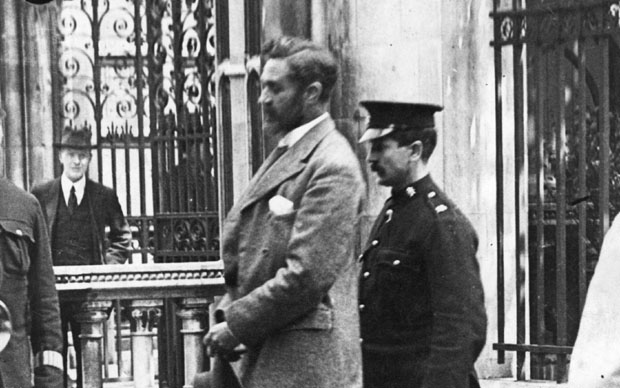
 Last week at the Roger Casement commemoration at Murlough Bay in North Antrim Martin Ferris, the Kerry Sinn Fein TD, described the Irish Independent group as an enemy of Ireland. And with good reason given its hatred of the Northern Catholics and its repeated attempts to frustrate that community’s struggle for justice and equality.
Now the very prominent letter of the week in the Sunday Independent accuses
Casement of Genocide. It seems the articles I have been writing for a year or so have been accurate in uncovering a sneaky agenda to get at the 1916 commemorations through the event that is fraudulently called the “Armenian Genocide”:
Sir – There is much celebrating of Roger Casement as a hero for recruiting Irish prisoners of war (POWs) and getting arms for Ireland. The full story should be told and the full context should be given; Britain was fighting for democracy and human rights. It had blockaded Germany and could read its code. Casement recruited the POWs and as it was impossible to get them to Ireland, Casement got them to sign on to fight for Turkey. Maurice Meade of Limerick and about 40 others fought with the Turks.
Even the Pope now accuses the Turks of genocide in World War One. The Turks massacred more one million Armenian Catholics and Casement and these Irish men are guilty of genocide. This massacre is seen too as the first holocaust. This blot on his character should be factored in before we celebrate his greatness.
James Mathers, Limerick
Here are some simple points about what the writer alleges:
- The view that “Britain was fighting for democracy and human rights” in its Great War against Germany and the Ottoman Empire is laughable. Britain’s Great War was a Balance of Power war waged to destroy an emerging commercial competitor and to absorb the strategic Ottoman territories of Mesopotamia and Palestine etc.
- The present Pope may accuse the Turks of “Genocide” but he is merely a Pope and has no authority or knowledge in that sphere. The Pope of the time – a much greater man – Benedict XV, demanded the release of Turks Britain was attempting to put on trial for the so-called “Genocide”. If it is a choice between Popes Benedict XV wins hands down as a witness.
- The Turks did not “massacre one million Armenian Catholics”. Around 650,000 Armenians perished in the Great War that was fought between 1914 and 1923 in Anatolia, from all causes, including insurrection, fighting in the ranks of the enemy, Royal Navy blockade, disease, hunger and poor conditions brought on by the Allied invasions, flight to the Russians, withdrawal with the French army in Cilicia or as victims of the mismanagement of the Erivan Republic etc. More Turks and Kurds died in the same period and the death rates in eastern Anatolia were comparable with those of the Armenians. So what we are talking about is civil war.
- The vast majority of Armenians were not Catholic – they were Gregorian Christians worked on by Protestant missionaries to change faith.
- There is no event called the ‘Armenian Genocide”. “Genocide” is a legal term invented in the 1940s. For an event to be termed “Genocide” there needs to be a ruling by a high, international court. No such ruling has ever been made so there is no “Armenian Genocide”. Quite the reverse. European courts have recently ruled that arguing there was no “Genocide” is quite legitimate. Conclusion – Genocide is merely an accusation with no legal basis and cannot be seen as fact. There is no historical evidence to support it and much evidence against it.
- The word “Holocaust” was actually applied to the events of the Irish Famine, much earlier than the events in Anatolia which the writer wishes to apply them to.
- The author mentions the Blockade of Germany. If Casement is guilty by association with the events in Anatolia, how much more guilty are John Redmond and the Irish who served in the Royal Navy, which subjected Europe to a 4 year blockade that killed over a million civilians, mostly women and children?
Update
The following information has been sent to me which backs up the points above:
Dr. Walsh has given a detailed account proving that the fairy tale about Casement is totally fabricated, illogical and does not hold done a sentence of truth or any written reliable evidence. I would like to add the following clarifications:
1. The “Armenian Population” in the Ottoman Empire, under best estimates was not more than 1,280,000. The number of “Catholic Armenians” possibly was no more than 50,0000, and Protestants may be 100,000. Separately the “Gregorian-Orthodox Armenians” living in Caucasus (Russia, Georgia, Persia) can be estimated as 500.000 in total. (Confirmed by National Geographic)
2. Other than the strict rules in using the “Genocide” word, we have irrefutable evidence that “relocations of Catholics and Protestants” (which started in July 1915) was annulled in mid August 1915 and those who wanted could all return back home; they were no longer treated as “dangerous”. For example Zenop Bezjian, Bishop of the Protestants, was sent to Der Zor with one of the groups when movements started (end June/ mid July) and he told the US Ambassador on Sept. 22th, when he returned, that their group had reached safety with no problems and that the “Armenians had already settled down for business”.
3. To kill 1,000,000 persons (out of 1,280,000) in about 100 days, you must kill 10,000 each day and bury them in stadium sized graveyards with a labour of 5,000 men each day to complete such a task. There is not “one page of authentic document or neutral eye witness” to confirm any mass killings. The writer should be asked give a logical explanation for the following “strongly documented” numbers of “living Armenians”.
a- According to the US High Commissioner’s Letter (June 19. 1919) 625,000 Turkish Armenians were counted alive after the Armistice. b- According to the Near East Relief Report of the US Senate (Doc.266, on the date 31.12.1921) there was 1,414,000 Armenians left in Turkey and Russia. c- According to the Official Memorandum of the Armenian Delegation (Feb. 26, 1919) given to the Paris Peace Conference, there was 1,403,000 Armenians living in Turkey. d- According to the League of Nations “Official Gazette” of Sept. 21, 1929, “200.000 Armenians had sacrificed their lives, fighting for the Entente against their home country. This is an Official document. e- Again according to the official Russian Historical Record magazine dated 1936, Armenian historian A.A. Lalaian stated that a total of 195,000 Armenians died in Armenia during the 30 month period of the Erivan Republic, when Armenians controlled their own state.
The writer is unaware of “written records” and also “deficient in logic and arithmetic”. The burden of “proof of the accusation of crime” falls to the editor or writer, “if they are serious” and can produce evidence they should do so.
Sukru Server Aya, (History Researcher and author)
A note on Maurice Meade
Maurice Meade was, in my knowledge, the only Irishman from Casement’s Irish Brigade to fight on the Ottoman side in the Great War. It is therefore very tenuous to connect Casement to the events that occurred in Eastern Anatolia
He was probably born in Limerick in May 1891, although his statement in the Bureau of Military History says 11 May 1893. Meade, an adventurous youth seeking personal independence, joined the Royal Irish Regiment of the British Army in September 1911. He landed in France with the BEF on August 13 1914 and fought at the Battle of Mons, the first engagement of the British Army. He was taken prisoner by the Germans, at Le Base with the rest of his battalion after they ran out of ammunition. At Hamlyn, where he was detained, the Germans announced to Meade and his comrades that all Irishmen would be released just before Christmas, 1915. He was then sent to Limburg where after hearing about it from Fr. Crotty, joined Casement’s Irish Brigade.
The following is from the Irish Brigade website:
“By the autumn of 1915 the Germans had all but abandoned any plans they might have had for a military invasion of Ireland. Casement and Monteith were instructed to “consider striking a blow at England… by joining the army for the invasion of Egypt and helping to free another small nation”. When Casement and Monteith put this idea to the 56 members of the Irish Brigade on 3 Dec 1915, only 38 were willing to go along with the idea… The whole Brigade moved to Danzig. During his time at Danzig he writes that he joined the 203 Regiment from Berlin, and actually went with them and served in Egypt. Now at Zossen the Irish Brigade were attached to 203 Brandenburger Regiment. Machine guns were issued to the brigade, plus a dozen German machine gunners and a German Lieutenant to train them.. They got on well with these men who were conscripts from the Rhineland, rather than Prussians. The machine guns were, of course, kept by the Germans when not being used for training. But the 203rd Infantry Regiment did not serve in Egypt, they were only in Russia and France.
The AsienKorps was a German Expeditionary force sent to assist the Ottoman war effort in late 1917. Originally intended to assist in the recapture of Baghdad, it ended up defending the Palestine Front in 1918… The German Asia Corps, Deutsche Asien-Korps was a well-equipped brigade. Trained in the Neuhammer forests of Silesia, the corps became a part of Army Group F (also known as the Yildirim Army) that included units of German, Turkish, and Austro-Hungarian soldiers led by the German General Erich von Falkenhayn. The Asien-Korps was formed to help aid the Ottomans in reestablishing a defensive position in the Middle East. After the Sinai front took a turn for the worse, the corps diverted their objective to Palestine in an effort stop British Field Marshal Edmund Allenby’s Egypt Expeditionary Force’s (EEF) march toward Jerusalem. On December 11, 1917, Jerusalem fell into British control forcing Army Group F to retreat north. Almost a year later what remained of the German and Turkish forces in Palestine, including what was left of the Asien-Korps, were defeated in Syria. The Deutsche Asien-Korps returned to Constantinople and, eventually, to Germany in early 1919.”
So Meade helped defend Palestine against the Balfour Declaration and the Zionist entity it sought to establish.
In December 1918 Meade was arrested by British military police at Dirschau and taken to London. He was charged with High Treason and sentenced to death, only to be given a Royal Pardon soon after. He then escaped from prison to Ireland. Back in Ireland Meade joined the IRA in Limerick. He participated in the ambushes at Kidorrery in August 1920, at the Grange in November, and at Glenacurran in December and the most famous ambush at Dromkeen in February 1921 against the Black and Tans that left 11 of the British forces dead. Meade personally executed 3 of the captured Tans.
Meade took the Treaty side in the Treaty War and served in the Free State Army in Tipperary. But he mentions nothing about this in his Memoirs. He was released from the Army in 1924 and died at age 81 in 1972.


Leave a Reply