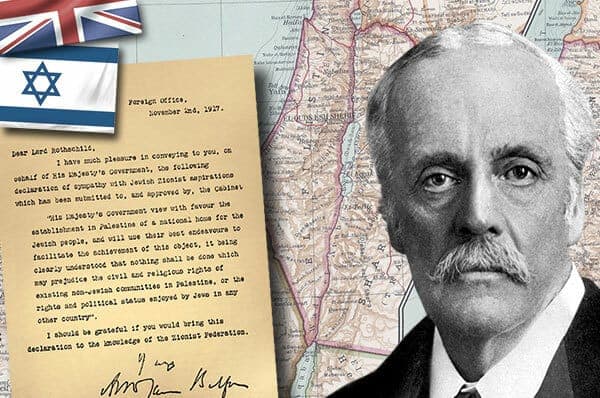
The strategic reason for the alliance between British Imperialism and the Zionist Movement that was to lead to the Balfour Declaration in November 1917 lay in the British desire to enlist the support of International Jewry in the Great War effort against Germany, and then to manoeuvre itself into control of Palestine, through the use of asserting the moral right of the Jews to settle there.
When England chose to destroy the Ottoman Empire in November 1914 it presented itself with a problem. The buffer zone that the Ottoman State represented for Britain between its possession of Egypt in the west and its Indian Empire in the east came up for grabs. Britain, whilst promising Istanbul to the Tsar, determined to take as much of the rest of the Ottoman territories as possible to secure this buffer zone against the other European Powers – which included both its allies, France and Russia, as well as its enemy, Germany.
However, the defeat of Ottoman Turkiye, like that of Germany, proved more difficult than was ever anticipated. Britain found that it had to make all kinds of promises to secure sufficient allies to tell against its enemies. The promises it made were conflicting and contradictory. But Britain understood that the only important thing was the winning of the War it had taken on in August 1914. So, it determined to worry about what would happen about all these conflicting promises later.
Britain’s promise to the Zionists took the form of the Balfour Declaration which announced a Homeland for the Jews scattered about the earth – whether they liked it or not (and there was plenty of evidence that the vast majority had little interest in it). Jewish religious opinion had hitherto taken the view that a return to the Promised Land was in the hands of God alone and Providence should be waited upon. So, there was no specific aim of reuniting the Jewish Chosen People with the Jewish Promised Land, aside from a small and unrepresentative Zionist movement which believed that the process should be hurried up by the hands of Man. A Jewish return to the ancient homeland after nearly 2000 years seemed ridiculous and it was either opposed or a matter of disinterest to both the Jews of Britain and those already inhabiting the Ottoman Empire.
England imagined that it could use the Zionist ambition of a Jewish Homeland in Palestine as the foundation of a British colony in the area to secure wider Imperial interests in the region – along with the parallel conquest of Mesopotamia/Iraq to the east. The significant fact that is often overlooked today is that it was only the power of the British Empire that made the Zionist project possible. The British acted on Zionist solicitation, but they did so both on Imperial terms and for Imperial purposes.
That it did not work out in the long run as Britain anticipated is really beside the point – except for the Palestinians that is. They continue to pay the price for England’s Imperial ambitions in the Middle East – ambitions that proved unsustainable as the Empire over-reached itself in seeing off the German and the Turk.
The Zionists proved an important ally for England in its maneuverings against the French who Britain had promised the territory of Palestine, as part of Syria, in the secret Sykes/Picot Treaty.
Through adoption of the Zionist programme Britain managed to detach Palestine from Ottoman Syria and, as a consequence, Palestine from the French through England taking special responsibility for the future of the Jews. This had the effect of trumping the French Christian historical claim to Syria through the English moral claim to be the guardians of the new Jewish homeland as proclaimed in the Balfour Declaration of 1917.
English Liberals were the driving force behind the Imperial plans for Zionism. Under the influence of Herbert Sidebotham, a prominent Liberal journalist, and C.P. Scott, the influential editor of the Manchester Guardian, there developed a Manchester school of Zionism. The leaders of Jewish nationalism in England, Dr. Weizmann and Harry Sacher (also of the Manchester Guardian), were from Manchester and the city became the hub for an Imperial Zionist project in England.
Sidebotham wrote the first book in support of the Balfour Declaration published in England by an English political writer ‘England and Palestine: Essays towards the Restoration of the Jewish State’. Sidebotham, a famous journalist on the Manchester Guardian and a member of the British Palestine Society, had the purpose of establishing a “community of ideals and interests between Zionism and British policy.” He was also a Secretary to Lloyd George and explained in his book that the British colonisation policy would, of necessity, involve non-British subjects in Palestine from the world-wide population of Jews. These Jews could be turned from being agents of Germany and Ottoman Empire into agents of Britain.
Jews did not want to particularly want to live in Palestine before the Balfour Declaration. In fact, many lived in the Ottoman Empire with little desire for any Zion on earth. The 5th ‘Herbert Samuel’ lecture is significant in this revelation partly because of the (Jewish) audience to whom it was being addressed:
“The Jews might suffer terrible persecutions and pogroms in Russia or Poland; but somehow when they left, with the Holy Land on their lips, their feet carried them resolutely in the other direction, to Germany or England or America. Even when, like the expelled Sephardim of Spain, they went to the hospitable, tolerant Turkish empire, that land of promise as it seemed in the sixteenth century, it is odd how few of them went to Palestine, which was after all an easily accessible and under-populated part of that empire. There was a trickle, but not a stream. To most of them Constantinople, with its opportunities of government finance, or Salonika, with its opportunities of army-provisioning, seemed more tempting than what Gibbon was to call the ‘mournful and solitary silence’ of Arab Palestine.” (20.10.1961, p.14-15)
Salonika, in Macedonia, was part of the Ottoman Empire in the 19th Century, before it was captured by the Greeks in the First Balkan War. It was a very ethnically diverse city, made up of Turks, Jews, Greeks, Macedonians and Bulgarians and was regarded as the greatest Jewish city in Europe because the Jews practically owned it and ran its civic and commercial life. It contained a large Jewish proletariat, who were of a strongly socialist disposition, as well as a Jewish commercial bourgeoisie.
The Ottomans had welcomed the Sephardic Jews to Salonika, and other cities in the Empire, when they were expelled from Spain at the end of the 15th Century (and Jews who fled Portugal slightly afterwards). And Salonika was the main area of the Dunmehs (from the Turkish, “to turn”), Jews who converted to Islam during the 17th Century. The British Foreign Office suspected many of the Young Turks of being Dunmehs, Muslims who were really part of an international Jewish conspiracy against Britain, in league with German efforts to take over the world commercially and then militarily.
Baghdad was the home to 50,000 Jews in 1917, a fifth of the population of the city. Arnold Wilson, Political Officer with the Mesopotamian Expedition who later governed Iraq, recorded the effect of the Balfour Declaration (or lack of it) on the Jewish community there in his memoirs:
“The announcement aroused no interest in Mesopotamia; nor did it leave a ripple on the surface of local political thought in Baghdad, where there had been for many centuries a large Jewish population… I discussed the declaration at the time with several members of the Jewish community, with whom we were on friendly terms. They remarked that Palestine was a poor country, and Jerusalem a bad town to live in. Compared with Palestine, Mesopotamia was a Paradise. ‘This is the Garden of Eden,’ said one; ‘it is from this country that Adam was driven forth – give us a good Government and we will make this country flourish – for us Mesopotamia is a home, a national home to which the Jews of Bombay and Persia and Turkey will be glad to come. Here shall be liberty and with it opportunity! In Palestine there may be liberty, but there will be no opportunity.’” (Loyalties, Mesopotamia, 1914-1917, pp.305-6)
In making war on the Ottoman Empire, and in pursuing the Zionist objective, the British Empire not only destroyed the prosperous and content Jewish communities across the Ottoman possessions but also sowed the seeds for generations of conflict with the local inhabitants of Palestine who would find themselves the chief victims of this great act of conquest and ethnic cleansing.
The Balfour Declaration appeared for the first time in public view in the Times on 9th November 1917 – a month before the capture of Jerusalem. This momentous announcement was produced from behind closed doors and was never debated in Parliament. Its timing was important. To have made it earlier would certainly have had a disorganizing effect on the Arabs who were doing much of the fighting for Britain against the Turks and who believed they had been promised the same territory by Britain for their efforts with Colonel Lawrence.
On December 9th 1917 Jerusalem fell to the British. The event was treated in England at the time as the major event of the War. Lloyd George imposed a news embargo on reporters until he could announce the news to the House of Commons. And to celebrate the liberation of the Holy City from the Muslim after 730 years the bells of Westminster Abbey rang for the first time in 3 years and they were followed by thousands of others across England.
General Allenby, the liberator of Jerusalem, and a descendent of Cromwell, declared in Jerusalem that the Crusades were over, mission accomplished! On hearing him, the Arabs, who had been encouraged into fighting for the British and who had been fooled into seeing them as liberators, wandered away. And many of them have found themselves wandering ever since.
Allenby carried two books with him to Palestine. The first was ‘Historical Geography of the Holy Land’ by Sir George Adam Smith, Professor of Old Testament Studies at Glasgow, which had been recommended to him by Lloyd George. The other was the Bible, which he read every day, and consulted – to draw historical information from it to inform his movements.
There are a considerable amount of reminisces produced by those British Officers who fought to liberate the Holy City. It was a special event, for sure. One such is the memoirs of Major Vivian Gilbert, published in 1923, under the title of ‘The Romance of the Last Crusade – With Allenby to Jerusalem’. It opens with a piece about King Richard the Lionheart and Sir Brian de Gurnay riding away from Jerusalem after their failure to capture the city: “In the heart of Sir Brian de Gurnay was the thought of another and a Last Crusade that for all time should wrest the Holy Places from the Infidel.” (p.1) As the British advanced into Jerusalem many of them began to see themselves as taking part in this final Crusade – forgetting all about the “war for small nations.” All the Old Testament fundamentalism imbued in English gentlemen by their Biblical education in the Public Schools came flooding out in a great surge, having re-conquered the Holy Land for Christendom after 700 years of Muslim occupation.
What created the impulse for the establishment of the Jewish Colony in Palestine was this English Christian fundamentalism. During the 19th Century a Christian Zionist impulse had developed within the Nonconformist wing of Protestantism in England. This English Christian Zionism actually predated the Zionism of Jewish nationalists and developed from Bible reading. As early as the 17th August 1840 an editorial in the Times called for a Jewish Homeland in Palestine. Christian Zionism then worked its way into the political classes of the British State as the Nonconformists came to political power and it became part of the political culture of Liberal England despite the fact that Darwinism seemed to undermine the religious impulse toward the end of the century.
The English Puritans who dominated the Liberal Party (and Tory High Church Evangelicals) were always strongly inclined toward the Old Testament part of the Bible – much more so than Catholics, who had their Priests to shield it from them. Their Bible reading bred a familiarity with, and imbued a strong interest in, reviving the Holy Land and creating a new Jerusalem. And there was another factor that exerted a gravitational on England from the Holy Land: Since the break with Rome the English Church had lacked a spiritual home. The Catholic Church had rebuilt the spiritual home of Christianity in Rome, and the Tsar coveted Constantinople as its new Byzantium, but when Henry VIII made himself pope of the English he had to be content with Canterbury. The more the English Protestants read their Bibles the more they yearned for their own spiritual home – in the original Holy Places of Judea and Samaria. And what could be more of a riposte to Rome than to expose its spiritual inauthenticity by trumping it with the original article.
And then there was the notion, encouraged by reading the Old Testament that a Second Coming of Christ depended upon the return of the scattered Jews to the lands of their ancestors. So, what happened to the Holy Land became to matter to Christian fundamentalist England since great Messianic promises and millenarian predictions depended upon it.
There was nothing ridiculous in the belief (and desire) that Imperial power could be used to bring about an end to history and the Second Coming. It made all the other pointless destruction and slaughter that the Great War entailed palatable for the spiritual classes.
Lloyd George, the Prime Minister who authorised the Balfour Declaration, was raised by an uncle, a lay preacher in a millenarian Baptist Church, and “was brought up in a school where there was taught far more about the history of the Jews than the history of my own land.” His biographer John Grigg described how the Prime Minister “had been brought up on the bible, and the story of the ancient Jews was as familiar to him as the history of England… the idea of reuniting the Jewish people with the land of their forefathers appealed to him.”
In 1903, when just an ordinary MP, Lloyd George had helped draw up a Jewish Colonisation Scheme for Theodor Herzl, the founder of the Zionist movement. The colony was meant for British East Africa, but by 1917 the real thing became possible with the conquest of the Ottoman territories and Lloyd George was in the position, personally, to realise it.
A significant element of British support for Zionism lay in English anti-Semitism. That seems a rather contradictory statement to make but it makes perfect sense when thought about.
In 1905 The Aliens Act established the first Immigration control in Britain. It was aimed specifically at preventing the entry of Russian and East European Jews, fleeing Tsarist oppression, into the country. It was said that the flamboyant display of Jewish wealth in Park Lane had offended English Upper Class sensibilities and prompted the Act. The Prime Minister and author of it was none other than the same man responsible for the Balfour Declaration, Arthur Balfour. Anti-Semitism and Zionism were no strangers to each other.
Herzl once said that the chief asset of the Zionist Movement’s campaign for a Jewish Homeland was anti-Semitism. That statement is indisputably demonstrated by the behaviour of the British state toward the Jews from 1916 on to the 1930s. It was this anti-Semitism that led to the Balfour Declaration and made Zionism into a going concern. So, it is an anti-Semitism that was indispensable and sacred to Zionism that would be wielded against friend and enemy of Zionism alike.
A number of British writers proclaimed at the time that the Jews had been a significant element in the vigour and success of German commerce prior to the Great War and they determined to remove the Jews from this useful function in German life (This is a feature of John Buchan’s famous Richard Hannay novels like Greenmantle). Germany was the closest thing that the Jews had to a homeland in 1914 and many found refuge there after the pogroms directed against them by Britain’s Tsarist ally, Russia.
Sir Gerald Lowther, British Ambassador in Constantinople before the War, sent a 5,000 word report to Edward Grey on 10th May 1910 which contains the flavour of English understanding of the Young Turk revolution, as a ‘Judea-Masonic conspiracy’ inspired by French Revolutionary ideals. Here are some extracts:
“Some years ago Emannuele Carasso, a Jewish Mason of Salonica, and now deputy for that town in the Ottoman Chamber, founded there a lodge called ‘Macedonia Risorta’ in connection with Italian Freemasonry. He appears to have induced the Young Turks, officers and civilians, to adopt Freemasonry with a view to exerting an impalpable Jewish influence over the new dispensation in Turkey, though ostensibly only with a view of outwitting the Hamidian spies… The inspiration of the movement in Salonica would seem to have been mainly Jewish, while the words ‘Liberte, Egalite, Fraternite,’ the motto of the Young Turks, are also the device of the Italian Freemasons. Carasso began to play a big role… and it was noticed that Jews of all colours, native and foreign, were enthusiastic supporters of the new dispensation, till… every Hebrew seemed to become a potential spy of the occult Committee, and people began to remark that the movement was rather a Jewish rather than a Turkish revolution…
Talaat Bey, the Minister of the Interior, who is of Gipsy descent… and Djavid Bey, the Minister of Finance, who is a Crypto-Jew, are the official manifestations of the occult power of the Committee. They are the only members of the Cabinet who really count, and are also the apex of Freemasonry in Turkey… The invisible government of Turkey is thus the Grand Orient with Talaat Bey as Grand Master. Eugene Tavernier… describes the French Republic as the ‘Daughter of the Grand Orient.’ The same epithet perhaps might be appropriately applied to the Ottoman Committee of Union and Progress… Like French Republicans and Freemasons, the words most frequently on its lips are ‘reaction’ and ‘clerical.’ Its first tendency was not to modify and modernise the Mahommedan sacred law, but to undermine and smash it. Most of its leaders, while frankly rationalist, also paradoxically endeavour to use the Islamic fervour of the masses as a political weapon and to divert it into chauvinistic channels on the lines of national, i.e. Asiatic Pan Islamism. It is intolerant of opposition, and one of its principle methods of destroying its adversaries is to drive them into opposition and crush them as ‘reactionaries.’
The Turk is mainly a soldier and… the economic organism of the Turk is of the feeblest kind, and unsupported could not stand alone a week. It was hoped in the beginning that the Armenians, Bulgarians, Greeks and the Ottoman Jew would serve as economic props, but the Young Turk seems to have allied himself solely with the Jew… The latter seems to have entangled the pre-economic-minded Turk in his toils, and as Turkey contains the places sacred to Israel, it is but natural that the Jew should strive to maintain a position of exclusive influence and utilize it for the furtherance of his ideals, viz. the ultimate creation of an autonomous Jewish state in Palestine or Babylonia… He would kill two birds with one stone if he could obtain from the Turk unrestricted immigration of Jews into Turkey, an aim that he has been pursuing for years back, and transfer to Mesopotamia millions of his co-religionists in bondage in Russia and Roumania… Mesopotamia and Palestine are only, however, the ultimate goal of the Jews. The immediate end for which they are working is the practically exclusive economic capture of Turkey and new enterprises in that country.
It is obvious that the Jew, who is so vitally interested in maintaining his sole predominance in the councils of the Young Turkey is equally interested in keeping alive the flames of discord between the Turk and his (the Jew‘s) possible rivals, i.e. Armenians, Greek etc… This aspect of the Turkish revolution… is not without its direct and indirect side-problems of the Near East. The Jew hates Russia and its Government, and the fact that England is now friendly to Russia has the effect, to a certain effect, of making the Jew anti-British in Turkey and Persia – a consideration to which the Germans, I think, are alive. The Jew can help the Young Turk with brains, business enterprise, his enormous influence in the press of Europe, and money in return for advantages and the eventual realization of the ideals of Israel… The Jew has supplied funds to the Young Turks and has thus acquired a hold on them… Secrecy and elusive methods are essential to both. The Oriental Jew is an adept at manipulating occult forces, and political Freemasonry of the continental type has been chosen as the most effective bond and cloak to conceal the inner workings of the movement…
Young Turkey regards itself as the vanguard of an awakened Asia. It fancies itself bound to protect the nascent liberties of Persia ‘now endangered by the selfish and over-bearing policy of Russia and England .’ … It is also coquetting, assisted by the Jews… to create a sympathetic current in Afghanistan and among Indian Moslems.
The Young Turks, partly at the inspiration of Jewish Masonry, and partly owing to the fact that French is the one European language extensively spread in the Levant, have been imitating the French Revolution and its godless and levelling methods. The developments of the French Revolution led to the antagonism between England and France, and should the Turkish Revolution develop on the same lines, it may find itself similarly in antagonism with British ideals and interests.” (Elie Kedourie, Young Turks, Freemasons and Jews, Middle Eastern Studies, January 1971, pp.95-102)
The British Ambassador’s report goes on, for page after page, about Jewish influence here, there and everywhere in the Ottoman Empire and the nefarious schemes of the Jews in wishing to create a Jewish state in Palestine and Mesopotamia in return for the financial help of Jewish finance to the Young Turks. And in one part it even recommends an alliance with the Arabs – who, it suggests, would have the most to lose from this despicable conspiracy.
These views were widespread in the British Embassies. During the War itself Britain’s Ambassadors bombarded London with dispatches about the sinister power of the Jews being exercised on the German behalf. George Buchanan, Ambassador in Petrograd complained of the “large number of Jews in German pay acting as spies during the campaign in Poland” against the Russian Ally. In the correspondence of the British Ambassador at Washington, Cecil Spring Rice, between 1914 and 1917 there are continual references to the Jews as German agents (e.g. “the pro-German Jewish bankers toiling for our destruction.” See Mark Levene, The Balfour Declaration: A Case Of Mistaken Identity, English Historical Review, January, 1992) and the character of the views expressed can only be described as anti-Semitic.
It was noted in Imperialist periodicals that Jews played a prominent role in international finance and the new international communist movement. The gist of the understanding was that they were dangerous loose cannons in the world of nations who needed to find their correct range by being given a national project.
Halford Mackinder, the Imperial Geopolitics Professor at the London School of Economics, and advisor to the British Delegation at Versailles, pointed to a desirable aspect of doing so in his book, Democratic Ideals and Reality, written a year after the capture of Jerusalem:
“The Jewish national seat in Palestine will be one of the most important outcomes of the war. That is a subject on which we can now afford to speak the truth. The Jew, for many centuries shut up in a ghetto, and shut out of most honourable positions in society, developed in an unbalanced manner and became hateful to the average Christian by reason of his excellent, no less than his deficient qualities. German penetration has been conducted in the great commercial centres of the world in no small measure by Jewish agency, just as German domination in southeastern Europe was achieved through Magyar and Turk, with Jewish assistance. Jews are among the chief of the Bolsheviks of Russia. The homeless, brainful Jew lent himself to such internationalist work, and Christendom has no right to be surprised by the fact. But you will have no room for these activities in your League of independent, friendly nations. Therefore, a national home, at the physical and historical centre of the world, should make the Jew ’range’ himself. Standards of judgement, brought to bear on Jews by Jews, should result, even among those large Jewish communities which will remain as Going Concerns outside Palestine. This, however, will imply the frank acceptance of the position of a nationality, which some Jews seek to forget. There are those who try to distinguish between the Jewish religion and the Hebrew race, but surely the popular view of their broad identity is not far wrong.” (pp.173-4)
The Jews were viewed within the British Foreign Office and other Imperial Departments of State as a unitary collective entity rather than a diverse collection of individual communities across the world. They were seen as powerful and they were seen as pro-German, or at least, disruptive of British interests. And no distinguishing was made between one Jew and another until a distinction was made between Zionist and other Jews.
So, the British offer of a homeland in Palestine presented a means of taming and ‘turning’ the Jew from his German, internationalist/socialist proclivities in the world, to being harnessed to more progressive, nationalist and British Imperial, purposes.
But where would all of this leave the large Jewish communities which would remain as Going Concerns outside Palestine in a Europe of post-war nationalisms in which they could not fit? What the British saw as the ‘Jewish problem’ was created by the wanton destruction of the Hapsburg Empire by Britain in 1919, and its division into a series of ‘nation-states’ by Versailles.
The Jews were the middle class of the Austrian Empire. They could not be the middle classes of the new nationalist states. And the undeveloped native middle classes, who had not created their states through their own efforts, set about ousting the Jews from their dominant position in commercial and academic life when they were placed in power.
The great surge of anti-Semitism that gripped Europe after the Great War came in these new states set up by Britain and France out of the Hapsburg Empire at Versailles. In these concoctions of the Imperial powers the Jews began to be seen as anti-nationalist elements and they were treated accordingly by the new nationalist bourgeoisies during the 1920s and 1930s.
At the same time the indigenous Arab people of Palestine began to be treated by the Jewish nationalists, under the aegis of the Imperial Power, in a similar fashion.
This was a natural outcome of the Imperial scheme to turn the European Jews into a nationality with their own nation-state along with the concocting of new ‘nations’ in Europe in which the Jews had no place. It was something the non-Zionist Jews had warned about and opposed the Balfour Declaration on the basis of. And who is to say that they were wrong?
Britain’s establishment of the Jewish Homeland in the great surge of fundamentalist Christianity brought about the catastrophic effects of its Great War led it to underestimate the Jewish colonists they helped plant in Palestine. They thought their Jewish colonists would remain a loyal and servile part of the British Empire – “a little, loyal, Jewish Ulster” as the first British governor of Jerusalem, Robert Storrs, put it. But they developed instead into vigourous nationalists inspired by the expansionist impulses of the Old Testament of the Christian Bible who saw Israel as having no bounds upon it, geographically or in its conduct of affairs.
History did not start with October 7th 2023. It began with the British destruction of the Ottoman Empire and the turning of the Jews into militant Zionists for the purposes of winning the Great War of 1914.
Published in Irish Foreign Affairs, Winter 2023
 Pat Walsh
Thought provoking, relevant information buried in the pages of past history which helps shed light on the construct of the present. Thank you.
LikeLike
[…] [14] https://drpatwalsh.com/2023/11/14/britain-the-destruction-of-the-ottoman-state-and-zionism/ […]
LikeLike