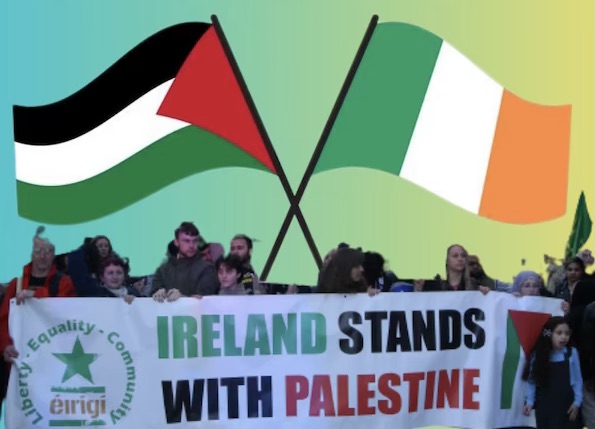
Today, the attitude of Ireland toward Palestine and Zionism, Government and people, stands in marked contrast to that of Britain and its Government and Opposition.
There was once a time when Ireland was an enthusiast for the Zionist project. Arthur Griffith, the founder of Sinn Fein, was both an anti-Semite and Zionist, like his British contemporary authors of the Balfour Declaration, prior to the Republican metamorphosis of Sinn Fein in the aftermath of the 1916 Rising. And the Irish Redmondites were enthusiastic cheerleaders for the destruction of Ottoman Palestine and the extension of British power into the region, despite the consequences for the people there.
The Belfast Irish News commented on the Balfour Declaration in the context of a potted history of Jerusalem on the day of its publication in 1917 in the Times:
“In Palestine General Allenby is beating the Turks. He has captured Gaza – the scene of Samson’s final display of untoward might – at last; and he may press on to Jerusalem, fifty miles away. The ancient capital of the Jewish Kingdom has stood many sieges. It was an old centre of population 3,000 years ago – before David the Psalmist extended and beautified it. Jerusalem was attacked by the Egyptians, the Philistines, the Israelite ‘seceders,’ the Assyrians, and the Babylonians between 1000 B.C. and 300 B.C. The Greeks plundered it after the death of Alexander of Macedon, and again at various periods down to the advent of the all-conquering Romans, into whose possession it came under Herod. In 70 A.D. the Jews revolted against Rome, and Titus captured their capital and levelled it to the ground… The Persians assailed it in the year 614; and 28 years thereafter the Caliph Omar and his Islamites seized upon it. Since that date it has been controlled by Mahommedans – with a brief interval. The Arabs were succeeded, as masters of Jerusalem, by the Seljuk Turks; and the atrocities committed by these ancestors of the present Turkish nation inspired Peter the Hermit with the idea of preaching a ‘crusade.’ Godfrey of Bouillon and the Christians of the West rescued the city in 1099; but it was retaken by Saladin in 1187. The Egyptians appeared on the scene as conquerors in 1247; but the Sultan Selim I., annexed it to the Turkish Empire in 1517. Now a new chapter will be added to the long and troubled history of the ‘Holy City.’ A great scheme of Jewish ‘re-colonisation’ has been adumbrated; but we cannot observe any evidence of sincere enthusiasm for the project amongst the masses of the world-scattered Hebrew race. Perhaps they are, with characteristic prudence, awaiting events before definitely committing themselves: or a vast majority of them may prefer the ‘flesh-pots’ available amongst the Gentiles to the prospect of figs and olives in the land of Solomon and Judas Maccabeus.” (Irish News, 9November 1917)
The Irish News piece is an extremely partisan reading of history. All the violence and destruction directed by Christians at Jerusalem is ignored, with no reference to any atrocity. And everything Muslims did around the city is described in terms of absolute evil.
It seems that Peter the Hermit and Redmondite Ireland had a lot in common. Atrocity propaganda directed against Muslims had inspired the Crusaders in 1099 to “rescue the city” of Jerusalem (by massacring up to 10,000 around the al-Aqsa Mosque, and wading knee deep in the blood of surrendered civilians). It reappeared again through Redmondite Ireland during August 1914 to inspire it to fight the battle for civilisation in the secular crusade against Prussianism. And then it appeared in The Irish News’s history lesson on Jerusalem, as the Last Crusade closed in on Jerusalem.
The Irish News noted that there was not a great deal of enthusiasm for a return to the Jewish Homeland on the part of the Jews. They seemingly preferred the comfort of the European “flesh-pots” to a life of pioneering hardship in honest colonial work, or indeed the Ottoman cities where they lived a good life with peoples of other races and religions, to the mutual advantage. But the all-conquering British Imperial Power, which the Irish News supported at that stage, had the objective of changing all that, in alliance with the small Zionist movement it was employing as its instrument.
One suspects that the editorial writer did not have much time for the Jews (in the mention of Judas – who must be the least favourite Jew of Christians). But adjustment to the Imperial will was a requirement for the winning of Irish Home Rule and adjustment can be seen in the editorial of the Irish News a month later, marking the fall of Jerusalem. This is how Belfast Redmondites saw the culmination of the last Crusade:
“‘Fallen is thy throne, O Israel!’ The power of the Moslem in ‘the Land of Promise’ has fallen at last: we may assume that with the entrance of General Allenby’s troops to Jerusalem an end has practically been made of Turkish rule over Palestine… When the Holy Land has been fully rescued from Turkish domination, who will possess and administer it? Official statements regarding the re-colonisation of the country by the scattered Jewish race have been made. Observers can discover no traces of enthusiasm for the project amongst Hebrews themselves. As an idea, nothing could be more sentimentally attractive; as a practical proposition, we believe each child of Abraham would bestow a benison on his brother who migrated from the lands of the Gentiles to the shores of Lake Galilee and the slopes of Mount Olivet. Thus might the storied little territory become once more ‘a land flowing with milk and honey’ – greatly to the content of the descendants of Abraham, Isaac and Jacob who remained where they were.
But an independent Jewish State cannot be established all at once, even did all the Rothschilds lead all their compatriots back to Jerusalem. The country must be ‘protected’ – in plain terms, annexed: a useful synonym in dealing with Oriental transactions might be ‘Egyptised.’ And the conquerors are, of course, the natural ‘protectors’ of the territory won by force of arms. Such has been the rule and practice from before the era of Moses and Joshua. We know all about it in Ireland. When the objects of the campaign in Palestine and Mesopotamia have been completely achieved, a solid ‘block’ of Asian territory will lie between the Germans and the Indian Ocean.
The Turks gave the Kaiser’s people a free passage from Constantinople to the Persian Gulf. The new occupants of Palestine and Mesopotamia will not be quite so accommodating. No one has hinted as yet at the ultimate fate of Constantinople itself: it was to have been the Czar’s property, but poor Nicholas would rest satisfied with less nowadays. England, at all events, is carefully building up a wall against German ‘aggression’ along a line on which German eyes were cast covetously many years ago… There are really some arguments against a precipitate disclosure of the Allies ’war aims’: one excellent reason for silence being that the Allies do not know how much they can aim at with a prospect of getting it.” (Irish News, December 11, 1917)
This is a good indication of how Ireland, and indeed West Belfast, would have viewed the world if there had not been Republican Ireland.
By 1921 though the Irish News began to show some skepticism about what was happening in Palestine, believing that the Zionist scheme was something of a fraud, and all just a cover for British conquest. It saw Palestine, like its Imperial Governor, Ronald Storrs, as “a little loyal Jewish Ulster.” On 7th September this editorial appeared on “The Holy Land”:
“England is committed to an immense and revolutionary experiment in Palestine. Mr. Arthur Balfour – curiously enough, when his political record as a condemner and enemy of small nations is recalled – was the chosen exponent of the policy which he declared was adopted to make Palestine “the national home for the Jewish race.” But are the members of the Jewish race – 95% of them – anxious to make the Holy Land of the Christian world their “national home?” Apparently not… Mr. Henry Morgenthau is a Jew; he is also one of the most eminent men in the public life of the United States… He acted as U.S. Ambassador in Constantinople until America came into the war; he knows the Jewish world; he knows the Near East; and he has written recently: “Zionism is the most stupendous fallacy in Jewish history; a surrender, not a solution, a retrogression into the blackest error, and not progress toward the light.” These are stern words of condemnation for the policy England is seeking to carry into effect at the point of the sword.
Mr. Morgenthau proves that the Balfour scheme is a physical and economical impossibility. Zionists had been working for 30 years in the same direction before the British took possession of Palestine; they had spent millions; “and in 1914 all they had accomplished was the return of 10,000 Jews to Palestine.” During the same period 1,500,000 of the scattered race emigrated from Europe to the U.S.A. The Jewish population of the world is 13,000,000. There are now 5,000,000 people in Palestine. That small and rather barren country cannot support more than an additional 1,000,000 even under the most favourable conditions. Fully 85% of the present inhabitants are Mohammedans – and there are as many Christians as Jews. Where is there room for the Children of Israel in their ‘National Home?’ Mr. Henry Morgenthau hammers the delusion mercilessly. He reveals the hypocrisy behind the British scheme: “Politically, Zionism is ridiculous. British influence must be omnipotent on both sides of the Suez Canal. Moreover, Britain cannot afford to trifle with the susceptibilities of its Moslem subjects.” … Yet the British Government are maintaining a Governor, a host of administrative officials and a large army in Palestine at an immense annual cost on the pretense that they intend to accomplish an impossibility and establish a new state, predominantly Jewish.”
Morgenthau had been behind a petition, signed by 30 other prominent American Jews, including Adolph Ochs, the publisher of The New York Times, to President Wilson, protesting at the establishment of a Jewish State in Palestine. The petition stated that the setting up of such a state would be “utterly opposed to the principles of democracy… for which the world war was waged.”
It was never imagined in 1921 – or if it was, no one suggested such a possibility in public – that the problem of living space in Palestine brought about by the moving in of Jews under Imperial auspices might be ultimately resolved by the moving out of the current inhabitants.
What appeared to Morgenthau and to the Irish News as British hypocrisy was, in fact, the product of reconciling the different promises made to the different parties Britain had involved in its Great War on the Germans and Ottomans in the post-War situation. Looked at from the vantage point of the pre-War world it looked as though England was about to grab Palestine for itself on the pretense of installing a small nation in its historic homeland.
But Britain was no longer complete master of the situation it had brought about. Before it had even occupied the area, it had promised Palestine to the Arabs as part of a much larger Arab State in return for an insurrection against the Ottomans, organized by Colonel Lawrence. At the same time, it had promised the same land to the Zionists in order that the American Jews changed sides in the War and removed a major obstacle to U.S. participation, found necessary to win it. And it had used the pretense of fully supporting the democratic anti-Imperialist demands of President Wilsonto guarantee America’s entry into the war.
So, England had restrictions on what it could do when it began to administer Palestine after the War and a balancing act to perform between the League of Nations, the Arabs and the Jews – all within the Mandate constriction. (The Jews, of course, gradually got the best of this balancing act and the Arabs, the worse.)
Britain calculated that the situation it created in Palestine, with two antagonistic peoples competing against each other in a small territory, would ensure its continued control of the territory – since Palestine could not ever be trusted to govern itself. In this context Britain facilitated the steady immigration of Jews into Palestine so that it could ultimately hand over a limited form of self-government to them, when they had attained a majority, and could remain as overseer to manage the gradual production of a Jewish State, in the Imperial interest. At the same time Britain reassured the Arabs – while anticipating trouble ahead. But all the time England believed the trouble could be kept within bounds and handled by its power.
But the Imperial Power was not the Ottoman Empire, and neither was it what it was, before it took on the Great War of 1914. Circumstances, that it had been directly responsible for itself, conspired against it. And after these circumstances also brought about another World War, and the killing of European Jews in large numbers, British Palestine came under pressure, with the result that the Imperial Power finally walked away from the mess it had created. Leaving behind the Arab nationalists it had cultivated, and the Jewish nationalists it had made into a force in the region, to settle accounts among themselves.
Ireland may have expressed joy in the recapture of Jerusalem for Christendom, but it did not fight the Great War to establish a Jewish Colony in Palestine (and see the native inhabitants driven out). If any Redmondite leader had proposed such a thing it is pretty certain they would not have recruited many soldiers on the basis of it. Colonisation and the destruction of native peoples were not popular causes in Ireland given its history.
But that is the problem with joining catastrophic wars in which the outcomes are unknown. War is a catastrophic activity and catastrophe on a large and wide scale was definitely the outcome of the Great War that John Redmond signed Ireland up for and which the Irish News supported.
Storrs, as Imperial Governor of Jerusalem, set out what he imagined the Jewish Colony might become in an emotional passage in his book:
“In spite then of non-Zionist and anti-Zionist Jews, world Jewry was at last within sight of home. No more would an infinitesimal minority out of all her sixteen millions creep to Jerusalem for the privilege of being allowed to die on sufferance as if in a foreign country. No longer would the Jews remain a people without a land, in exile everywhere… Civilization had at last acknowledged the great wrong, had proclaimed the word of Salvation. It was for the Jews to approve themselves by action worthy of that confidence: to exercise practically and materially their historic ‘right.’ The soil tilled by their fathers had lain for long ages neglected: now, with the modern processes available to Jewish brains, Jewish capital and Jewish enterprise, the wilderness would rejoice and blossom like the rose. Even though the land could not yet absorb sixteen millions, nor even eight, enough could return, if not to form the Jewish State (which a few extremists publicly demanded), at least to prove that the enterprise was one that blessed him that gave as well as him that took by forming for England “a little loyal Jewish Ulster” in a sea of potentially hostile Arabism.” (Orientations, pp.357-8)
Before the War the Arabs had been unaware of this mysterious “principle of self-determination.” The Ottoman State had done nothing to foster nationalism in order to subordinate people to its dominion, as England had, so there was no need of such a concept for the living of life. The Arabs were made aware of the concept of self-determination by their exposure to the Great War that the Christians took to the Ottoman Muslim State.
The War propaganda led peoples across the world to understand the idea of self-determination as a general political principle, for which the War was being fought, and which would be universally applied after it was won. However, it soon became clear that self-determination was not for universal application – it was a prize that was in the gift of those who won the War. And it was only to be applied in cases that suited the interests of those who won that War.
The British Mandate for Palestine had one fundamental difference from the other Mandates that were awarded. All the other Mandates were instituted on the premise that the Mandated Power would bring the inhabitants of these countries considered unfit to govern themselves up to a level whereby, in the future, they were capable of self-government. But in the case of Palestine the inhabitants were to be kept under control by the Mandated Power while another group of people were brought in from outside – until they achieved such numbers that they would be capable of government. And then, and only then, would self-government be awarded.
Essentially, the scattered Jews of the world, though not at present resident in Palestine, were given as much right to the country as the actual inhabitants – until the time came that the build-up of Jewish nationalists in Palestine was sufficient enough that they could become the predominant receivers of government.
The self-determination that was applied to Palestine involved a very novel application of the concept indeed. Self-determination is usually based on the people who had been inhabiting a region over a sustained period of time. But in this instance the right to self-determination of the actual inhabitants of the region was being over-ridden by a right of self-determination based on a two thousand year old Book and the view that the land should be possessed by those most likely to develop it to its fullest, and contribute to ‘progress’ of a Western kind.
That, of course, is usually called colonialism, rather than self-determination.
The British scheme for Palestine did not envisage the establishment of an independent Jewish state. It was realised that from the time of the Romans Jewish states had been conducted in a way that did not lead to stability and tended more toward catastrophe. A Jewish state would have been anticipated to go the way of all the others in 1918 but one was possible under British auspices – if a balancing act could be accomplished between the Jews and Arabs.
But if Britain imagined that the Jews could be turned into a loyal garrison of British interests in the region they were to be disappointed. The Jewish colonists were not content to meekly accept a role within a communal contest of attrition with the Arabs, in the British Imperial interest, and in perpetuity. They were of far more substantial stuff than the other group which Britain was embarking on this project with, the Ulster Protestants, and having been re-orientated as nationalists by the Balfour Declaration they developed full-blown ideas of nationhood of their own.
The Jews might have started out like the Protestant planters in Ireland but they almost instantaneously turned out to be more like the Irish Catholics, whom England had been intent on denying nationhood to.
The British objective of establishing a Home Rule State of Jews, or a Jewish Dominion, in Palestine, for strategic purposes, had that great potential flaw – that the Zionists, like the Irish, might really want more. The Jews might become whole-hearted nationalists and desire independence, rather than be just Britain’s garrison in the Near East. And what would become of Imperial plans then?
Britain, in turning the Jews, made a miscalculation in an ecstatic state of Biblical fervour in 1917. If Britain believed the Jews to be mere mercenaries of Germany and the Ottomans why could they not also be the same of Britain? It was never considered that in turning the Jews into nationalists of Zion that might not cause them to cease being mercenaries? Would they then not see themselves, after their return to Zion, as real nationalists with national independence as their aim – the only objective worthy of the name of self-respecting nationalism? And would that not repel them from the Imperial motherland – which was not really a mother to them at all but really just a surrogate?
What would the attitude of thoroughgoing nationalists, imbued with notions of religious and racial superiority, make of a large and hostile group within their midst? That seems to be what happened in 1947/8, and then ever since, is it not?
Ronald Storrs, the British Imperial Governor, had despaired of Zionism after witnessing the experiment, and he saw it as a terrible mistake. When contemplating a note for a 1948 edition of Orientations he wrote the following:
“Re-reading these chapters I compared what Britain had done for Zionism with what Zionism had done to the British, to the peaceful inhabitants of the Holy Land and to the Middle East, to Judaism and to world Jewry, to the fair name of the United Nations, to the Anglo-American relationship, upon which the future of humanity depends – then, in the speech of our book of common prayer – “I held my tongue and spake nothing.” I kept silence, even from God’s words, but it was pain and grief to me.” (Rory Miller, Sir Ronald Storrs And Zion: The Dream that Turned into a Nightmare, Middle Eastern Studies, July 2000, p.138)
Britain made the nightmare of Zion possible and then suffered for it, before washing its hands of it and leaving the suffering to those it had inflicted its project upon. Storrs, in knowing his Bible well, should have realised he was the successor of Pontus Pilate.
But there has been no escaping the nightmare for “the peaceful inhabitants of the Holy Land and the Middle East” from what Britain and Redmondite Ireland inflicted upon them.
Published in Church and State, Winter 2023.
 Pat Walsh