Two years ago, on February 24, Russia launched its Special Military Operation in Ukraine. This was not the start of the war in Ukraine. The war in Ukraine, which was a civil war provoked by a US organised coup, had begun in 2014. The subsequent Russian intervention two years ago was prompted by the imminence of a large scale offensive by the forces of Kyiv against the Russian-orientated areas of the East and South. What changed on 24 February 2022 was the West. The West, outside the US, began to be hoovered up by Washington in its geopolitical interest.
In December 2021 President Biden launched his Summit for Democracy, an event that aimed at strengthening “Western democratic values” across the world and “confronting authoritarianism”. It divided the world into two, perhaps in anticipation of a future US-led war against those it was established to confront. Two months later, Russia launched its military intervention in Ukraine, perhaps not wishing to wait around until more substantial forces had been fully mustered by Washington to confront it.
In the last 30 years most countries of the world have been trying to establish democratic modes of government in one form or another. Some are more executive led than others due to a wide range of factors including culture, history, economics and geography. There are very few totalitarian states of the sort that existed in the 20th Century and even those with strong durably popular leaders have elections that legitimise their form. However, the US has suddenly chosen to make a central issue of “Western democratic values” to divide up the World into opposing camps.
Whatever Washington is up to, it led to the war in Ukraine. Whether the US miscalculated with regard to the Kremlin and underestimated Russia’s will to engage in war to halt continued NATO expansion, or whether it desired a luring of Russia into Ukraine, is a moot point. It is probable that there was a bit of both in Washington – the US being a democracy after all.
But it now seems increasingly clear that the Summit for Democracy was not just aimed at “confronting authoritarianism” and was actually a geopolitcal move by Washington to put manners on the rest of the West. When Foreign Affairs and other similar US media outlets and think tanks announced that “America is Back!” (after the Trump interregnum) what was meant was the taking back of control over the West and marshalling it collectively in the US interest. Democracy, 2 years after the Ukraine crisis of 2022, equals vassalage and the only way to preserve any form of independence of state, is to protect oneself from it by not being a democracy.
Chief of all the West that Washington has put manners on is Europe. And the EU, if it stands back from the ideological delusion it inhabits, should be very worried about what is happening to it.
It should be clear that since Washington provoked the Russian military operation in Ukraine 2 years ago the United States has successfully reasserted its hegemony over Europe, ending a period of a generation in which Europe had been something in the world, after the disaster of two world wars.
“Germany’s Days as an Industrial Superpower Are Coming to an End,” reads a recent headline in Bloomberg.
Germany is in krisenmodus (crisis mode). A recent article by Conor Gallagher notes:
“The current government coalition has lost almost all trust from the public, yet they soldier on determined to make things worse for the vast majority of Germans. The Greens push for more war, the Free Democrats want more social spending cuts, and Chancellor Olaf Scholz and his Social Democratic Party (SPD) are in the middle adopting the worst from both sides and leading Germany to ruin.
Led by the ill-equipped and overconfident Green, Annalena Baerbock, Germany’s foreign policy has been disastrous and has spilled over into the domestic arena. Severing itself from Russian energy drained government coffers; at the same time, in addition to the money and weapons already sent to Ukraine, Berlin wants to increase military spending and become more interventionist. After running up the tab in these areas, there are now calls for a renewed fiscal responsibility, which means social spending cuts at home.
A botched energy transition led by the Greens, which has industry collapsing and higher prices for consumers, militarization, and austerity – has proved to be an awful combination for the average citizen. And the data is grim. Inflation continues to be problematic, the economy is contracting as industry shrinks, exports to China are declining and there is constant pressure from Atlanticists to self-impose a further reduction, living standards are declining, political paralysis reigns on most matters except social cuts and more military spending, wealth inequality grows, and industry continues to leave the country. Farmer protests are also now taking place across the country in response to the government’s decision to phase out a tax break on agricultural diesel. Scholz paid homage to the krisenmodus in his New Year’s address (including erroneously blaming blaming Putin for “turning off the tap on our gas supplies”, centered around the fairytale that Germany’s crises are just a string of bad luck as opposed to the result of government policy.”
Two years ago the US told Germany and the rest of Europe that for their own good they should decouple themselves from the existing Russian energy infrastruture. Washington promised the Europeans that they would be able to substitute cheap Russian gas with American liquefied natural gas. The pipelines supplying Europe with the cheap and reliable supply of Russian gas was then mysteriously blown up by persons unknown in September 1922, presumably to discourage any turning back. Europe was, therefore, effectively decoupled from the energy supply that provided it with the economic and political environment for continued economic growth and development.
Russia had had no interest in interfering in such a mutually beneficial relationship over energy and trade with Europe. Washington, on the other hand, looked with displeasure upon the European cosying up to Russia, which gave it some independence from Washington and made it an economic competitor to some degree.
While Washington admitted that US LNG would start selling at 40% higher than Russian piped gas, the Europeans were assured that costs would come down in time, as investment in the sector increased. And the US would be a more reliable supplier to Europe than the Russians.
In August 2022 Biden introduced the bizarrely-named Inflation Reduction Act that created a favourable subsidy and grant environment for the migration of European business and industry to the US. It scuppered the developing energy renewable sectors. Then in January 2024 President Biden suspended new LNG export projects to appease green activists within the Democratic Party. The Germans, who thought that the “battle for democracy” and support for allies was more important to American politicians than domestic US party politics, are now learning a hard lesson about how Washington operates.
The guilty Germans might want to altruistically self-sacrifice themselves in humanity’s interests but the US is still the hard-headed realist, screwer of competitors, friend or foe. And it, liberal or conservative, has little guilt about what it does to the rest of the world in its own interests.
The US has manoeuvred a willing Europe into energy dependence upon it. It is now insisting that Europe only trades with the US, and not Russia or China.
The de-industrialisation crisis in Germany is leading to a significant shakeup in its internal politics. The AfD has been very critical of the decision to stop buying cheap Russian gas and is currently second in recent polls with around 20% of the predicted vote. The newly launched party of Sahra Wagenknecht, which is also critical of the decision, is already polling close to 10%.
Germany has steeped up to the mark in the “battle for democracy” in support for Kyiv while Washington seemingly hesitates, for domestic party politics. The EU, under German leadership, recently allocated 50 billion Euros in funding for Ukraine over the next four years.
Up to the end of last autumn Poland was competing with Germany to build the EU’s largest military. Poland smelt an opportunity to become the premier power in central Europe, perhaps replacing Germany as Washington’s favourite. There were tentative suggestions from Washington that if Germany did not shape up to its responsibilities in confronting Russian aggression it would have to cede its ascendancy in Europe to the rising force of Poland, which the US would, in future, patronise. Poland with its strong anti-Russian character and will to be a great European state again would be the preferred partner for the US in leading Europe, with all the economic benefits that would entail. The spirit of Ronald Reagan would return.
Poland’s short bid for ascendancy, however, seems to have been overturned by the defeat of the previous conservative-nationalist government and the victory of Donald Tusk. Tusk, a strong European and anti-Russian, seems to prefer to subordinate Poland to Berlin in the wider cause of the defence of Europe.
Tusk has been impressed by the proposal of the German NATO logistics chief, Alexander Sollfrank, who proposed a “military Schengen” aimed at optimising the organisation of Europe into a single military bloc. The initial stages of this are occurring with an agreement for German troops moving into Lithuania, and this will be extended to Poland. The Baltic states’ Defence Ministers also agreed to the building of a “Baltic defence line” along their borders with Russia and Belarus.
Tusk has also trumpeted the reviving of the “Weimar Triangle” between his country, Germany, and France, which proposes close military co-operation against Russia. Poland has joined Germany and France, following the UK, in signing military pacts with Kyiv. The US objective seems to be to tie European states into the commitment of 10 year defence treaties to assist Kyiv, guarding against changes in government both in Washington and Europe.
The objective seems to be to create something called “fortress Europe” against the Russians. This would involve the EU taking ownership of the costs and organisation of their own defence, leaving the US free to re-deploy its military resources toward Asia. This seems to have been communicated to the European leadership, who, having taken up the cause of Kyiv with relish, is now incapable of the kind of hesitation currently prevalent in Washington, without disaster appearing on its doorstep.
Hungary is one outlier in the European effort in the “battle for democracy”. Hungary, like most self-respecting states, has a weird tendency to act in its own national interest. It, therefore, hesitates to self-sacrifice, in humanity’s interest, knowing that there is no such thing as humanity, and humanity is made up of nations.
It has been reported that several EU heads of state told Hungary’s Prime Minister, Viktor Orban, that they would crash the Hungarian economy if he continued to block a €50 billion economic aid package for Ukraine. This was revealed to the media by his adviser, Balazs Orban. Before the package was approved, the Financial Times reported that the European Council had drawn up a plan to cut funding to Budapest and destroy the Hungarian economy if Budapest maintained its veto. The EU threats against Hungary were successful and the Kyiv package was signed off by Brussels.
Ireland, at the other end of Europe has proved another outlier in this. Its traditional policy of neutrality prevented it from military collaboration on the side of Kyiv, but it was still prone to the warmongering hysteria whipped up during the early part of the conflict. As a result it compensated for its lack of a military contribution to the “battle for democracy” by an over-generous support of Ukrainians fleeing the country. This is now having implications in its domestic politics.
Gone are the days of “Ireland of the Welcomes” and a different attitude to migrants has taken hold within the masses which the main political parties are having to take account of.
However, it is Ireland’s refusal to go along with the general European and British support for another war – Israel’s attempt at destruction, ethnic cleansing and genocide against the Palestinians – that has most annoyed the vassals of Washington in Brussels and London. Attacks are becoming more frequent on the Irish, who beg to differ, from UK think tanks and media which call the Irish State, the West’s “weakest link”. Even the Jerusalem Post has got in on the act. Presumably, this is a warning for the Irish that they cannot free-load on European defence any longer. If Washington demands a European contribution, Europe demands an Irish one.
Perhaps, it will be the case that a striking out to Non-Alignment, with the building of an effective domestic military capacity, including an arms industry, drone technology and s-400 style air defences, will be the only true defence for Irish independence for the future.
Meanwhile the war on the battlefields of Ukraine looks like it is entering the decisive phase. The situation has been brought to a head after the failure of Kyiv’s counter-offensive, prompting Europe to brace itself for a counter-counter-offensive from Russia.
It is finally being admitted in the mainstream media that things are going badly for Kyiv. The BBC, in the person of Fergal Keane no less, let slip that Ukraine had lost more than 200,000 men and quite a large amount of these were expended on a rather futile counter-offensive that the West hustled Zelensky into. The Ukrainian chief of staff, Zaluzhny, publicly warned Zelensky about the lack of wisdom in pursuing such a course – but to no avail. Zaluzhny, who no longer had the will to send Ukrainians to their deaths in Western-pleasing offensives, and who hinted at the need for negotiations, was made the scapegoat for something he didn’t support in the first place. He has been replaced by someone known as a General Haig type.
The losses suffered by Ukraine in the NATO-organised counter-offensive has resulted in great shortage of manpower in the army. This has provoked another forced mobilization of the unwilling. People who are hiding or who have no desire to lay down their life and limb for Kyiv are unlikely to make for good soldiers against the relentless Russian war of attrition. And it is a war of attrition rather than a stalemate, however the Western media would like to minimise the crisis. This is not a war for territory from Russia’s perspective. Ukrainian forces and resources are being relentlessly ground down in the Russian way of warfare.
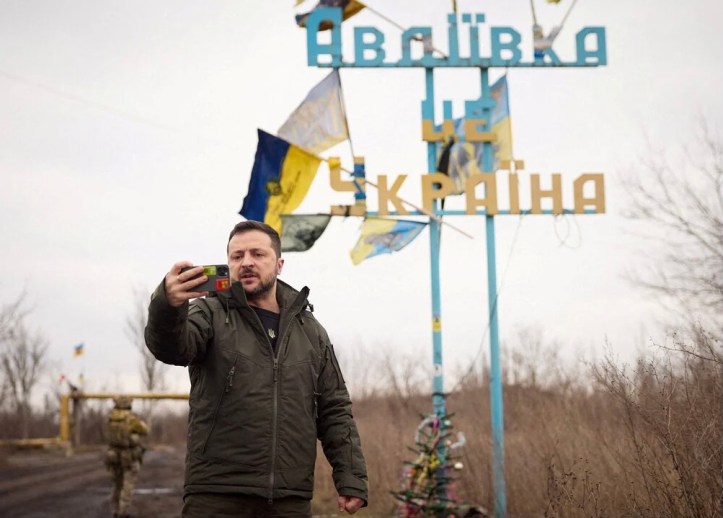
The important fortress city of Avdiivka, held by Kyiv since 2014 and used to regularly shell residents of Donetsk with impunity, was surrounded by Russian forces and abandoned in a chaotic collapse by Kyiv’s forces. Enormous losses were taken in the final days by Kyiv’s forces. Only recently Avdiivka was the launching site for the massacre of 27 people at the Tekstilshchik market. The Ukrainians are now only capable of slowing the Russian advance. The Western press have to content themselves with the occasional meaningless media event to keep the pecker up. There is nothing to cheer about from the real battlefield.
Zelensky put the loss of Avdiivka down to the holding up of money from Congress and Biden used the sudden death of Navalny in a Russian prison to put pressure on the Republican obstructors. However, Kyiv was given the best of US finance, weaponry and NATO training for the counter-attack last year and it didn’t make any impression. In truth, Kyiv is running out of motivated manpower with the will to fight and die.
On the other hand, it is becoming clear that Russia has been made stronger by the War. It has had no necessity to mobilise in any substantial way, unlike Ukraine, and has plenty of volunteers willing to fight. Russia is out producing the entire West and important Russian electronic warfare advances have been prompted. The Russian defence industry has been proved immensely superior to the West’s and the Russian armed forces have got valuable combat experience against Western weaponry and tactics. NATO tactics have been found wanting. Luckily for Europe, Putin is a moderate man and his ambitions are limited. He, and Russia itself, is nothing like its Western caricature. However, a drive to the Dnieper is suddenly a possibility.
The West’s focus will, therefore, most likely be on the “containment of Russia” and the prevention of a Ukrainian collapse. The lack of Ukrainian success will be made up for by NATO directed missile strikes on the Black Sea fleet and Russia (pretending to be Kyiv’s work). Behind the dissolving Ukraian lines will be built a great military zone, from France to Estonia, reaching Finland via Denmark/Sweden.
Prof. Niall Ferguson, British/US historian and political commentaor, is a worried man and spoke very bluntly to John Anderson recently:
“Ukraine will lose on our present trajectory. We have given the Ukrainians up until this point enough weaponry not to lose but not enough to win. If our interest wanes and it’s clearly waning amongst Republican voters and Republican politicians in the United States. If support wanes – and it could be cut off if Donald Trump is re-elected President in November of 2024 – then I don’t see how Ukraine could win. In fact, it seems to me that is quite likely that Ukraine loses.
We have reached a very critical point in that conflict. A stalemate has been arrived at. The Ukrainians themselves have acknowledged this. Their offensive this summer achieved far less than they had hoped. In terms of resources it’s David v. Goliath, but Goliath looks more and more the Likely favorite to win.
If Russia wins this war… if it is able to retain control of those parts of Ukraine that it currently does control, that land bridge that extends right down to Crimea, that will be the first big defeat of Cold War II for the West because we were all in it. We were all up in our support for Zelensky. How many speeches did Western leaders make in support of Ukraine? how many promises did they make? How many pledges were uttered to be there “for as long as it took”?
If we lose in Ukraine our credibility is shot.
And then what if there is an all-out multi-front assault on Israel and its defence forces are stretched to breaking point and the United States does not intervene and simply carries on lamely, calling for some kind of diplomatic resolution? What if those aircraft carrier strike groups just sit there and do nothing to impact Iran, the sponsor of this multi-front attack? Then you’ll have lost Ukraine and the fate of Israel will hang in the balance. It would be surprising if China, looking at all this, didn’t take the opportunity to add Taiwan to the strategic mix because how exactly would the United States respond if Taiwan were blockaded by China tomorrow?… This is a very dangerous moment in world history for the West.”
But the people who are most likely to escalate matters in these conflicts are the warhawks in Washington, in conjunction with the Zionists. This is a “dangerous moment” because the taking on of these, not so easily abandoned, conflicts may involve the choice of serious consequences of defeat or a willingness to engage in world war brinksmaship.
Perhaps the US should have encouraged Kyiv to accept Minsk II, which now looks a very good deal? Perhaps Biden should have realised that others in the world have red lines, and not only the US? Perhaps Washington should have taken Putin seriously in 2021 when he suggested a negotiation of the mutual security arrangements in Europe? Perhaps Kyiv should have accepted the peace settlement offered by Russia early in the war, and not been encouraged by Wetern promises and threats into destruction?
Now Europe, having enthusiastically hitched itself to the predictable disaster, should be very worried about the failure of the West in Ukraine. It should be very concerned about the failure of US leadership in the world. And it should be very worried about how the West’s moral standing has been whittled away in the world by the support of what Israel is doing to the Palestinians.
The US Congress is, at present, transferring its financial aid from Kyiv to Tel Aviv, in support of the ethnic cleansing and genocide of the Palestinians. That Washington considers the cause of Israel far more important than that of Ukraine should ring alarm bells in the chancelleries of Europe. What does that say about US priorities in the world? One thing it says is that the moral basis of the Ukraine War is bogus.
The warhawks in Washington want the conflict in Ukraine to continue to bleed Russia and keep it permanently tied down in war. They know that NATO has a GDP 25 times that of Russia and are at a loss at why the war isn’t been won. For these people Ukrainian lives are of no consequence. They will fight to the last Ukrainian.
Some in the Biden administration are looking for a way out in Ukraine and they could find a handy scapegoat with the ascension to power of Donald Trump in November. At that point the US can wash its hands of Kyiv and the liberal expansionists can blame the isolationist Trump for the abandonment of Kyiv. Ukraine lost the war and Trump abandoned the fight!
Of course, the non-democratic/crooked US judicial system may still prevent the democracy from giving Trump the Presidency again. However, if Trump is allowed to win at the ballot box he is much better prepared for the task ahead than first time round. He has a thousand strong cadre ready to replace the present incumbents. And there is a determination, according to Steve Bannon, to decouple America from the corrupt Kyiv elite which is dependent on Washington tax dollars.
Europe should be worried because Trump is going to make it shoulder the war against Russia if it is prepared to sustain it. He will probably wish to make the point that Europe has been a parasite on the United States and if it wants to throw its weight around in the world it will have to do so with its own resources, and not with America’s. Europe is already bearing most of the financial cost of Ukraine over the past 6 months, as Washington hesitates. Europe’s contribution will increase dramatically if Trump hands the war over to NATO in 2025.
The EU does not get the benefits for its aid that the US gets, where 80 per cent goes back into the US arms industry supporting jobs and profits. EU aid is mostly charity and money after nothing. Even the construction of a bigger European arms industry will divert resources away from social and standard of living improvements. And this in a continent facing demographic melt-down and a frightening dependency ratio, without large numbers of migrants.
Such is the price of democratic vassalage for Europe. Ukraine, of course, pays a far higher price.
 Pat Walsh