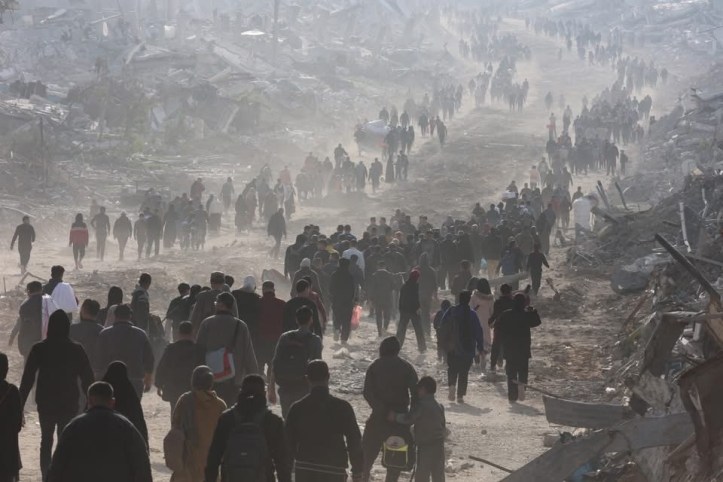
There was an informative interview on BBC Radio 4’s Today programme on Saturday 18 January with the senior Middle East correspondent Jeremy Bowen. It took place on the eve of the ceasefire in Gaza.
Informative interviews are a rarity regarding events in Gaza because the senior management of the BBC have kept a tight muzzle on its journalists, fearing accusations of anti-Semitism (i.e. criticism of Israel for killing tens of thousands of innocent people) and they have in place watchdogs of a Zionist persuasion to guard against information reaching the general public about what is happening in Gaza. Owen Jones has conducted an investigation into this aspect and found that there has been a behind closed doors revolt among journalists about how their reporting has been distorted into a shape that corresponds to the acceptable BBC narrative.
The normal presenters of Today, who keep a firm hand on things, Nick Robinson, Justin Webb and Emma Barnet, were not in situ that morning and Darshini David, the Sri Lankan lady, was presenting and asking Bowen the questions. It would not be surprising to find out that Bowen, being the experienced journalist he is, realised he had the opportunity of speaking a little more freely that usual, on the eve of the ceasefire. His interview was proceeded by someone from an aid agency who described how the Israelis were preventing food from getting to the vast number of homeless people in a state of starvation and babies were dying of hyperthermia.
Bowen said:
“As you have been hearing there are absolutely horrendous conditions inside Gaza at the moment…
I think one of the really big questions is the degree to which this ceasefire is actually going to last. Is it going to work because there is an enormous political controversy going on within Israeli Prime Minister Benjamin Netanyahu’s government about whether it’s actually something worth having or whether it’s a defeat, because he promised from the outset and said many, many times that Israel would score a total victory over Hamas?
But his right wingers, who really believed in that very strongly, are now looking at the deal and saying, well hang on a minute, we’re actually doing a deal with Hamas at the moment and they’re still there and they are far from being eradicated. So, what they’re saying is that after the first six weeks, after the first phase, Israel should go back to war.
Now the thing is that Netanyahu was stuck between a rock and a hard place. The rock is the promises he made to defeat Hamas and the hard place is President Donald Trump who wants this thing over with and Trump has essentially twisted Netanyahu’s arm until he agreed to the ceasefire. I think it now makes it very, very difficult for Netanyahu to collapse the ceasefire agreement because although that’s what a lot of his supporters will actually want President Trump is pushing him hard for it to continue.
I think that the thing about Biden was that Netanyahu basically had him where he wanted him because Biden was not prepared to put any pressure on Israel. Trump has already put pressure on Israel which is why they’ve essentially signed the ceasefire.
There’s now very, very, strong evidence that Netanyahu, since last May, has been actively blocking a deal and promoting the war. He has been prolonging the agony of the hostages and prolonging the fact that in that period thousands, literally tens of thousands of Palestinians have been killed and people from both sides are saying that there could have been a ceasefire ages ago, if it wasn’t for Biden and Netanyahu.”
Bowen was then asked what he thought the prospects of the ceasefire lasting were. He replied:
“One of the big unknowns is what will happen in phase two of the deal, in six weeks’ time. Phase two is meant to be the end of the war, when all hostages are released, and all Israeli forces come out of Gaza. That is the most delicate and dangerous time of the process because the ceasefire might collapse because there will be forces that don’t want the deal to work. In the coming weeks there will probably be many provocations from those who don’t want the ceasefire. And, of course, these will come mostly from the Israeli side, because there is a big political row in this country at the moment. There are people in Israel who argue that the country has no business making peace with Hamas. They should have been eradicated as Netanyahu had promised.”
This is a realistic assessment of what has been happening. It hasn’t appeared on the BBC website, which reports generally do.
The present writer has emphasised again and again since Israel began its response to October 7 that it was only the US which could curtail its destruction of Gaza and civilian population. Trump has proved that point.
Trump famously threatened that there would be “All Hell to Pay” if the hostages were not freed by his inauguration on January 20. This was taken as a threat to Hamas that the US would unleash Hell on the Palestinians if they did not give up the hostages.
One Israeli video blogger explained the impossibility of this since Israel had already made Gaza a Hell for Palestinians to the best of its ability, and it was unlikely the US was going to add to this. Israel was dependent upon the US for its ability to make Gaza Hell so it was only if Washington was prepared to destroy its own moral standing in the world in making it a worse Hell that it could do anything more, and that was unlikely.
It now appears that Trump’s “All Hell to Pay” was aimed not only at Hamas but primarily at Israel. That was logical since it was well known that Israel, in obstructing a deal over the hostages for nearly a year, was actually the primary obstacle to their release. Trump would have known how Netanyahu had turned down a very similar deal, signed by Hamas in the presence of the CIA head, William Burns, last Spring, in favour of the Rafah offensive.
All of the military destruction the IDF had visited on the Palestinian civil population had resulted in only a recovery of a handful of hostages. More than 10 times as many had been secured in a previous negotiated deal with Hamas, in November 2023, when 105 were set free in exchange for a week’s truce. But Netanyahu prioritised the punishment of the Palestinians over the recovery of the hostages because this was an opportunity he did not wish to miss.
Last Autumn Netanyahu opted for the “General’s Plan” which aimed at bombing and starving the Palestinian population out of northern Gaza to facilitate the building of real estate for Israeli settlers and reducing Gaza by one-third with the construction of a security corridor.
Trump’s Middle East envoy Steve Witkoff demanded a meeting with the Israelis to impress upon them the incoming President’s insistence that a deal was done before January 20. When the Israelis said they could not meet him on the Sabbath he reportedly used colourful language on the lines of: “F*ck your Sabbath, Donald wants a deal”. Witkoff told Netanyahu after traveling to Jerusalem on the Sabbath that decisions needed to be made and he needed to authorise Israeli negotiators to make them. If the Israeli Premier did not want to do so then all those involved in the talks would pack up and head home. “The president has been a great friend of Israel,” Witkoff told Netanyahu, “and now it’s time to be a friend back.”
Netanyahu understood that Trump had up his sleeve the power to restrict US subventions to Israel that enabled it to wage war and provide a lifestyle to those who might otherwise head to the US or Europe, if it did not do the deal he wanted.
Netanyahu also understands that Israel has not achieved any of its stated war aims. Wave after wave of IDF attacks have failed to defeat Hamas and new recruits volunteer and are trained quicker than Israel can eliminate existing members. The war started with the Israeli assault on Beit Hanoun and yet Hamas still fights on there, after multiple Zionist declarations of “Mission Accomplished.” The IDF is exhausted, the economy is shattered and Israel is detested across the world, like never before.
The Biden Presidency was, of course, very bad for the Palestinians. It smothered the natural instinct of left Democrats to agitate against what Israel was doing to the Palestinians. Kamala Harris shushed criticism of Israel during her coronation at the Democrat Convention when the Zionists were going about their business with most vigour. Progressives were told they were enabling Trump to win the White House when they criticised her or the administration for its support of Israel. They were told to hold fire while Biden gave Israel the ammunition it needed to destroy Gaza. All would be well when she was in the White House. Meanwhile thousands more Palestinians died.
With his last act as Biden’s Secretary of State Antony Blinken spread the lie that Hamas had obstructed previous deals, when he knows full well it was Israel which was the iron wall against them. He then went off to queer the pitch in the South Caucasus by signing a military convention with Armenia to prevent a peace settlement there, while the ceasefire deal was concluded by Trump’s man.
There was not a hope in Hell that Kamala Harris would have stood up to Israel either.
If Trump had presided over this state of affairs as President a serious anti-war movement would have developed in the US among the progressives. As it was, it was neutered by Biden and Harris.
As Jeremy Bowen suggests the challenge for President Trump will occur before the second phase of the deal when the Israeli leader may attempt to escape it by restarting the war on the Palestinians to prevent a collapse in his government. Netanyahu has already signalled his willingness to do so. In his first public speech since the agreement was reached, Netanyahu described the first phase of the ceasefire as “temporary” saying, “If we need to resume fighting, we will do that in new ways and we will do it with great force.”
It is at that point that President Trump will determine whether he wins a Nobel Peace Prize or not.
 Pat Walsh