The United States will abandon trying to broker a Russia-Ukraine peace deal unless there are clear signs a truce can be reached, the US Secretary of State, Marco Rubio, has now warned. Rubio said the US wanted to help end the war but would move on if there were no signs of progress.
“We’re not going to continue with this endeavour for weeks and months on end,” Rubio said, adding that the US had “other priorities to focus on”.
As Rubia correctly noted, the previous US administration, under President Biden, had put Ukraine on the course to disaster. It was the new administration which was attempting to clear up the mess. If it could not it would have to wash its hands of the Ukraine. And that would probably be Kyiv’s loss.
The basic problem in Ukraine is that while President Trump wants a ceasefire in Ukraine, President Putin wants a settlement.
Trump wants a quick fix to the Ukraine problem. Having made the pledge to stop the war he would like to deliver on his promise, no matter how superficially.
But Russia did not fight the war to win a ceasefire. It did not lose a substantial amount of blood and treasure for a ceasefire. It fought the war for a settlement that would guarantee Russian security – and indeed the security of Europe. A quick fix does not satisfy President Putin, Russia or the Russian public.
The Trump peace missions have been incoherent. Marco Rubia and Tim Walz are former anti-Russian super hawks whereas Steve Witkoff, a realist, real estate negotiator, no matter what his deal-making abilities are, is unlikely to understand the historical issues involved.
It is most likely, therefore, that Trump will allow events on the battlefield to play out. Kyiv can use all the gifts they got from Biden. But these are finite. So, the Russians will take more and more of their territory.
Trump knows that is not at all an intolerable situation for US interests.
Meanwhile, Europe will squabble and the “coalition of the willing” will fall apart due to the conflicting national interests involved. It is not unlikely that Sir Keir Starmer is Trump’s agent in this. It is in the UK interest to let Europe stew in the Ukrainian juice whilst Britain makes hay with its Atlantic cousins.
Then Trump will probably cut a deal with Putin, if the terms are right for both parties.
It is really only on territory that there is room for manoeuvre in negotiations. Crimea and the four oblasts are lost from the Ukrainian state. Even though Ukraine is unwilling to formally cede them, Russia will take them.
A Trump deal will ultimately save Odessa and Kharkiv for Kyiv.
The moment is not right for a deal now. It requires further Russian pressure on Kyiv and Europe. Putin knows that and Trump knows it too.
A ceasefire always favours the losing side in war. As such Trump is indeed doing Kyiv a favour in attempting to achieve one with Putin. Kyiv has adopted the position of supporting a ceasefire in the belief that a settlement is impossible. In this way they hope to take the political high ground in the US. But Trump’s men are no fools and many of them despise the Ukrainian political elite.
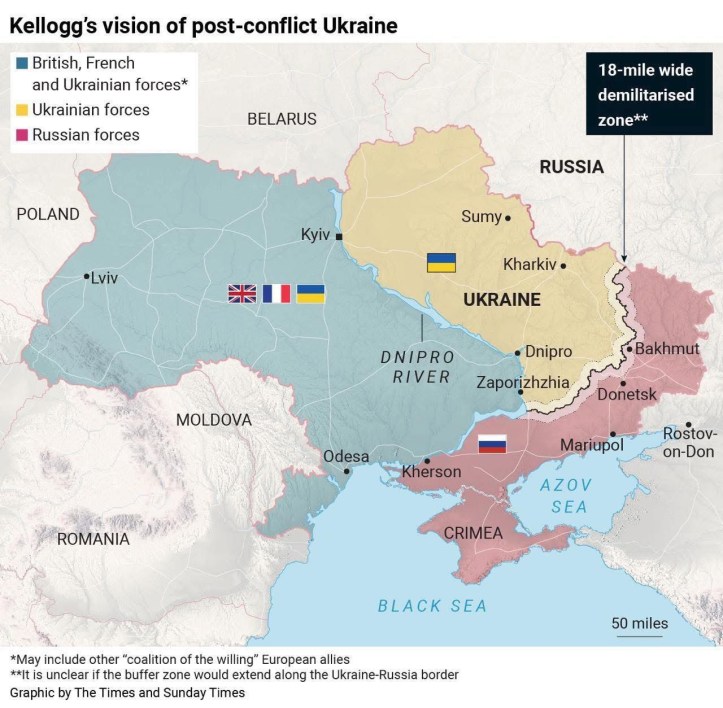
A ceasefire in itself is problematic. It requires a buffer zone to be established between the lines. A buffer zone needs to be around 50 kilometres wide, meaning that about 100,000 troops would be required for peacekeeping within it. Who will be responsible for this force? Who would fund it?
NATO and EU are out the question since it was the purpose of the Russian Special Military Operation to prevent this.
Whether the Ukraine war ends in 2025 is largely Putin’s decision and not Trump’s. Trump has little leverage over Russia. His leverage lies in, and on, Ukraine and Europe, both of whom he has the power to disable to force a settlement.
Reuters reported in early April that the latest version of Trump’s resource deal with Ukraine, that Zelensky appears willing to now sign, includes a clause giving the US International Development Finance Corporation control over its international gas pipeline between Russia and the EU. It seems that French and German companies are open to the possibility of resuming imports from Russia via that route. These reports, therefore, infer that the US is aiming to control Russia’s pipeline gas exports to Europe.
This would give the US further leverage over the EU in any trade war and could lead to the US also obtaining control over the four Nord Stream pipelines. America would then have Europe’s testicles in the palm of its hand.
As Andrew Korybko notes Trump could pressure the EU into releasing whatever amounts of seized Russian assets under its jurisdiction he chooses. If the EU refuses, then Russia and the US could agree to a financial arrangement whereby Russia transfers legal ownership of this sum to the US, the US transfers this same amount to Russia, then Trump weaponizes the $15 billions of newly US-owned assets under EU jurisdiction as a bargaining chip in the trade war.
It is then possible that the $300 billion worth of total assets that the West seized from Russia (95% in Europe) could be transferred to the US via these means in lieu of large-scale purchases across a range of American industries that would solidify the strategic economic partnership that Trump and Putin may wish to forge in the multi-polar world.
White House Press Secretary Karoline Leavitt recently noted that “There is an incentive for Russia to end this war and perhaps that could be economic partnerships with the United States.”
Russia has made do without those assets and probably does not expect them to be returned in full, despite Moscow’s rhetoric to the contrary, which is why this could be a mutually beneficial arrangement for the US and Russia in developing the “New Détente.”
In reality, at the present time, Putin holds most of the cards and whereas Trump has a good hand in relation to Zelensky’s poor hand, Putin has a very good hand in relation to Trump’s hand. President Trump’s only alternatives to disabling Ukraine are the failed Biden strategy or escalation, which the US state, outside the war hawks, has already rejected, and which makes no sense for US interests due to what it will result in.
Russian progress on the battlefield is slow, but glacial. Ukraine is attempting to wear Russia down through making it pay for every territorial advance. Russia requires at least a 2 to 1 advantage to gain territory which they do not presently have. So, the Russian advance is measured, meticulous and carefully managed to minimise casualties.
Western fabrications about high Russian casualties are propaganda to keep the Ukrainians in the fight and stem the declining will in the European public to keep supporting the lost war.
While Ukraine can inflict casualties on the Russians, it will never win without a vast increase in US aid and a great many more soldiers. And it has neither of those assets at its disposal. Kyiv’s idea seems to be to wear the Russians down over a period of years, economically, until they sicken of the conflict and hope the US can be persuaded to return as paymaster once Trump is gone.
However, if Ukraine’s resistance breaks there will probably be a catastrophic collapse.
The new form of warfare that has developed does not make for quick results. There are vast grey areas contested by drones, surveillance and snipers and constant movement within these grey zones by dispersed individuals. The infantryman now rides to the front on motorcycles rather than in Armoured Personnel Carriers. This is because drones are ineffective in cost against individuals on motorcycles.
NATO’s APCs are continually destroyed and there were hundreds left smouldering in Kursk. The small North Korean expeditionary force attempted to fight a Soviet war and they suffered heavy losses by all accounts. They did not heed advice from the Russians and did not adjust to the new form of warfare.
Cheap drones have proved much more effective than the expensive NATO material supplied to Kyiv. Western tanks are technologically developed, which makes them both costly and fewer in number. Training is more difficult to operate them effectively and it is harder to replace lost operators.
The West’s weakness in warfare came about because of the New World Order/War on Terror and the capitalist arms industry which aimed products at wealthy buyers. Western equipment is not fit for purpose in the new form of warfare in Ukraine.
Most drones used on both sides originate in the workshop of the world, China – FVP drones – and have final assembly/modification in Russia and Ukraine. The vast majority are the cheapest of commercial drones. They often have small amounts of explosives in sandwich boxes taped to them. They are good for use against concentrations of infantry and vehicles but wasteful in use against individual soldiers unless the target is of high value.
At the moment of writing the likely endgame in Ukraine is the frozen conflict seen between Armenia and Azerbaijan after the 1990s war. In that war the losing side, Azerbaijan, signed a ceasefire agreement with the Armenians, but refused a final settlement. Nearly 3 decades of frozen conflict ensued with periodic flareups but little movement in territory or diplomatic breakthroughs to resolve the conflict.
Around 30 years after the ceasefire of 1994 Azerbaijan had to use physical force to recover its lost territory – which at 18% was almost identical to Ukraine’s losses.
The First Karabakh War was always considered a catastrophic defeat for Azerbaijan and in Azerbaijan. It is likely that the Ukraine war will be depicted differently in the West. But in truth it has been a catastrophic defeat for Ukraine and also a big defeat for the West and NATO.
The Azerbaijanis had things going for them that enabled the recovery of their territories which Kyiv does not have – at present, at least.
For one thing, Azerbaijan had a very able leadership cadre in the Aliyevs – father, Heydar, who had extensive political leadership experience in the USSR at Politburo level, plus son Ilham, who built effectively on his father’s work. The leadership cadre struck the right balance between West and Russia and were able to manoeuvre skilfully between, and indeed against, both.
That political skill has never existed in the Ukraine. Kyiv has been very poor at statesmanship, reflecting a divided country characterised by what Samuel Huntington termed a civilisational cleft, between European Ukraine and Russian Ukraine. In 2014 it was led down a fateful path by Victoria Nuland and others that has led to the failure of the Ukraine to encompass what it was bequeathed by the Soviet nation builders of the state. From that point onward it was impossible for the political elite to steer a balanced course, particularly after militant Ukrainian nationalism had infused and saurated the body politic.
It has paid a heavy price for this ever since through intransigence in dealing with Russia, that has been encouraged by the West, desiring a war that it got indirectly in 2014 and then directly in 2022.
Ukraine also has a much more powerful enemy in Russia than Azerbaijan had in Armenia. The Armenians over-extended themselves through their extravagant territorial gains which their state, economically and politically, and population were inadequate to retain. They could only triumph as long as Azerbaijan was down and out, as it was in the confusion and chaos brought about by the collapse of the USSR. Once it got its act together and became a going concern under the Aliyevs, the Armenians needed to cut a deal.
Russia, since the rise of Putin, has had excellent political leadership, and if anything has been strengthened by fighting and winning its war against the West in Ukraine. Short of a future collapse it is likely that Eurasian development, along with better relations with the US will make Russia a formidable force in the world that Kyiv will have to do business with again.
There is, therefore, far less likelihood that Ukraine will recover from its defeat in 2025 than Azerbaijan did from 1994.
But it may help the Ukraine to recover if it believes that it might one day build a functional state out of the ashes of defeat, with the assistance of President Trump. There are many European states that have diminished in size in the course of the last century – Germany and Austria amongst them – and become more functional as a result.
Why not Ukraine?
 Pat Walsh