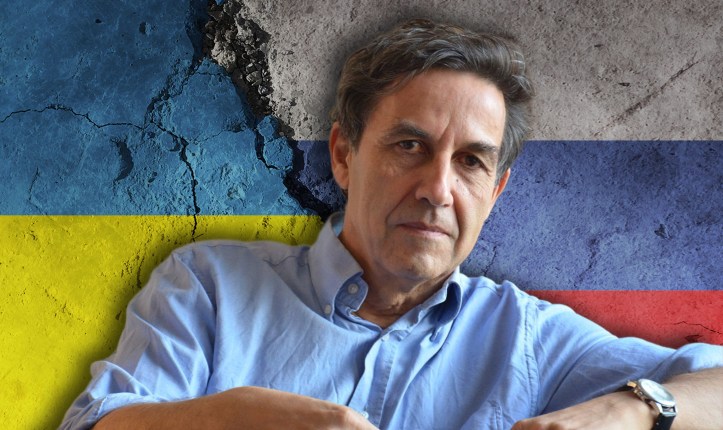
In early April, the French demographer and philosopher, Emmanuel Todd, gave a talk in Budapest, in the Várkert Bazár, as part of the Eötvös Conference organized by the 21st Century Institute. Todd is the author of the recent book, La Défaite de L’Occident (The Defeat of the West), which although it has been translated into a couple of dozen languages remains untranslated into English.
Presumably this is a deliberate omission.
Emmanuel Todd’s talk was generally about the decline and defeat of the West, as is the bulk of his recent work. Here, however, we focus on his view of Russia (and the Ukraine) in the talk and in previous published work.
As a young man Todd studied at Trinity College, Cambridge, where Peter Laslett supervised his doctoral study of peasant communities in pre-industrial Europe. In his most influential book, The World We Have Lost (1964), Laslett argued that the key to understanding past societies was not in studying their economies but their distinctive family structures. Inspired by this idea Todd produced a series of books charting the relationship between political ideologies and family structures across Europe and the world.
Todd argued that liberal freedoms developed in societies such as England and the United States where most families were nuclear. In these societies children escaped from the authority of their parents and formed households of their own. In other societies, like Germany or Japan, where children lived under the thumb of their parents in “stem families,” there was a tendency toward authoritarian government. The French Revolution, argued Todd, had drawn its egalitarian inspiration from Paris, where families divided up inheritances between siblings. Communitarian ideologies developed in societies such as Russia, where families lived in large agricultural communes.
Todd went to work for the French national institute for demographic study after he had made his name with a 1976 book, La Chute Finale (The Final Fall). This work identified and analysed the Soviet world’s demographic problems, such as rising infant mortality and falling fertility, in an absence of economic growth, and Todd predicted its collapse from this data. This went totally against the grain in the academic circles of the West, which at that time were very Marxist, and strongly of the opinion that the future was Soviet – especially in the aftermath of the US defeat in Vietnam and the advance of socialist-inspired national liberation movements in Africa, South America and South East Asia.
Todd was to prove prophetic, but for the wrong reason, as he admitted himself in his recent talk:
“The… collapse of communism made me cautious. Of course, my prediction was correct, and I was very sure of myself: the rise of infant mortality is a very, very reliable indicator. But when about 15 years later the Soviet system did indeed collapse, I have to admit with some humility that I didn’t really understand what was happening. I would never have imagined the consequences of this dislocation for the entire Soviet sphere. I wasn’t so surprised that the former “people’s democracies” within the Soviet sphere adapted fairly easily: In my book I had already noted the enormous differences in energy between Hungary, Poland, and Czechoslovakia, for example, and the Soviet Union proper.
But the collapse of Russia in the 1990s is something I would never have anticipated. The fundamental reason why I was unable to understand or anticipate the dislocation of Russia itself is that I had not understood that communism was not simply a means of organising economic activity in Russia, but also a kind of religion. It was belief that allowed the system to exist and the dissolution of that belief represented, of course, something at least as damaging as the dislocation of the economic system…
I knew that Russia was a stable power. I had been aware of the enormous hardships and suffering of the Russian people in the 1990s, but throughout the period between 2000 and 2020, while everyone was explaining that Vladimir Putin was a monster and that the Russian people were either submissive or stupid, I had been seeing data that showed the stabilization of Russia. In France, David Teurtrie published an excellent book called ‘Russie: le retour de la puissance’ (in English, Russia: The Return of Power). In it, Teurtrie demonstrated the stabilization of the Russian economy, the increased capacity of the Russian banking system to function autonomously, and how the Russians had managed to shelter themselves against retaliatory measures in the electronic and IT fields, protecting themselves from any sanctions that the Europeans might impose. His book also includes a description of renewed efficiency in Russian agricultural production, as well as in the production and export of nuclear plants.
I had my own view of Russia as well, also based on rational factors. I had my own indicators. I am still following infant mortality, this indicator that allowed me to predict the collapse of the Soviet system. But infant mortality is now decreasing very quickly in Russia. In 2022, and it is still true today, Russian infant mortality sank below that of the US. I find it difficult to admit – and I would need to double-check – but I believe that this year infant mortality in Russia is now lower even than in France. There has also been a decrease in the suicide rate and the homicide rate in Russia. So, every indicator I was aware of suggested that Russia was stabilising. In addition, I had my experience as an anthropologist. My true speciality is the analysis of family systems, which were very diverse in the past, and the relationship between those family systems and the social structures and form of nations. The Russian family system is communitarian. The traditional Russian peasant family was structured around the father, his sons, and strong values of authority and equality; this family structure nurtured a collective mindset and very strong national feeling. And even though I hadn’t anticipated the Russian suffering of the 1990s, I could, by this analysis of the specific Russian family system, anticipate that a stable and solid Russia would re-emerge, and that this Russia would not be a western democracy. Its system would accept the rules of the market, but the State would remain strong, as would the desire for national sovereignty. I had no doubt at all about Russia’s essential solidity…”
In 2002 Emmanuel Todd had published ‘After the Empire: The Breakdown of the American Order’. This too would be a prophetic work because at that point America seemed to be at the height of its unipolar power, waging war in Afghanistan and Iraq and about to smash up more of the Muslim world over the following decades. Todd predicted that like the USSR, the American empire was doomed.
There is a chapter in ‘After the Empire’ recognising ‘The Return of Russia’ before most of the West were realising it – after the disasters of the Yeltsin years. Todd noted that “The United States is failing in its attempt to eliminate or simply isolate Russia—even if it continues to act as if its old strategic adversary were no longer a factor.”
Todd, writing in ‘After the Empire’, went on:
“Faced with the Russia question, the American strategy had two goals— the first is no longer attainable and the second grows less likely over time. The first objective was the disintegration of Russia, something that was supposed to be sped along by stimulating
independence movements in the Caucasus and with an American military presence in Central Asia. These demonstrations were supposed to encourage the centrifugal tendency of the provinces within the ethnically Russian part of the federation. This policy seriously underestimated Russian national cohesion.
The second objective was to maintain a certain level of tension between the United States and Russia and thereby prevent a reconciliation between Europe and Russia—in other words the reunification of Western Eurasia —by keeping alive for as long as possible the antagonist climate inherited from the Cold War, But the disorder and incertitude engendered by America’s Middle East policy has had the opposite effect and has created the optimum conditions for Russia’s being dealt back in as an international player, a situation that Vladimir Putin has taken advantage of immediately. In an impressive speech, given mostly in German before the Bundestag on September 23, 2001, Putin offered the West a true end to the Cold War. But what West? Offering short-term help to the Americans in their made-for-TV. micro-military show in Afghanistan — the traditional object of a strategic
fallacy —was only window-dressing for the Russians. Their actual project is to create more ties with Europe, the planet’s leading industrial power. Paying attention to the flow of imports and exports allows one to appreciate the real stakes of the subtle three-handed game that is preparing itself between Russia, the United States, and Europe. In 2001 Russia and the United States did 10 billion euros of business with each other, Russia and the European Union did 7.5 times more or roughly 75 billion euros worth. Russia can get along without the United States but not without Europe. Russia is implicitly offering Europe a counterweight to American military influence and a secure supply of its energy requirements. It is a tempting offer.”
While America’s eyes were elsewhere, Russia and Europe began to do business and develop economically in the mutual interest, within the US New World Order.
It was in ‘After the Empire’ that Todd charted the decline of Russia’s infant mortality rate, the increase in life expectancy after the big fall during the Yeltsin years and the regeneration of its industry and economy by Putin. But Todd noted that Russia’s birth-rate remained stubbornly low at 1.2 (Ukraine’s was even lower at 1.1 producing the younger and fewer generation that fight and die today).
Emmanuel Todd suggested that “If we want to judge Russia, we should adopt a broader perspective and refuse the historical myopia of day-to-day reports” in the Western media:
“We ought to think comprehensively of all that Russia has been able to achieve in the midst of enormous social and economic suffering.
By itself Russia overthrew the most complete totalitarian regime in human history. It accepted without violent resistance the independence of its satellites in Eastern Europe, as well as the Baltic republics and those in the Caucasus and Central Asia. It accepted the breakup of the properly Russian center of the state with the splitting off of Belarus and Ukraine. It even allowed the independence movement of many territories to advance despite the presence of large ethnically Russian minorities. However, nothing should be overidealized. One can point out that Russia often had no real choice in the matter and that leaving these minorities in place outside Russia allows for the possibility of exploiting their presence later. If that is true, one has to admire the wisdom and mastery of the Russian leaders who preferred gambling on a far-off future instead of succumbing immediately
to an easy but useless violence. In a relatively short amount of time since the days when it enjoyed superpower status, Russia pacifically accepted all the defections and devolutions that Milosevic’s Serbia refused. Achieving this, Russia proved itself to be a truly great nation, both calculating and responsible—a nation that, despite the horrors of Stalinism, we will be forced one day to admit has made a positive contribution to human history. This contribution includes one of the most universal of world literatures with Gogol, Tolstoy, Dostoyevsky, Chekhov, Turgenev, and many others. An account of Russian history cannot be limited to a retrospective denunciation of communism…
Communism fell apart. The anthropological base of the former Soviet sphere is changing, slowly. The new Russian democracy, however, if it succeeds, will retain certain basic characteristics, and we should keep them in mind if we want to anticipate its likely future behaviour on the international scene. A liberal Russian economy will never be an individualist Anglo-Saxon style capitalism. It will keep communitarian features, creating horizontal associative forms that it is too early to define more precisely. The political system is unlikely to function along the lines of the alternating two-party English and American model.”
On the whole, Todd saw Russia in 2002 as playing a positive balancing role within the New World Order of American hegemony if its contribution was acknowledged and welcomed by America.
However:
“As for the American strategists, their approach is to endlessly explain that for the long-term security of the West we have to make sure the Russians understand that their empire days are over. In doing so they are no doubt hinting at their concern over the longevity of the American empire. No sophisticated intellectual speculation is necessary to understand that Russia is no longer an expanding force. No matter what form its regime takes, democratic or authoritarian, Russia is shrinking demographically. Its population is decreasing and ageing, and this factor alone permits us to view the nation as a stabilizing force rather than a threat.
From an American standpoint this demographic movement has produced something rather surprising. At first the contraction of the Russian population, added to the collapse of their economy, made the United States the only remaining superpower and started Washington dreaming about an impossible empire, At that time there arose the temptation to kill the Russian bear for good. Lately, however, the world is realizing little by little that a diminished Russia is not a source of worry but on the contrary is becoming almost automatically a balancing force in a situation made disturbing by an America that has become too powerful,
too predatory, and too erratic in its international actions. This is what allowed Vladimir Putin to make the following declaration in Berlin: “No one doubts the great value of European relations with the United States, But I think that Europe would consolidate its reputation as a truly independent global force . . . if it associated its capacities with those of Russia —with its human, territorial, and natural resources and the economic, cultural, and defense potential of Russia.”
When it comes right down to it, we are not absolutely sure that Russia is going to establish a democratic society and prove forever, or at least for a long time, Fukuyama’s dream-hypothesis about the universalization of the liberal society. In this political area Russia is not fully reliable. But it is reliable in the area of diplomacy for two essential reasons. First, because Russia is weak. Paradoxically, along with the internal stabilization of the country,
weakness is Vladimir Putin’s major advantage, one that is allowing him to reinsert Russia as a potential ally on the European chessboard. But Russia is also reliable because, liberal or not, it has a universalist temperament capable of perceiving international relations in a just, egalitarian way. When linked to its weakness that prevents delusions of grand domination, Russian universalism can only be a positive contribution to the equilibrium of the world.”
Predictably Todd’s points fell on deaf ears within the powerful anti-Russian foreign affairs establishment in the US, for whom the Cold War did not result in the complete victory they had hoped for. This was Fukuyama’s territory and that of the belief in an end to history. It was made up of a large proportion of people of East European and Russian Jewish origin, consumed with a congenital hatred of Russia from Tsarist times. It, of course, hasn’t gone away you know and is an influential opponent of Trump, preserving itself for his departure so that it can get back to business.
The US was ultimately to cut down the Russia/Europe relationship of mutual benefit, that acted as a counterbalance to US hegemony, in the fields of Ukraine, from 2014 after the EU unwisely meddled in the country forcing a political schism upon it that was exploited in the Victoria Nuland coup.
A 7 year long civil war developed in the Ukraine between its nationalist half and its Russian half, assisted overtly and covertly by Russia, before the special military operation halted the Kyiv/NATO advance and began rolling it back.
Getting back to more recent events and to the question of why Vladimir Putin chose February 2022 to launch his special military operation Todd gives two answers in his more recent book La Défaite de L’Occident.
Firstly, he argues that Russia was prepared and ready at that stage, after having suffered a wave of NATO enlargements it had to take due to its weak position. Since the 2014 Western sanctions in response to the Russian annexation of Crimea, Russia had been building up its military capability, including hypersonic missiles for which NATO had no match, and future-proofing its economy. Russia had developed the capacity for “great technical, economic and social flexibility” and become again “an adversary to be taken seriously.”
Secondly, based on his study of birth rates and mobilisation cohorts, Todd concluded that Putin saw a five-year window of opportunity in which to tackle Kyiv and to roll back NATO. By 2027 the cohort of men eligible for military service in Russia would be too small so it was now or never, particularly with Kyiv pushing against the Donbas.
He noted that the idea that Russia would invade Europe after defeating and subduing Ukraine is absurd and the stuff of Western “fantasy and propaganda.”
In the lead-up to February 2022, Russia made three demands on Ukraine: permanent Russian retention of Crimea, protection for the Russian-speaking populations of the Donbas, and the neutrality of Ukraine. Todd noted that “A Ukrainian nation sure of its existence and of its destiny in Western Europe would have accepted these conditions… it would even have got rid of the Donbas.” Recalling the amicable break-up of Czechoslovakia, Todd noted that this smaller polity should have focussed on building itself as a truly Ukrainian nation-state.
Todd argues that few in the West, or Russia, anticipated that a “failed state” beset by corruption and in the grip of oligarchs would put up a substantial fight against the Russians. “What nobody could have predicted is that it would find in the war a reason for existing, a justification for its own existence.” It was the Americans who put out the idea that Ukraine would fall in 3 days, not Putin.
Todd noted that Ukraine was irretrievably divided, with the Southern and Eastern regions having opted out of the Ukrainian national project a long time ago. The 2010 Presidential elections revealed this division with an “almost disconcerting simplicity”. Votes for the pro-Russian Viktor Yanukovych were 90.4%, 89.0% and 78.2% in Donetsk, Lugansk and Crimea, but only 8.6%, 7.9% and 7.0% in the Western provinces of Lviv, Ternopil and Ivano-Frankivsk. Ukraine was two-nations in one collapsing state.
For Todd the May 2014 Presidential elections which resulted in Poroshenko’s election, were the turning point. In Donetsk turnout was a mere 15%; in Lugansk, 25%: “These elections mark the moment when the Russian regions disappeared from the Ukrainian political system.” This was “the end of a Ukrainian democracy, which in fact had never functioned” and “the true birth of the Ukrainian nation, through the alliance of the ultra-nationalism of the West and the anarcho-militarism of the Centre, against the Russophile part of the country.”
Ukraine’s determination to reconquer the Donbas and reclaim Crimea was “a suicidal project”, Todd claimed. It was trying “to maintain its sovereignty over the populations of another nation – a nation far more powerful than it is”. He continued: “The suicidal lack of realism in Kiev’s strategy suggests – paradoxically – a pathological Ukrainian attachment to Russia: a need for conflict which reveals an inability to separate from it.”
As for Russia, Todd notes that: “The truth is that Russia, with a shrinking population and a territory of 17 million square kilometres, far from wanting to conquer new territories, wonders above all how she will continue to occupy those she already possesses.”
Demographic factors also limited Russia’s conduct of the war, Todd suggests. Initially a mere 120,000 Russian troops were deployed in Ukraine, a gigantic country of 600,000 square km. In the USSR’s 1968 invasion of Czechoslovakia 500,000 troops were used in 128,000 square km. Contrary to the absurd narrative of Western commentators, Russia’s current military strategy is not to hurl millions a meat grinder. The war is being prosecuted slowly, carefully and methodically, to minimise losses. Men were precious to Russia given its demographic problems.
Todd points to the important role played in the conflict’s early stages by Chechen regiments and the Wagner group, and to the partial, gradual, and sparingly implemented Russian mobilisations: “Russia’s priority is not to conquer a maximum of territory but to lose a minimum of men.”
For Todd, Russia is not the principal geopolitical problem in Ukraine, but America: “Too vast for a shrinking population, she would be incapable of taking control of the planet and has no desire whatsoever to do so… Rather, it is a Western – and more specifically American – crisis, a terminal crisis, which is putting the planet’s equilibrium into peril.”
Todd notes that the Russian economy has successfully withstood the fierce American and European financial sanctions. Widely expected to bring Russia to its knees, the sanctions proved something of a paper tiger. The West itself subverted them in fear that they would damage the global capitalist system, whose success Western governments depend on for re-election – as much as they might harm Russia.
Secondly, by the summer of 2023, it had become clear that the United States and the West lacked the industrial capacity to supply Ukraine with sufficient artillery shells to win the war. The West, led by Washington as the self-proclaimed “arsenal of democracy,” and with 30 times the total income of Russia, could not match the artillery and war economy of Moscow. This raised the question of how much of the political economy of the neo-liberal world was, as Todd suggests, “phoney.” Not a real economy, but simply the moving around of money to make more money for a small economic elite.
A key example of Western failings was the assessment of Russia’s economic power. In 2016, John McCain famously remarked that Russia was “little more than a gas station masquerading as a country.” Many members of the US Congress uttered or repeated something similar and variations of that ignorance were repeated endlessly in America’s major media platforms and were thoroughly embedded in the American psyche by the time the first Ukraine crisis broke out in 2014.
In reply, Todd puts out some simple statistics in his recent book: From 2000, at the beginning of Putin’s rule, to 2017, the Russian rate of death from alcoholism dropped from 25 per 100,000 citizens to 8; from suicide, from 39 to 13; from murder, from 28 to 6. As for infant mortality, long the gold standard signifier of the level of a country’s development, under Putin it fell from 19 per 1000 live births to 4.4. Todd quotes UNICEF to note the American rate is currently higher at 5.5 per 1000.
Todd goes on to cite several sectors where Russia has made stunning progress in the last 20 years, including agriculture, internet access etc. before speculating about how it is that Russia, dwarfed by the United States in per capita income statistics, is somehow able to keep pace during wartime and produce more armaments than the US. An interesting clue is that 23 percent of Russians in higher education study engineering, as against only 7 percent in the US. The US elite universities, with their business models, have particularly failed and are rotten. The result is that Russia, with a far smaller population, produces more engineers than the US, which helps it outpace America in ingenuity.
If the resurgence of the Russian economy under Putin has helped Russia survive Western sanctions, so too has the fact that much of the world is not in the least invested in the notion that Ukraine and Washington represent freedom and progress and Moscow some form of tyranny. One major argument Todd makes is that the Washington-led West simply has no idea as to how much of the world – particularly the Global South – rejects the value system of contemporary globalist neoliberalism. He argues that the Western globalist economic model enabling disproportionate mass consumption in the West through the outsourcing of factory work is no longer welcomed by elites of the Global South as it once was, particularly since the 2008 economic crisis.
And it is increasingly not beloved by working class populations in the West, either, who are turning to the populists like Trump and others to save their nations from the globalists. The globalists, responsible for mass migration to undercut wages and undermine organised labour movements, are on the defence against popular-national forces (dismissively called “nativists” by the degenerate cosmopolitans).
Todd recognises that Russia is an authoritarian democracy. How could it be anything else? It has just the kind of polity you would expect to be generated from its patriarchal and communitarian family patterns. But by the same token this also makes Russia a conservative and realistic power, largely content to live within its borders. It nurses no grand designs, as Europe suggests, and its ageing and stagnating population affords no demographic basis for expansion. It is concerned, just like the US (and its Monroe Doctrine), with its immediate hinterland being used as a base to attack it. And it is very consistent and predictable in its behaviour – unlike the West:
“As for Russia… it’s the only country that strikes me as completely predictable. I have moments when, in an attack of a kind of geopolitical megalomania, I feel I can read the minds of Putin or Lavrov, because Russian politics seems to me so fundamentally rational, consistent and limited.
In Russia, national sovereignty is paramount. Russia felt threatened by NATO’s advance. Russia has a problem; in that it can no longer negotiate with Westerners – neither the Europeans nor the Americans – because it considers them as absolutely unreliable in the negotiation of treaties or agreements.
Trump, however, is rather well inclined towards Russia. He is motivated by so many phobias and resentments – against Europeans, against Black people, etc – that it is clear that Russophobia is not a key motivation for him. But for the Russians his constant changes of attitude make him a caricature of American unreliability.
So, for the Russians the only practical option is to reach their military goals on the ground, to take the territory in Ukraine they need to feel safe, and then to stop. It’s not true that they want or that they have the capacity to go further into Europe. Then they will simply let things settle down in order to restore peace without any negotiation as such.
Of course, Vladimir Putin’s policy towards Trump is rather elegant. He doesn’t try to provoke him. He takes part in negotiations. But here is what I think about Russia’s objectives. This is my personal opinion, it’s not in the texts, although it’s beginning to appear in some discussions. I think that the Russians can’t stop at the oblasts they’re currently controlling in Ukraine. Naval drone attacks launched from Odessa have demonstrated that the Russian fleet was not safe in Sebastopol. I think that Odessa is one element of Russia’s security objectives. This isn’t based on any private information – this is purely a product of logical inference – but in my opinion the Russians will only stop the war once they have captured the oblast of Odessa. This is my prediction: maybe I’ll be wrong, maybe I won’t be. We shall see.
What frightens me isn’t having misguided ideological views. What frightens me is the thought of making a mistake as a predictor of future events. So, I am taking a risk here, albeit a small one. It’s obvious that all the media noise about Russia attacking Europe is ridiculous. Russia, with its population of 145 million and 17 million square kilometres of land, is not expansionist. It is profoundly happy that it no longer has to manage the Poles. Personally, (and this is my own preference), I hope that Vladimir Putin will have the wisdom to avoid so much as touching the Baltic countries, in order to show the Europeans just how absurd is their idea of Russia as a threatening power…
Russia has always been very clear, and I hope our leaders are aware of it: the Russians know that they are less powerful than the West, than NATO, because of their relatively small population. That is why they have warned that if the Russian State is threatened, they reserve the right to deploy tactical nuclear weapons to suppress the threat. I point this out, and I keep doing so, because European recklessness on this point is a real risk. In France, journalists often dismiss this Russian message as posturing, or as empty threats. But one of the distinctive features of the Russians is that they do what they say.”
Emmanuel Todd’s insights are backed up by a reading of events.
In the 3 months prior to the Special Military Operation the Russians tried to encourage a deal over Ukraine to prevent NATO expansion. The US believed it could shove 1999 and 2004 down Russia’s throat. This was the major cause of the war – the US desire to push NATO up to the Russian border. Russia had been forced into accepting previous expansions and they would accept this, or so it was thought in the West.
Washington believed that once the war had started it could defeat the Russians. Nothing was done to prevent a war and Putin’s warnings were ignored. When Kyiv was ringed by the Russian expeditionary force, after 3 weeks of the military operation, and negotiations took place in Istanbul, Boris Johnson and the United States ended the negotiations, telling Zelensky to walk away when he was about to do a deal. Hadn’t Ukraine been armed and trained so they could hold their own on the battlefield while sanctions were applied to oust Putin from the Russian leadership and reduce Russia to the chaos of the Yeltsin era?
General Milley, in the fall of 2022, had urged the settlement of the war at the high point of the Ukrainians’ fortunes. Biden however shut him up and continued the war. Washington believed it had further cards to play against Russia and was confident of Ukraine’s ability along with the sanctions, to deal a deathblow to Putin.
Alas, General Milley was right.
Ukraine and the New World Orderers (President Trump’s assorted opponents across the US political spectrum and internationally in the UK and Europe) want to obstruct a peace settlement which, if it reflects the battlefield, as it surely will as all peace following war does, will represent a great defeat for Ukraine and the West. The ceasefire proposal is part of this obstruction. It sounds reasonable, but in actuality it is an ill-disguised attempt to provide respite to Kyiv, while guaranteeing the continuation of the conflict.
Kyiv and the New World Orderers aim to simply continue the war after they have seen off President Trump. They hope to be able to do this through European assistance which, while it will not replace the United States assistance, will hopefully enable Kyiv to remain in the field, fighting and dying, hoping for another day.
The Russians have fixed demands. It is simple to understand Russia as Emmanuel Todd suggests. And it is also easy to understand that If Russia’s core demands are not met then it will continue to wage war, extending Russian control over more Ukrainian territory and demanding greater terms of Kyiv in the future for making it necessary for Russia to expend further blood and treasure on the war.
President Trump is vulnerable because he is trying to cut deals on Ukraine, Iran, Gaza and tariffs all at the same time. He is therefore vulnerable to a variety of entrenched interests – the US foreign policy establishment, Wall Street, Britain, the EU political class and Israel, as well as assorted woke liberals, feminists, and various flotsam and jetsam – who all have the simple desire to see the failure of Donald Trump, in order to feel better about the world.
But what then?
 Pat Walsh
Absolutely first class analysis. Todd’s cautious approach is very solid. The line taken here and in a previous article that Trump is attacking on too many fronts is also sound. The decline of the West is a sight to behold. Who would have thought the Western elites could make such a mess of things.
LikeLike
A very interesting analysis. Nice to see things from the Russian point of view. Thanks a lot. Your work is always excellent
LikeLike