States operate on the basis of the national interest. Arthur Griffith noted: “Between the Individual and Humanity stands, and must continue to stand, a great fact – the Nation.”
States, on the whole, do not operate on the geopolitical interest, unless they happen to be Great Powers. States which are not Great Powers but which are encouraged to act upon the geopolitical interest invariable end up in trouble – Ukraine being a case in point.
In Europe, at present, there is great hysteria over the letting down of Ukraine. This is over the geopolitical interest abandoning Ukraine to the national interest. It is not pointed out that Ukraine has been encouraged to subsume its national interest to the geopolitical interest of the West and made the mistake of doing so.
It was in the national interest of Ukraine to strike a deal with Russia prior to February 2020. This would have meant the preservation of a heterogeneous Ukraine with, at worst, the loss of Crimea (only given to Ukraine in the 1950s by Khrushchev in order to enhance the Russian interest with a bigger Russian population). A substantial renewal of the lease to the naval base might have even preserved the whole of the Ukrainian state intact.
However, Ukrainian nationalism decided to throw in its lot with the then US geopolitical interest of weakening Russia by fomenting conflict within the Russian world at its most vulnerable place – Ukraine. Kyiv then offered Ukraine up as a battlefield for Western geopolitical interests and its people as military material for a war with Russia – a war which the West decided to only keep stoking rather than attempt to win. And now Ukraine has been left high and dry, it appears from what happened in Alaska.
The geopolitical interest, in the shape of the US President, who is elected by the American people (give or take the Electoral College provision) has decided that the US has to pursue its own national interest, and this has no further use for Kyiv. And now a bewildered Kyiv is going to pay the price for not understanding that geopolitical interest and national interest are two very different things. One is shifting and one is constant.
This brings us to Trump’s (largely unheralded in the West) success in the South Caucasus, where he has presided over the beginnings of a peace deal between Armenia and Azerbaijan.
A clue to what was happening in the region come from last year. It is found in statements that the President of Azerbaijan, Ilham Aliyev made strongly supporting the candidacy of Donald Trump during the 2024 Presidential campaign. It is apparent now this these were not just reactions against the Biden administration and its strongly pro-Armenian stance but an indication that Baku felt it could do business with an enterprising and activist Trump administration in his foreign affairs. Moscow probably saw what was happening during the early months of 2025 and decided to show its disdain.
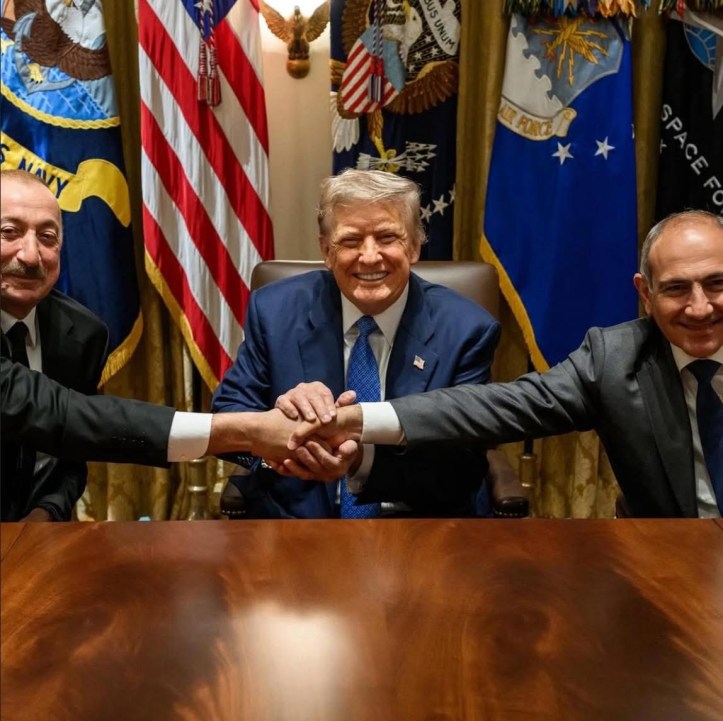
On August 8th 2025 President Aliyev’s confidence in President Trump as the potential key to unlocking the standoff over a settlement bore fruit. ‘An Agreement on the Establishment of Peace and Interstate Relations between the Republic of Azerbaijan and the Republic of Armenia’ was signed by the leaders of Armenia, Azerbaijan and the United States in a great ceremony in the White House.
The Washington declaration involved the initialling of a peace treaty between Armenia and Azerbaijan, including the affirmation of the inviolability of international borders by the two states; the inadmissibility of using force to seize territory; the rejection of any present or future acts of retaliation and the dissolution of the OSCE Minsk Group and related structures.
Under the declaration, Azerbaijan and Armenia agreed to sign separate deals in areas of mutual interest to foster co-operation in fields including the economy, transit and transport, the environment, humanitarian issues and culture. Both governments pledged to take no hostile actions against each other in diplomatic, informational or other spheres, nor to encourage or engage in such activities, and to hold regular consultations to this end. Claims against each other in courts were to be discontinued as an act of good faith.
The peace deal contained 17 articles in all. The two states agreed to open a road connecting mainland Azerbaijan with its exclave, Nakhchivan, called the “Trump Route for International Peace and Prosperity” (TRIPP) which would be managed by an Armenian–American consortium. This bridge would not have extraterritorial status, as Baku had previously demanded when referring to it as the “Zangezur corridor.” Armenia’s sovereignty and jurisdiction over the road would remain intact under the agreement. The logistics of this route remained unclear, except that it would no longer be overseen by Russian Federal Security Service (FSB) border guards, as the November 2020 ceasefire statement stated.
Armenia would keep legal control but gain investment and future transit revenue from the Trump bridge without having to bear the onerous construction costs. Azerbaijan would obtain faster and cheaper export routes for its oil, gas and manufactured goods to international markets. Armenia stood to benefit in time from re-opened access to Turkiye after three decades.
With regard to American/South Caucasus relations bilateral agreements between the US and Armenia, and between the US and Azerbaijan, were signed about energy, trade, and new technologies. Significantly there was also a freezing of the enforcement of Section 907, the provision added to the 1992 Freedom Support Act that had barred Azerbaijan from receiving direct US government aid and which the Biden administration had used against Baku.
The August 8th Agreement was not a full peace settlement, but it was more than a roadmap toward a settlement between Armenia and Azerbaijan. It did not resolve a number of outstanding issues, which were left for future negotiations. These included the signing of an actual peace treaty itself which would be dependent upon Armenia fulfilling one of Baku’s preliminary conditions for a final settlement – the revision of Armenia’s constitution removing the reference to the Declaration of Independence, which mentions Armenia’s reunification with Nagorno Karabakh.
Prime Minister Pashinyan, of course, will have to get any changes to the constitution agreed to in a referendum so it is not a foregone conclusion that he will succeed since there will undoubtedly be strong opposition within Armenia and the diaspora.
The issue of the return of around 100,000 Karabakh Armenians to their former residences is not resolved. Any return is complicated by the fact that the declaration has effectively affirmed that the Karabakh Armenians are an internal affair of the Azerbaijan state. This essentially means that they require Azerbaijani citizenship and passports to return and thus will have to accept the rule of Baku unconditionally, something they have been unwilling to do. The Karabakh Armenian leaders detained in Baku, charged with various war crimes, who the Yerevan government want released, would also remain in custody for the present, at least.
The agreement came about because a window of opportunity presented itself to all three signatory parties – President Trump, Prime Minister Pashinyan and President Aliyev.
The Washington summit came after years of unsuccessful intermittent mediation attempts. Over the last few decades US geostrategic interest in the region has been very limited. What set the latest round apart was sustained, high-level US engagement, pushed personally by Trump, who sensed an opportunity. The Trump administration sent envoys repeatedly, kept negotiations focused on solvable issues, and re-framed the transit corridor as a shared commercial venture. The Biden Presidency was incapable of completing such a deal because it was too pro-Armenian in orientation, personified in Nancy Pelosi’s provocative words in, and visit to, Yerevan.
President Trump set about dealing with the Armenian/Azerbaijani imbroglio in a practical, non-ideological way in pursuit of US commercial interests and his own personal desire to have a legacy as a peacemaker, perhaps obtaining the Nobel Prize for his efforts.
Although the character of the Trump initiative was primarily transactional, US involvement is understood to be something of a guarantee for both Armenian and Azerbaijani interests. By establishing a long-term stake in the corridor’s development, Washington has an interest in ensuring the agreement is implemented and respected. For Armenia, US backing offered a reassurance against possible renewed action from Azerbaijan, with regard to the corridor. It also saved Yerevan from the prospect of the Russian FSB operating it, which it feared might result in Moscow/Baku collaboration against Yerevan. For both Yerevan and Baku it may be seen as having some deterrent value against Russia. Azerbaijan realised that an American facilitated corridor would overcome fears of Russian or Azerbaijani control or infringement on sovereignty.
It would, of course, be mistaken to see the Trump initiative as representing a US security guarantee as some pro-Western commentators in the South Caucasus have tended to herald it. While the Trump bridge will maintain the current President’s interest in the region there is little evidence of a more substantial American drive into the region and it would be dangerous for either Armenia or Azerbaijan to act as if that were the case.
The White House declaration was politically useful for Prime Minister Pashinyan, facing an election in 2026, whilst engaging in a difficult peace settlement with Baku after a defeat in war. The Armenian opposition, already angered by the loss of Karabakh, will likely seize on any constitutional concessions made by Pashinyan as evidence of national betrayal. With parliamentary elections on the horizon in 2026, Pashinyan’s rivals are positioning to campaign against any peace deal.
The high-profile Trump intervention should have the effect of enhancing Pashinyan’s political standing, protecting him from the pro-Russian opposition in Armenia and negating the efforts of the powerful diaspora in the US, which cannot afford to go into open opposition to Washington.
Trump’s facilitating of the peace process opens the door for Azerbaijan to forge deeper ties with the West during a period of bad relations with Russia. It assists a rebalancing of relations, putting distance between Moscow and Baku, something that was inevitable after the successful conclusion of the liberation war. US investment would also potentially provide for a much-needed diversification of Azerbaijan’s economy through any investment by US multinationals.
At the diplomatic level Russia gave a guarded welcome to the Washington declaration, provided a full peace settlement remained within the regional context – meaning the Russian regional interest. Moscow’s initial circumspect stance was, more than likely, influenced by the imminent and delicate nature of talks between Putin and Trump over Ukraine, which potentially could lead to a new détente between the US and Russia. The success or failure of this could have a large bearing on the future of the South Caucasus. Whatever the case, history, geography and economics are likely to determine that Russia remains a major player and influence in the region, despite any evolving relations.
Iran, of course, was hostile to the Trump bridge, fearing a future US/NATO presence on its border and its potential cutting off from Armenia. Ali Akbar Velayati, a senior adviser to Iran’s supreme leader, stated that Tehran would attempt to block the Trump initiative “with or without Russia.” Iran’s President, Masoud Pezeshkian, has been more circumspect seeing the deal in its present form as not a threat to Iran. He has made two recent visits to Baku to improve relations with Azerbaijan.
There is obviously a division of opinion in Iran over this and other issues. However, Iran’s options are limited given that any action against the Trump deal would inevitably put it into conflict not only with the US but with Azerbaijan and Turkiye and that would give Israel further opportunity.
There is, of course, much work to be done, and further hurdles to be cleared before a comprehensive peace settlement is reached between Armenia and Azerbaijan. Peace processes tend to be long and difficult and contain many events which threaten to derail them before a final and durable settlement is reached in the South Caucasus.
The distinction between national and geopolitical interest has been lost on commentators on the deal both from the pro-Western and pro-Russian alt-media camps.
Azerbaijan, like all ex-Soviet states, has a pro-Western alternative political class. It is the English speaking, Western sponsored intelligentsia which seeks to replace the current largely Russian derived existing national establishment. It is found within various think tanks and media organisations and new academic institutions, overwhelmingly in Baku. It should be noted that the President is the son of the prominent Politburo member, Heydar Aliyev and the Azerbaijani establishment is overwhelmingly Moscow educated.
The pro-Westerners have been happy with the recent poor relations between Azerbaijan and Russia, after the years of close ties between Baku and Moscow, including the agreement made by Aliyev with Putin on the eve of the Special Military Operation which could be described as a non-aggression pact.
The pro-Westerners are hopeful that the Trump deal represents more than just a personal foray into the South Caucasus and brings with it much more substantial aspects of US and Western power and influence, to be directed against Russia and Iran. Of course, there lies the road to destruction as both Ukraine, and, to a lesser extent, Georgia found out. Georgia has since re-oriented after its fortunately swift defeat in 2008 and produced a functional government which has brought stability to the country, despite being hard-pressed by Georgian pro-Westerners keen to put the country on the Ukraine route.
President Aliyev of Azerbaijan has been the most successful exponent of the national interest in the South Caucasus. This is more than likely because he bridges the Russian and Western worlds in a way that no other leader, aside from Eduard Shevardnadze of Georgia did. If the pro-Westerners in Azerbaijan ever got their way it is likely that the state would go the way in which it went under Abulfaz Elchibey in the 1990s. And it was from the ruins left by Elchibey that Azerbaijan was rescued and revived by Heydar Aliyev.
The mirror of this is the pro-Russian alt-media which has got itself into a great tizzy over the Trump deal in the South Caucasus seeing it as akin to a Western thrust from the infamous Rand Corporation playbook. But, as far as I can remember, the Rand Corporation plan described the South Caucasus as a minor geopolitical front and it advised only mischief making by cultivating pro-Western elements in the former Soviet states.
The basic problem of the pro-Russian alt-media is seeing everything in terms of geopolitics and not national interest. They ask: Is this good for the Russian interest or bad? They then adopt a position condemning all states who act upon their national interest and not upon the Russian geopolitical interest, as they see it. The narrative is then coated in multi-polarity rhetoric, despite multipolarity being the last thing they desire. What they seem to desire is a bi-polar world in which the mythical Russia/China/Iran bloc win victory after victory against the West/US/Israel.
The fact there is little in common between the positions of Russia and Iran on Israel is ignored. In fact, the Russian position on Israel is very similar to Azerbaijan’s. What Russia and Azerbaijan diverge on is Iran, having different national interests in relation to it. The alt-media notion that Turkiye, Azerbaijan and Israel are some kind of combination is ridiculous. Even Turkiye and Azerbaijan have different positions on Israel and different national interests.
All three – Russia, China and Iran – act in their own national interest. If they have any commonality of geopolitical interest it is largely due to Western pressure and activity against each of them.
When the USSR collapsed there was a debate whether there would be an End of History (Fukuyama) or a Clash of Civilizations (Huntington). It is pretty clear now who was right. Huntington produced a map with a dividing line through Ukraine and warned that this would be the result if statecraft was lacking on the part of Kiev. But Kiev became Kyiv and gambled, with the West at its back, to impose a nationalist state upon all the territory provided it by the Soviet nation-builders. They took a stand on an End of History (Fukuyama) rather than a Clash of Civilizations (Huntington).
There are lessons in all of this for statesmanship. We doubt, however, they will be learnt, so that the world will remain a very interesting, if destructive, place. There will be no End of History.
 Pat Walsh