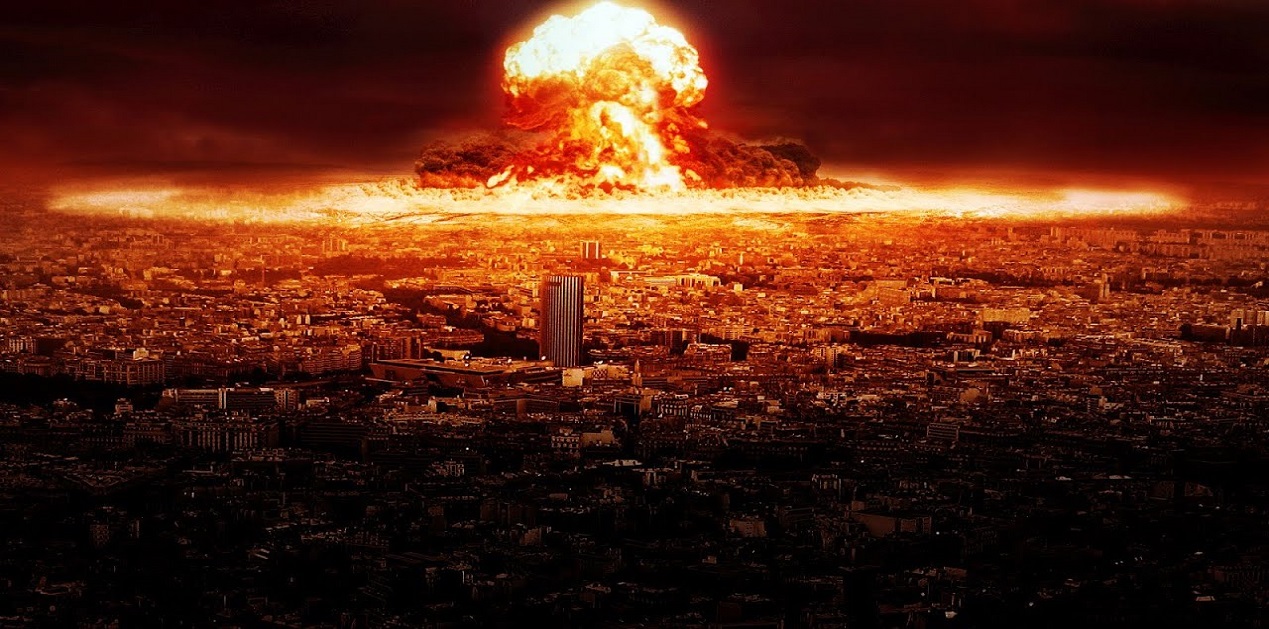
It has been fashionable to talk of the World War of 1914 as having resulted from sleepwalking by the European powers.
This, of course, is complete nonsense.
Any reading of British accounts, including the insider memoirs of the illustrious Cabinet Secretary, Sir Maurice Hankey, shows that there was a well-worked out and purposeful plan for a Great War on Germany – and indeed for the attacking of, and carving up of, the territories of Ottoman Turkey. And it was all part of something much greater in the British mind than a mere Balkan or European War.
Sleepwalking is a much more apt description for what Europe is currently doing in the Ukraine and against Russia.
Europe’s sleepwalking problem began at the Bucharest summit of April 2008 when Ukraine was earmarked to be a part of NATO’s eastward expansion. Angela Merkel accurately described this as amounting to a “declaration of war against Russia” that Putin would never stand for.
But Europe carried on regardless and proceeded to undermine the peaceful stability and development it had hitherto enjoyed by meddling in Ukraine in 2013 and setting off the course of events that has put it into sleepwalking toward general European war today.
It did this by attempting to take the whole of the Ukraine state – constructed by the USSR – away from Russian influence into its own orbit. It failed to heed Samuel Huntington’s observation that there were two civilisations that met in Ukraine and a balancing act had to be carefully maintained to keep them together within a single state.
Instead, Europe accepted Fukuyama’s assertion that there was the dawning of an end of history that only needed to be completed by the absorption of all backward residues of the old world by the inevitable progress of liberal democracy toward utopia. Europe, with North America, feeling it was its mission to mop up its eastern hinterland, threw its weight on one side of the Ukrainian scales and the rest is history.
I take it that Europe has no plan for a general, direct war, between it and the Russians, even though the direction of its sleepwalking takes it in that direction. The intention has always been to remain fighting from behind the Ukrainian skirts and letting them do the dying and suffering all the destruction.
But Europe and the UK, already provocateurs in the conflict against Russia since 2013, seem to have become emboldened by Washington ceding its direction of the war to them, after Trump’s return.
In a recent public speech, Ursula Von der Leyen announced that the European Union was explicitly allied with Ukraine as a participant in the war:
“In Europe, we already have huge technological and industrial capacity that can be deployed. And we have safe and secure production sites that can help to scale up. But we do not have that battle-tested knowledge and expertise that Ukraine has forged. So the point I am making is that we need to combine our strengths. Together, we can work on joint production.”
Kaja Kallas has called for the dismembering and balkanisation of Russia.
The constant and escalating provoking of the Russians that the UK and Europe is engaged in, involving among other things the direct targeting of Russian cities and energy infrastructure, seems to be based on the premise that Putin will not respond in kind.
Putin, of course, has always been a conservative and cautionary realist. He made only one bold move in recent history and that was in launching the Special Military Operation into Ukraine in February 2022. Most of the West, and indeed Kyiv, did not expect him to do so. It was evidently felt that they could threaten Russia to their heart’s content by marching NATO up to its borders with impunity. Putin would bluster but do nothing.
It did not seem to occur to them that they were altering the existing security order in Europe to Russia’s great disadvantage – something that was seen as existential by Russia and which could not be accepted by Putin.
When Putin warned them of the threat their behaviour was posing and offered to settle the matter through negotiations, they ignored him. In October 2021 Putin attempted to have negotiations with those mustering force at Russia’s borders through two letters sent to President Biden and the NATO chief at the time setting out Russian terms – no NATO in Ukraine and no heavy offensive weaponry on Russia’s perimeter. That was a reasonable position that should have been taken seriously.
When the intelligence services told the West that Putin was deadly serious, and was making contingencies for a military operation, the same people who believed they could carry on regardless could not bring themselves to believe it.
After the Special Military Operation was launched the narrative in the West was changed. The US congratulated its intelligence services for “calling it correctly” and said it had removed the stain of the WMDs in Iraq against them.
Once Kyiv was bolstered at Istanbul to fight, effectively checkmating Putin’s gambit to end the war quickly through a limited show of force and diplomacy, the West congratulated itself on a job well done. Russia had been lured into the quagmire of Ukraine with no possibility of retreat, without the fall of Putin himself – the main objective of the West for more than a decade. It could now be bled by the most extensive sanctions ever exerted and vast amounts of weaponry and intelligence assistance to Kyiv.
Little seems to have been learnt from this. The change of narrative, for the purposes of war propaganda, into one in which Putin made a terrible mistake in February 2022 left Europe forgetting that he surprised them by responding to their challenge – once placed in a bind.
The present writer was of the view at the time that Putin, when he made his bold move in February 2022, was mistaken in his criticisms of the conservative Stalin. The Russians had always fought most effectively in defensive mode within their own borders. Their armies had ended up in Paris and in Berlin as a result of effective defensive warfare. In the one partial failure Lenin’s army was only stopped short of Warsaw after the European/North American invasions of Bolshevik Russia in 1918/19.
Some people, including a Professor in University College Cork, revealed that Putin was concerned at the existential threat posed by the large build-up of Western Ukrainian forces in the east and a potential genocide of the Russian population in the Donbas. They described what Putin had done as essentially a preventative war, aimed at heading off a greater potential catastrophe for the Russian world, described by Huntington. For this reason, they noted, Putin had decided upon the Special Military Operation – a radical move which went entirely against his instinct as a cautionary statesman.
That, of course, is ancient history now. The wisdom of Putin’s decision will depend upon the outcome of the war and nothing else. We will never know what would have happened if he had stood idly by, or adopted an alternative approach.
Since the launching of the Special Military Operation Putin has confirmed he is a moderate and cautionary realist by his conducting of Russian operations in Ukraine, that he still hesitates to term a war.
The West has always ridiculed the idea of the Special Military Operation and the BBC has termed it “the full-scale Russian invasion” of Ukraine. That is despite the fact that, according to General Syrskyi, the present commander-in-chief of the Armed Forces of Ukraine, only around 100,000 Russian troops made up the “the full-scale Russian invasion” of the Ukraine.
That is the same size as Haldane’s British Expeditionary Force in Belgium in August 1914!
It never seems to have dawned on them that Putin’s reluctance to give it the term “war” may have been an indication that the Special Military Operation was meant to be a limited operation and there might be higher gears if the stage of “war” might ever be called for.
Putin had no desire to conquer the Ukraine; he never gave any indication he believed such a project was feasible; and he has certainly not attempted to do so in the 4 years of hard fighting.
In his July 2021 article, describing the Russians and Ukrainians as one people, Putin made it very clear that he supported post-Soviet Ukrainian self-determination, and only demanded respect from Kyiv for the diversity of its internal character – i.e., that it had a substantial Russian element within it – along with a non-threatening position toward its main neighbour.
Four days into “the full-scale Russian invasion,” in February 2022, negotiations begun in Belarus to end the Russian military intervention. This led to talks in Istanbul and a generous offer made by Putin to end the war.
Fiona Hill later revealed in Foreign Affairs that Zelensky was ready to accept Putin’s offer and a state of permanent neutrality for Ukraine.
However, Zelensky then walked away from the talks after Boris Johnson made his intervention – telling Zelensky, on behalf of President Biden, that he could be a great war leader, fully supported by the immense moral, economic and military power of the West. Or he could take his chances, alone, in making a shabby deal with Putin and face the hard men Ukrainian nationalists who had already threatened him and his family with death if he thought of compromise.
Denys Kieryev, a prominent Ukrainian negotiator at the Belarus talks, had been eliminated by ultra-nationalists in March 2022, reportedly for not being robust enough at the conference table. That was food for thought for Zelensky who then put on his military uniform.
When the West showed its hand at Istanbul, and Kyiv proved its willing instrument, Putin’s objectives changed, through necessity. His minimalist objective of intimidating Kyiv into good behaviour failed and Russia was drawn into a sustained conflict aimed at relieving Kyiv of territory containing the population it aimed to subjugate or clear. The objective then became providing for this population’s and Russia’s future security by digging in.
Putin has always aimed to confine the war he was bounced into to Ukraine, largely ignoring the Western provocations. And he has attempted to win it – unsuccessfully so far – through the minimal application of force against people he still sees as brother Russians – despite everything.
His policy against Kyiv has certainly not been that of the state of Israel toward the Palestinian people. The Palestinians are not seen as brothers, or one people with the Jews, by the Zionists.
Due to stubborn Ukrainian resistance and the West’s continued support – even after Trump’s attempted retreat – Russia has been forced into building up a much bigger army than Russia ever had since 1990. If Russia is now militarised it was from necessity not choice.
Although it has undoubtedly suffered considerable losses it now has a much better and battle-hardened army than anything that might have existed without the war in Ukraine.
This is the factual self-fulfilling prophecy part of Europe’s “Russian threat” narrative that runs parallel with the “Russian collapse” narrative.
Putin’s attempt to preserve the Russian economy from the war has now begun to become problematic due to the long-range Ukrainian strikes on the oil installations and infrastructure, facilitated by Western intelligence, weaponry and satellite technology. It is reported that the situation in Crimea is becoming critical for Russia. Certainly, supply has become difficult for the Russian population across land and across the Sea of Azov where Kyiv has shown its capability of destroying tankers with Western assistance.
Retired Western generals and analysts have recycled the “Russian collapse” story again – to keep Kyiv at the job.
Is it intended that this rhetoric, plus the attacks on Russian territory, should produce escalation from Russia?
The message that is coming out of the West these days is that its war objective, and why it is provoking Russia, is “to bring Putin to the conference table.” This is also what it has argued in relation to Trump continuing US support for Kyiv. It is necessary “to bring Putin to the conference table.” It is now a war for peace!
Nobody suggests this is a rather miserable objective, which is hardly worth the destruction the war has brought. Nobody states that it is an objective, if achieved, that would be likely to engulf Ukraine in civil war, since the driving force of Ukrainian nationalism would be very unlikely to accept such an outcome.
When Azerbaijan lost 20 per cent of its sovereign territory in the early 1990s it was seen universally as a humbling and humiliating defeat by Armenia that had to be reversed. But this seems to be the current war aim of Europe in relation to Ukraine!
Even if this is all hogwash it suggests European weakness to the Kremlin. And coupled with the increasing provocations this is the most likely way of producing an escalating situation.
Russia is organised around an understandable idea of existential threat from Europe, from historical experience. Europe, in all its different political forms, does not seem to be able to help itself in attempting to dismantle the big state of Russia to the east.
While Britain historically exerts a Balance of Power policy to prevent a concentration of power on the European continent, Europe aims to create a Europe of Russia, turning its eastern hinterland into small, divided and conflicting states that would be weaker in relation to Europe and could be manipulated in the same way as Britain did in Europe.
However, when Europe found itself on the verge of doing this in 1918-20 it realised what a bad idea that was and it suddenly had no idea what to do with Russia afterwards. This is clear from the Lloyd George/Churchill conflict of the period on the public record. General Thomson was sent to Baku, the great oil town of the world, with instructions to return it to Russia, once it had recovered from the Bolshevik virus.
Europe has found that Russia can do war economy at scale, if necessary, and it can absorb cost in a way Europe never can. Any required European mobilization for war is likely to produce mass protest and the destruction of the fair-weather European economies. Spending of 3.5 per cent of GDP on war production is already producing political crises in a number of European states and “increases” aimed to meet Trump’s magic number are being made up of ancillary economic measures (roads, railways, services and pensions) that could hardly have any effect on war making if bit came to bit.
The announcements of spending by NATO in Ankara are a very different thing to actual military capability. Trump knows that Europe and the UK are engaged in theatre and are attempting to cheat him.
The NATO conference at Ankara was a shambles of disunity. Erdogan’s gift of personally inscribed and loaded pistols to the heads of state was its most memorable and insightful act.
The situation Europe is sleepwalking into is this: if it succeeds in provoking Russia into a dramatic escalation of the war it will either have to put up – by mobilising for a general European war – or shut up – backing down ignominiously to the Russians, with very harmful consequences.
The West seems to have a very different calculation toward Russia than it does toward Israel. There is little doubt Europe would not provoke Israel in the same way it is provoking Russia. It knows that Israel would soon respond with murderous force if it was subjected to the same provocations the Europeans have made on Russia.
Europe, for all its demonisation of him, sees Putin as a soft touch and relies on that calculation being correct indefinitely.
The pertinent question now is whether Russia can win the war in Ukraine without ordering a general mobilisation, launching ballistic missiles at selected targets in Europe, or using tactical nuclear devices in Ukraine to create a permanent buffer zone for its own protection, giving the population time to leave. It has always been Putin’s intention to minimise the war and its general consequences. But others may not see it that way after 4 years of failure to finish the war in one way or another and the Europeans acting with impunity in organising attacks on Russia.
Putin is undoubtedly the most pro-European leader in the Russian political class. Europe is banking on the calculation that while he is in office it is probably safe from this kind of Russian response.
The war goes on: Kyiv has evidently learnt its lessons over costly counter-offensives and under General Syrskyi has settled into a more limited battlefield strategy, organised around defence and the use of drones to prevent large Russian attacks while striking at energy infrastructure deep in Russia. It has had to because Ukrainians are increasingly reluctant to sacrifice themselves just to win a seat at the conference table that would surrender Donbas to the Russians, at least for a generation.
Russia has increasingly targeted Ukraine’s military industrial infrastructure, its fuel stations, energy reservoirs and supply lines to choke off its military capacity at source – rather than just at the front. A large NATO arms dump sited in Kyiv was recently destroyed with massive explosions that shook Zelensky into making a public statement.
That is a strategically different approach by Putin, of recent origin. It is why the Ukrainians are so worried about their interceptor shortage, because its war production is being vitally threatened. Civilian casualties in Kyiv are still minimal with the worst being comparable to a very good day in Gaza or Lebanon during a “ceasefire.”
The “Russian collapse” narrative being presented in the Western press is false and serves as a diversion to the Western public. The real situation, instead, indicates that the war in Ukraine is intensifying to secure a decision of one kind or another.
In early May, Minister of Social Policy Denis Uliutin revealed that only 22-25 million people still live in Ukraine. Of them, at least 10 million are pensioners per the Pension Fund of Ukraine’s estimate in April.
To make matters even more concerning, UNICEF estimated last year that there are 6.6 million children under the age of 18, so taken together, that leaves just 6-9 million working-age adults left in the country. The World Bank’s latest data from 2024 estimates that males comprise 46% of the population, so that would roughly mean that Ukraine has only 2.76-4.14 million working-age males, a non-insignificant but unclear percentage of whom were either killed or permanently handicapped by the ongoing conflict.
If one accepts the Center for Strategic and International Studies’ early 2026 figure of 500,000-600,000 Ukrainian casualties, then this means that Ukraine only has between 2 million and 3.5 million working-age males at most.
On any metric Russia has suffered nowhere near the population losses and destruction Ukraine has – on the battlefield or behind the lines. Ukraine will take generations to recover from taking the road it took on Western prompting back in 2014.
Ukrainian Defence Minister Mikhail Fedorov revealed in January that over 200,000 men had deserted the front line and ten times more (2 million) were actively dodging the draft. For as active as the press-gangs of nationalists have been, Ukraine is struggling to replenish its extensive losses. This is why Kiev requested that the European Commission no longer provide refugee rights to military-aged men who flee to the bloc.
No matter. For the West the war is not about the suffering of the Ukrainian people, the loss of its territory and the destruction of its population – it is entirely about the bleeding of Russia.
Europe walked like zombies into Ukraine and they now sleepwalk toward European war. But this time they are bit players within something much bigger.
It should be remembered that in August 1914 European war was merely a transitional step between regional war and World War.
If anyone has a plan today it is the predominant power in the world, the United States – like its predecessor in 1914, Great Britain. It has a plan to hold onto its world predominance and is determined to do so.
A Great Game is being played by the US which takes in both the conflict in Ukraine – which it has now franchised out to Europe – and the war on Iran, which is actually the start of its pivot east, under Trump – a leader free of disabling moralism. It is all of the same movement in the world.
Trump has seen that the US wasting its resources against Russia in Ukraine is a ridiculous thing for a Great Power with bigger fish to fry. He understands that Europe/Kyiv tying up Russia in Ukraine is not detrimental to the US pivot east and can complement it. He cannot stop the thing started and given momentum by his predecessors, and maintained by Congress and the Europeans. He has more than enough on his plate to make peacemaking in Ukraine a pointless task.
The Iran war, presented as being about other things entirely, has now been shown to be a war for the architecture of global trade, upon which US predominance is built. The control of the Straits of Hormuz is its real issue.
The Great Game of which it forms part is about US power over global energy supplies and the maintenance of the economic system (the Petrodollar system) that facilitates continued US predominance in the world.
It is, therefore, a war for the frustration of the China/Russia Eurasian project of which Iran has begun to assume an important geopolitical part due to its location and substance among lack of substance.
It is a very similar gambit to Britain’s war on the Berlin-Baghdad railway a century ago.
In that period the Royal Navy controlled the maritime choke points of the global economy and Britain was determined to prevent Germany and the Turanian/Muslim world possess an alternative Eurasian economic development that would undercut the British economic and military predominance.
If we were to look for a particular parallel it would be in the Balkan Wars that preceded the World War of 1914 – something Roger Casement accurately described as a British Imperial attempt to cut off German/Ottoman Eurasian development at its Balkan chokepoint. The Serbians were described as the Guardians of the Gates, if I recall.
That is what the United States is attempting to repeat today.
The British counter to Eurasian development sparked off a World War a century ago and there is no reason to suggest why this shouldn’t be the case again.
It seems that we are in the preliminary stages of World War and all that needs to happen is for the touchpaper to be lit by someone or something.
As in 1914, there are multiple options.
Irish neutrality now becomes existential to prevent the state following the sleepwalkers to the abyss. Unfortunately, there is little clear thought about Ukraine, Iran or the world in the Ireland of today. It gives all the appearance of the Redmondite delusions of a century ago.
In such a situation, Casement and Dev become very relevant as a guide to action to those who wish to think about the situation. It was people who did, and prepared for it, that determined our history, while all else was swept away like tumbleweed.
 Pat Walsh