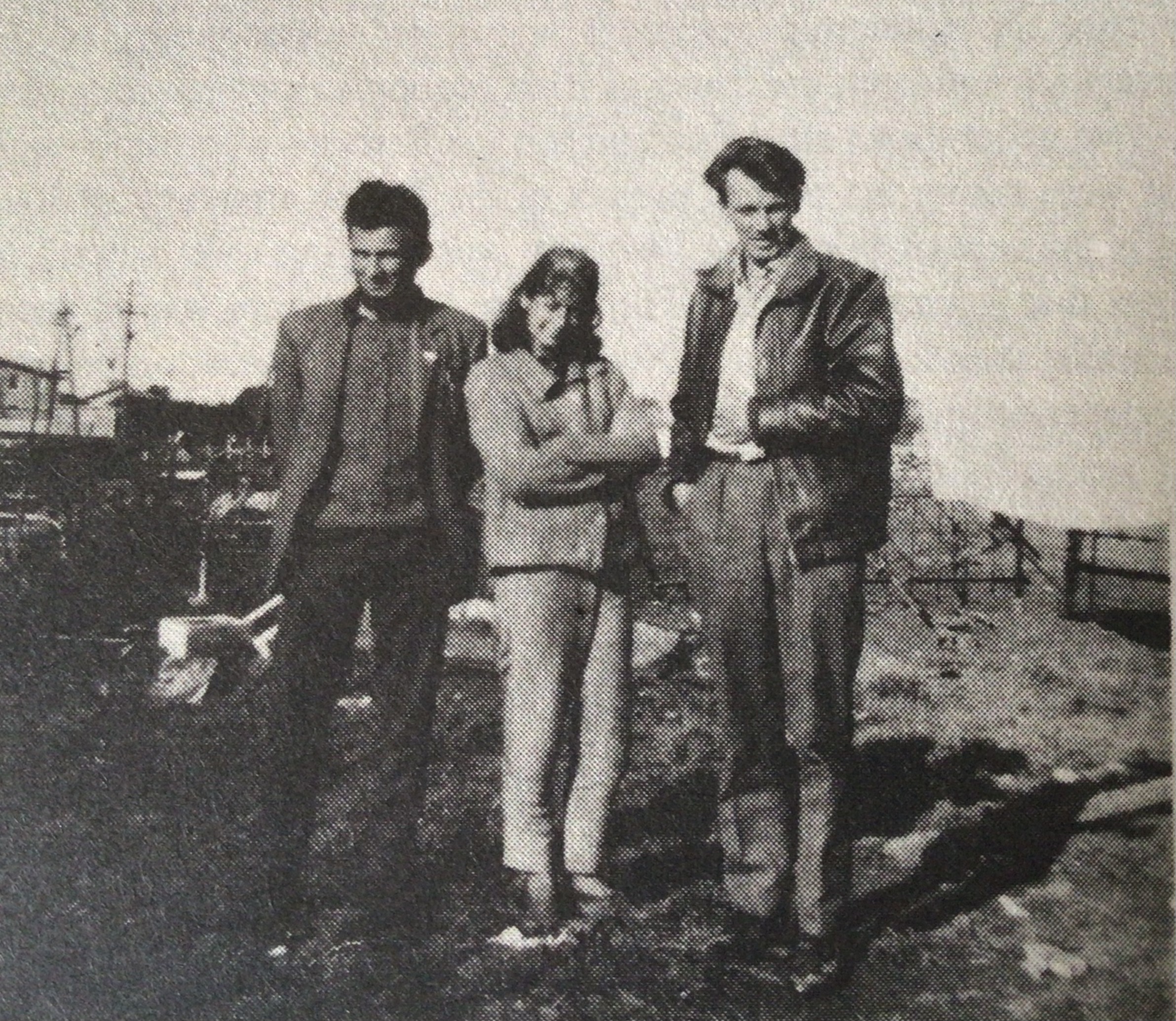
(Part 1 by Brendan Clifford appeared in Irish Political Review, April 2026).
In Part One of this article it was described how the Irish Communist Group was constructed in the course of discussions within a loose grouping of people drawn from a wide variety of sources on the initiative of Liam Daltun and Pat Murphy. Daltun was a Republican of the 1956 variety, who saw no future for pure and simple Republicanism, and was looking for a way of locating it in a socialist context. He had looked at the various kinds of organised socialism that were available and arrived at a view that was more or less Trotskyist in spirit.
Pat Murphy was Dublin working class and had become an independent thinker in the course of long hospital stays, resulting from botched treatment of a broken hip.
Others who took part in these discussions came from the Communist Party and Connolly Association direction, but were alienated from them by the way they defended the Russian invasion of Hungary in 1956.
The discussions were held in the first instance in the London offices of Ted Grant’s Trotskyist organisation, which did not have a name but later became very well known as the Militant Tendency.
I think it would be fair to say that those meetings were patronised by English Trotskyism, which was then getting into its stride. It was a kind of envious patronage. Revolution could not happen in England, but, with the Irish, one never knew what might happen.
It was true, of course, that Ireland was priest-ridden, and that the Irish who wanted to be socialist had to go to England. But priestcraft was an outmoded system of state. It had become brittle and it might break up at any moment. Look at France—which was dominated by the priests until the moment when the Great Revolution erupted and blew them away.
Something like that was how Ireland was thought of in England when I went there in the mid-1950s. It was the under-lying view of both the Communist Party and the Trotskyist organisations.
And I think it was that prevailing view of the Irish that enabled the discussions that led to the formation of the ICG to go on for so long on the ‘no man’s land’ between the two.
The meetings gradually took on a formal character, with Trade Unionist (ETU) Gerry Golden as Chairman and Angela Clifford as Secretary. It was arranged for a magazine to be
published at regular intervals. If material could not be supplied for the magazine, there would be no point in continuing the discussions. One-off declarations of principle, followed by silence, would be of no consequences.
But what was there to be said when nothing was happening in the society? Gerry Golden insisted that it was never the case that nothing was happening. There was always something to talk about, therefore there was always something to write about.
Big events were brought about by a succession of barely discernible little events.
And he insisted that there was no use in just knowing better than the bourgeoisie—it was necessary to engage with what they thought they knew.
The magazine was called An Solas (The Light)—an Enlightenment title. I don’t recall that there was anything notable in it.
I suppose it was when the group finally sorted itself out with regard to the Russian revolution, on the understanding that Lenin’s Party applied itself after his death to the project for which he had constructed the Party, that the name of the magazine was changed to The Irish Communist. But I suppose we also had the shock effect of that title in mind, and were interested to see its effect. The combination of Irish and Communist could be seen—under the received understanding—as paradoxical.
The production of The Irish Communist as far as I recall—and I printed it on a hand-operated duplicating machine in the rented room in which I was living—was sixty copies. Its only sale was on the streets.
The public response, was a kind of puzzled disbelief, that was lacking the conviction necessary to throw you in the Liffey (as we were told we would be!). Very often people would say Irish Communist—a contradiction in terms!). I happened to be selling it at the GPO when an arrest was made. I was taken to Store Street Garda Station and questioned by a plain-clothes policeman who turned out to be the famous Lugs Brannigan, well-known for beating up suspects. He had taken me in for questioning following a public complaint, but then he didn’t seem to know what questions to ask. I was willing to help if I knew what his problem was, but I couldn’t see the problem. So, after a short while, he just told me to go away. And that was how Communism came to Dublin.
This was, I think, my first experience of urban Ireland. In my small corner of rural Ireland, where I was a labourer in a Creamery, I was known to have read Marx’s Capital, and I discussed this, and anything else that came to mind, with the people I worked with. I found out later that, when I left, it was assumed that I had gone to Russia (still Communist at the time!). I never had any notion of going to Russia. It was the last place—other than the United States—I would have gone to.
And I did not leave Sliabh Luacra because I was pushed out as a Communist. I left in 1957 because I saw that institutions of the Church Militant were beginning to encroach on Sliabh Luacra from the Metropolis. They were being held in check by local resistance for the time being. But I learned that an attempt was made to raise my suitability with the shareholders of the Creamery—120 small farmers who all knew me. That attempt came to nothing. But I could see that the Church Militant, securely based in the cities, was intent on extending its network of lay organisations around the country. So I decided not to wait—life in the townlands along the Old Road between Boherbue and Knocknagree had been pleasant and interesting until then, but all good things come to an end . . .
I should say that the only Communist tract I had read, before taking part in the discussion group launched by Pat Murphy and Liam Dalton, was the one written by St. Thomas Moore—the chief Catholic martyr in the English Protestant revolution.
*
There was an ICO Branch in Dublin because Pat Murphy returned to it from London—as did Michael Murray, who was on the run from the Royal Navy, and who escaped capture after information was given to the police about him by the super-revolutionary Géry Lawless (who operated in the shadow-land between revolution and counter-revolution and enjoyed a quixotic relationship with the police).
In Dublin, Murphy became involved with Dennis Dennehy from Kerry—who was intent on doing something drastic about the homeless situation in Dublin— and did so with considerable effect in his Hunger-Strike agitation in 1968/9. This sparked off a supportive agitation in Cork led by Jack Lane.
Murphy also struck up an acquaintance with Hardial Bains, who had organised a student revolutionary movement in Trinity College that was partly based on a cult of himself and on an ingenious system of ideas which he had woven and propagated in the University. The group was called the Internationalists and was committed to engaging in spectacular defiance of the status quo, regardless of consequences.
The first notable act of the Internationalists was to spoil the State Visit of the King of the Belgians by demonstrating against it [on account of its continuing colonialist involvement in Africa, ed.] The Irish Government was thin on foreign relations. It was the odd man out in Europe, not having committed itself to either side in the all-absorbing “Anti-Fascist War”, and having served as a refuge for the defeated in 1945. And public opinion within it determined that it should in effect be a Catholic state, even though the Church hadneither Constitutional nor property-based power within it.
Belgium was the other ultra-Catholic state. It was Catholic because there was no Belgian nationality—only an alliance of French and Dutch who had seceded from the very Protestant Netherlands on the ground of religion. As well as that, this absence of nationalism led to accommodations being made during World War 2, which made it prudent for some people to get offside in Ireland after the War, where they earned their keep by founding successful businesses.
I assume that these things lay behind the official State Visit. But the Internationalists had no concern with that.
Their business was to spoil the show. Pat Murphy, who was ‘uneducated’ through
being physically disabled and had spent much time in detached reflection on the world, soon got the hang of the jargon used by Baines and persuaded him that
his movement needed grounding, and the place to ground it was the stolid working
class movement which was in need of an injection of spirit. I had little to do with Bains personally.
I knew him only through Pat’s understanding of him. And I doubt that he knew that what he meant was what Pat said he meant until Pat suggested to him that that was what he meant! Anyhow, the Internationalists became involved in Dennis Dennehy’s homeless agitation. And so did the past generations of Republicans as Dennis’s Hunger Strike approached crisis point on the 50th anniversary of the Declaration Of Independence by the First Dail.
The ICO and the Internationalists stirred up a protest on the streets. The protest was on a mass scale, in line with the severity of the Hunger Strike, when the Dail met to celebrate its half-centenary. Dublin city centre was brought to a standstill as the Dail was reminded of the Social Programme with which it had begun.
The Government needed to find a way of getting Dennis out of jail, but he refused to collaborate with any subterfuge or evasion of the law, and the Government was inexperienced in handling social, as distinct from Constitutional, dissent.
Dennis was eventually got out of Mountjoy to live in a Caravan in Mountjoy Square. He became a Dublin folk hero, and was courted by Very Important Persons.
He declared that he was a Communist and published a pamphlet on Engels and the Housing Question. Das Kapital Study Groups sprang up in the Housing Estates. And there was an extensive overlap between the ICO and the Internationalists, which led to a decline of the Internationalists as many of them became members of the ICO.
Len Callender, a Trinity student who was, I think, Baines’s second lieutenant, joined the ICO and moved to Belfast, where he established a Branch with Tommy and Micky Dwyer—staunch working class Falls Road Republicans—as well as some students drawn from Queens University by way of the Internationalists.
During those months of 1968-9, while these things were happening in Dublin, events in the North were ripening towards the rupture of August 1969. If the Southern movement had converged with the Northern movement of 1969, the course of events could have been very different!
The Civil Rights Association had launched a Constitutionally bland agitation for One Man, One Vote, as well as for Fair Employment, fair allocation of public housing, and an end to gerrymandering in Local Government. Its demonstrations became confrontations. Its demands were formulated with the British public audience in mind. No account was taken of what Northern Ireland was.
It was put to me, in the early Summer of 1969, by one of the managers of the London-based New Left Review, that the ICO should become involved in the Civil Rights agitation. He explained that it was not really the bourgeois reform movement it appeared to be. The peculiar conditions under which Northern Ireland was governed made reform revolutionary.
The assumption of the radicals of the Civil Rights Association was, in the light of what the ICO had been doing in Dublin, that it was revolutionary. It wasn’t noticed that the homeless agitation was conducted in support of an implementable demand, even though the mode of agitation was drastic!
The CRA demands, insofar as they concerned public affairs, were implementable in principle within the existing constitutional system, but the purpose of those who pressed demonstrations towards confrontation was to break the system. And the effect of breaking the system would be to bring into the open the raw antagonism between the Protestant/Unionist majority and the Catholic/Nationalist minority.
Sinn Fein/IRA was in this period engaged in remaking itself from the ‘Government of the Second Dail’ into a kind of revolutionary/Constitutional party under the Treaty, and it was expelling members who were not willing to break with the Second Dail. It was in future to be a socialist class-war organisation. At the end of 1969 the class-war Republicans split off to become the Official Republicans, and the expelled Second Dail Republicans became the Provisionals. But in August, when the Civil Rights provocations of the Unionist Stormont Government brought about the explosion, there existed neither Officials nor Provisionals in any active sense.
As confrontations sharpened in the North, the class-war Republicans in Dublin seemed to forget what they had become—or were intent on becoming! Their Chief of Staff issued a warning to the Stormont Government that, if it did not impose order on its adherents, he would send his Belfast Brigade into action! The Loyalist storming of West Belfast followed immediately.
And there was no Belfast Brigade. In mid-August the IRA was absent as a defensive force, and the Provisional organisation had not yet been formed. In Derry the defence of the Bogside was organised by Catholic ex-Servicemen of the British Army, and in Belfast the only organised body of defenders was the ICO—which had become unexpectedly substantial because of its homeless agitation during the preceding year. Its Branches in Dublin, Cork and London did what was necessary in one way and another to give back-up to the Belfast Branch.
The ICO then, under the impact of the August events, set about separating the issue of the subject status of the Nationalist minority in this area of the British state under the strange “Northern Ireland state”, from the issue of Partition.
Pat Murphy had challenged Desmond Greaves of the British Communist Party and of the Connolly Association about this. Also Dennis Dennehy had been mulling it over during the housing agitation and thought that a case should be made for the Ulster Protestant community. And I had taken a look at Belfast, getting a degree of insight through the brother of Shankill Road’s Gusty Spence—who had married a Catholic—and through a group of members of ‘The Communist Party, Northern Ireland’: who I could see were irritated by the complicated artificiality of the explanation of things which the Party had adopted under the influence of Desmond Greaves.
But, basically, I trusted the appearance of things I saw on the streets. The least that can be said about appearance is that it exists! So I wrote an article for the September 1969 Irish Communist about the Two Nations. (For the August issue, in order not to contribute in any way to the agitation that was gathering force, I had written an article on Kant & Hegel On Contradiction!)
I did not see anything theoretical in that statement that there were two nations in Ireland. I saw it just as a statement of obvious fact. And it was widely taken to be a statement of obvious fact—but as a fact that should not be noticed, or, if noticed, not stated.
Brendan Clifford
To Be Continued…

