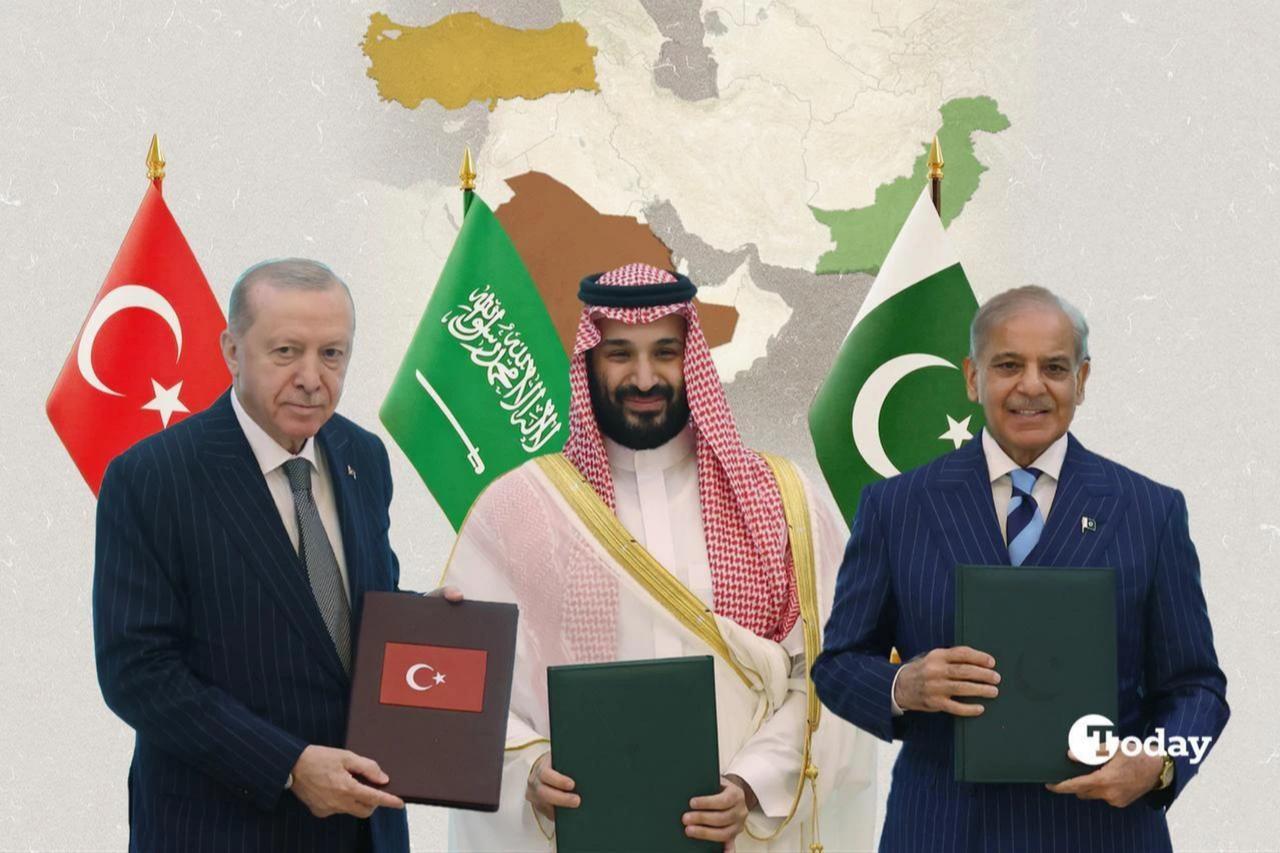
The Mecca Joint Defence Agreement – the pact between Pakistan, Saudi Arabia and Turkiye signed in August – has been described inaccurately by Andrew Korybko and others as “the Muslim NATO”.
This is nonsense, since the orientation of it and the reasons for it have little to do with Russia.
Tariq Ali has described it as an anti-Houthi alliance.
George Friedman, more accurately, identified its cause as Israel. Friedman in the most accurate Western analysis described how it “threatened” Israel as follows:
“With this agreement, a massive new potential threat emerges. Turkey and Pakistan have massive militaries, and Pakistan also is a nuclear power. The Saudis can underwrite any military expansion, and in the long run, if it works, the Mecca agreement (which is likely to include Egypt in the future) will become an organizing force in the Middle East with both economic and military power. It can over time organize the region and empower it. Under these circumstances, if hostility toward Israel continues, Israel’s ability to act preemptively declines dramatically, and should the alliance choose to attack Israel, its lack of strategic depth will make defense much more difficult. Though Israel has advanced military systems, the Mecca agreement may well lead it to have equally sophisticated and larger forces and the time to create them.”
Friedman went on:
“Israel has two choices. One is to seek to disrupt the alliance in some way, military or political. If an attempt to disrupt it fails, it may lead to a much stronger alliance. The second choice – what I see as the safest approach – is to reach an accommodation with the alliance, as there are far more constraints on Israel’s ability to increase its power, given its geography, while the alliance’s ability to expand its size and force is far greater. Time is not on Israel’s side, nor is the strategy it has used since its founding likely to remain effective. The evolution of the alliance, if it holds, outstrips Israel’s ability to evolve. Therefore, the logic is to reach an accommodation with the alliance while the correlation of forces gives Israel some advantages. The nations of the alliance are all formally hostile to Israel, but none has ever gone to war with Israel, while the Saudis have in the past been cooperative with Israel to some extent.
It is my view… that Israel is in a very dangerous circumstance that becomes more dangerous over time if the alliance holds, which I think it will. I think such an evolution is possible despite the formal hostility of these nations (but with very few hostile actions taken) toward Israel. The fundamental question is whether Israel’s political system can appreciate the new reality and take steps to reach an accommodation with an alliance that would accept, but does not profoundly need, such an agreement. In the long term, I do not see Israel having any other choice if the alliance holds.”
These are mainly Western perceptions, of course.
The Mecca Alliance has actually come about due to a number of national strategic factors outside of Western narratives. The West – mainstream media and alt-media alike – do little to understand the world that exists outside its interest and shoehorns caricatures of the bulk of humanity into its categories of thought, which have become more limited as it has proclaimed its belief in diversity.
Let us take the parties to the Mecca Agreement one by one.
Saudi Arabia has been feeling abandoned by the United States and its cousins in the United Arab Emirates. Mohammad Bin Salman feels let down by Trump and Kushner. The US failed to defend Saudi Arabia from Iranian retaliation after Trump launched his war on Iran in conjunction with Israel. Trump showed also that the US has a much higher priority in defending Israel than it does in defending the Saudis and the Gulf Arab states.
The Saudis and their pipelines are also under pressure from the Houthis in Yemen after their military intervention. The US also seems unwilling to help them out there. Trump demanded normalisation of relations with Israel in return for assistance in nuclear technology. The Saudis refused and he has decided to let them stew.
It was this worsening situation that meant the Saudi ruler had to do business with the Muslim Brotherhood inclined Erdogan. The Kingdom is under threat. Turkish and Pakistani military technology is what Saudi Arabia wants in this situation, in the absence of US support.
Pakistan is facing multiple insurgencies on its Afghan border, particularly by the TTP. The TTP is being backed by the Taliban. Pakistan aided the Taliban in order to produce a friendly government on its western border. Now they have found the Taliban, fresh from their victory over the US, have ambitions across the Durand line. The Taliban released the TTP guerrillas from prison after taking Kabul after the American flight. Pakistan’s nuclear status and large army is useless against the type of warfare it has been facing in Waziristan. It does not have US power to degrade the TTP anymore.
The idea of the Mecca Agreement probably originated in Turkiye. The Turks have seen a coalition being organised against them. This coalition consists of the Greeks and Israelis, and the United Arab Emirates – as well as the Armenian lobby in the United States.
The Turks are particularly worried about the Mediterranean, where energy disputes are getting hotter and where the Israelis are moving into Cyprus and making arrangements with the Greeks in anticipation of a future confrontation with Turkiye. The recent UN appearances of Netanyahu and Erdogan contained diplomatic shots of a developing conflict, in which the Israelis are weaponising the “Armenian genocide” allegations to both isolate the Turks and cover up their own genocidal activities.
The Turks realise they cannot confront this coalition on their own. Erdogan wants to build broader alliances. He also needs Saudi money for the Turkish economy.
The Turks wanted Egypt to be part of the alliance to give greater security in the Red Sea and combat the Israeli drive toward Somaliland and toward the Mediterranean. However, the Saudis vetoed Egypt.
Another notable absentee is Azerbaijan – presumably a natural partner to Turkiye. Is this because Azerbaijan is Non-Aligned and views Mecca as an alignment? Or is it to do with its relations with Israel? Certainly relations between it and the Turkish brothers are not good at present over the Israel issue and the exclusion of hijab wearing girls from Azerbaijan’s schools.
In essence, the Mecca Agreement is an alliance of convenience in which nobody trusts anyone else. There are too many conflicts of interest. It is unlikely that any part of it will come to the aid of any other – NATO Article 5 like. NATO worked because it had a dominating predominant Power with allies in submission to it, politically, economically and militarily. With that power lukewarm about NATO and insisting its minor allies take more responsibility it has become brittle and more dangerous.
The Mecca alliance cannot assume such a character with each party being independent entities that formed through struggle in one way or another and which can exist without the other. It is more like an agreement in which each state has something to offer the others that may provide better each with more effective individual security, rather than collective security.
Trump welcomed the Mecca Alliance initially, but his advisors were completely against it. They told Trump that it was a dangerous development and was a sign of US weakness and he should not support it.
His advisors are also strongly intertwined with Israel and they are not happy at all at the sudden appearance of a semblance of Muslim unity and the slimmest potential that the Muslim world might make something of itself in the wordly sphere.

