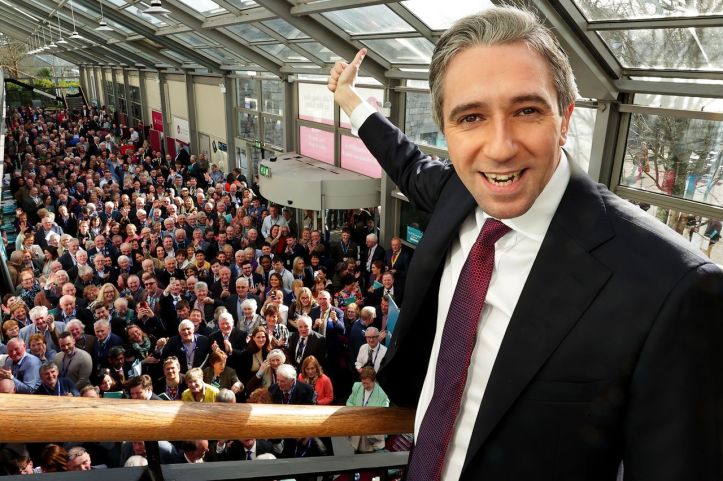
The new Taoiseach, Simon Harris, has stated that Irish unity is not his priority. It is merely an aspiration – as opposed to a policy. He has, therefore, returned the Irish state to the policy of De Valera.
De Valera was conscious that ‘Northern Ireland’ had an ulterior motive as far as the British were concerned. It was distanced from the British body politic not only to keep Ulster politics in a form of quarantine from Britain, but also to act as a lever on the new Southern State. It was established as something Dublin could attain, given good behaviour in relation to Britain. Britain understood that the lost Fourth Green Field was Ireland’s heart’s desire. Through good behaviour this Fourth Green Field, held in bondage, would exert another form of bondage on Southern minds. As Pharaoh said: “You may go! But you won’t go very far.” And if you do, you will not have your Fourth Green Field, which will remain in bondage.
Northern nationalists have been naturally perturbed by the statement of the new Taoiseach. They have compared Taoiseach Harris unfavourably with the previous Taoiseach, Leo Varadkar, who had said something about seeing a united Ireland in his lifetime. John Manley the political correspondent of the Belfast Irish News said that
“Mr Harris, it would appear doesn’t even care about talking the talk, never mind walking the walk. While his predecessor insisted no Dublin government would ever again leave the North behind the newly appointed Taoiseach suggests that he has already abandoned his compatriots. By being tone deaf to Northern nationalism and consistently side-stepping the constitutional question he will only foster resentment north of the border, which may well prove contagious in the Republic.” (Irish News, 10.4.2024)
We doubt it very much. The new Taoiseach’s statement may foster resentment in the offices of the Irish News but it is unlikely to have much impact outside in the Catholic community, who have long ceased looking for deliverance from the South.
There was a time when the only place that Northern Nationalists looked for deliverance was from the South. That time ended around May 1970, as a result of Jack Lynch abandoning the Northern Catholics in the most dramatic way, and washing his hands of them, by putting the executors of his own policy on public trial, accused effectively of treason.
From around 1921, when Michael Collins visited the North and held out the hope that the Northern statelet would be an abortion, the Northern Catholics looked South for deliverance. Collins himself let them down in dramatic fashion in 1922 when he encouraged a Northern offensive and mysteriously subverted it. The Northern IRA stayed loyal to their chief, despite this, following him into exile before Collins departed the struggle in a misadventure at Béal na Bláth.
This lasted for about 50 years. During this period the Northern Nationalists lived their lives firmly within an anti-partitionist narrative, waiting patiently for something to turn up from the South.
They could do little else since any possible breakout from their predicament to an alternative destination was rendered impossible by the boycott of the British parties of state and the detachment of ‘Northern Ireland’ from state politics. They were, thus, imprisoned in ‘Northern Ireland’ with only one means of escape.
During the 1960s a sudden external intrusion into ‘Northern Ireland’ changed everything. This was the Civil Rights Movement. Civil Rights was a blow-in from the United States, with the events in Paris 1968 providing a radical froth to the new brew. It came from an extraordinary radical time of global proportions, connected to the Vietnam War and the protests around it transmitted via the new popular medium of Television.
The Northern Catholics were thus prompted into mass activity by what they saw in the world around them – other people no longer buckling down under forms of long-standing oppression and taking it upon themselves to do something. They were inspired into action and upon being inspired a momentum developed that could not be easily stopped.
The Civil Rights agitation gained purchase because the Irish Taoiseach had encouraged the Nationalist Party to play the part of an Opposition at Stormont and thereby put its democratic pretensions to the test. The Lemass/O’Neill initiative raised expectations of reform which could not be possibly met within the perverse system of Stormont, which could only reproduce one party government for eternity. It seems that both O’Neill and Lemass had limited understanding of the system they interfered with. The existing political structures of Northern nationalism were publicly humiliated by the charade of Opposition, encouraged by Lemass. And that made the Northern Catholics ripe for a revolutionary development from outside.
The old anti-partitionist agitation had got nowhere and was discredited and the equal rights agitation produced a revolution. It did not alter the basis of the conflict in the North – which remained Union versus United Ireland – but it brought the masses into confrontation through the new form of street politics imported from abroad.
This all provoked the seminal events of August 1969.
The Civil Rights Movement wrong footed everybody. The Ulster Unionists reacted to it as if it were an IRA insurrection, treating it as such. In doing so they eventually helped make it into one.
The British State was also caught on the hop by the demand of British citizens to have British rights. Surely that was reasonable, although the thing that maintained Westminster’s policy in the North, the Unionist Party, told them this was nothing of the sort. The demands of Civil Rights could not tackle the crux of the problem, which was the perverse form of government in existence in ‘Northern Ireland’. When these civil rights were conceded there was barely a cheer from the Catholics and the conflict intensified rather than diminished.
It was Dublin, however, that was wrong footed the most. It initially attempted to take in hand the new movement, channelling it away from “British Rights for British Citizens,” toward a more traditional anti-partitionist direction.
Captain Kelly wrote his intelligence reports warning the Dublin government that something was stirring in the North that might take on an existence that could no longer be controlled and resolute and purposeful action was required to manage it carefully, by engagement with it. And that was the policy Dublin pursued from August 1969 to May 1970, until Jack Lynch subverted it, under pressure from the British Ambassador.
Taoiseach Lynch’s subversion had the effect of subverting the long-term dependency and subservience of the Northern Catholic to the Southern State. Abandoned by Dublin in the most public way, the Northern Catholics were forced to stand on their own two feet, producing something of their own, for the very first time.
That thing which was produced – or improvised – was the Provisional IRA, which waged war for 28 years, and in turn produced Provisional Sinn Fein, to wind down that war. After the 28 years of warfare, it concluded a peace settlement with the British Government short of its formal objective of a British withdrawal, but which enabled a disciplined retreat from the battlefield and put the two communities in ‘Northern Ireland’ on an equal footing.
The conclusion of the war, and the peace agreement, was concluded during another extraordinary time, when the United States was doing some housekeeping after its victory over the USSR in the unipolar moment. It was attempting to sweep away the residues of the Cold War period in South Africa and the Middle East (Oslo Accords) and Sinn Fein saw its opportunity in using US pressure at an opportune time to conclude a settlement on favourable terms which would transfer the momentum of the war to politics.
That unipolar moment, and the US productive activity associated with it, quickly passed as Washington returned to geopolitical business. So like 1967-9, 1998-2001 was an extraordinary interlude in the normal run of things both globally and in its impact on ‘Northern Ireland’.
The Irish News talks about there being “a Constitutional imperative” for the Southern State to have a United Ireland policy. Have they forgotten something? In 1998 the Constitutional imperative was abandoned, with the permission of the Provisional IRA, and replaced with an aspiration towards unity by the South, within the framework of the provisions of the Good Friday Agreement. The Constitutional claim had wrecked a settlement in 1974, a decade prior to 1998, and Dublin had learnt its lesson and no longer rode the effort North of the border.
Taoiseach Harris’s position is welcome compared with the mindless United Ireland provoking of Unionists which Fine Gael Taoisigh over the years have periodically indulged in, to nobody’s advantage.
It is very doubtful if the West German State ever had a policy for German re-unification. In any case it came about, very unexpectedly, as a result of an extraordinary external event – the collapsing of the will of the Soviet Union to maintain its Western buffer-states through the policy of its last General Secretary, Mikhail Gorbachev. Chancellor Kohl read the situation, saw his opportunity and pushed for it with all his energy. It was accomplished through will, rather than planning.
Is it unreasonable to expect that if Irish unity comes about it will also be through such an unexpected event and that aspiration is, therefore, more functional than policy?
PUBLISHED IN IRISH POLITCAL REVIEW, JULY 2024.
‘Captain Kelly’s Intelligence Reports, August 1969-January 1970’ by Angela Clifford is available here.
 Pat Walsh
excellent summary. However (maybe for reasons of space) it left out the unionist supremacy, anti-catholic and anti-irish aspects which made NI a cold house for everyone but Unionist supremacist bigots
LikeLike
Very interesting Pat.
<
div>
<
div dir=”ltr”>
<
blockquote type=”cite”>
LikeLike