President Bashar al Assad has gone, but the problem of governing the state of Syria remains.
The Western media (and its alternatives in the Western alt-media) have described the fall of President Assad as an “overthrowing.” It was nothing of the sort. Assad was not overthrown. He was, in fact, fired.
The circumstances of the fall of Assad all indicate this. The Syrian Arab Army melted away, quite suddenly, after initially putting up a fight. It had no stomach for another round of conflict after a decade of hard fighting and it disposed of its uniforms and equipment, complaining that its commander-in-chief had deserted it. Iran and Hezbollah, both in Lebanon and Iraq, did not come to the Syrian government’s aid, after earlier threatening a powerful response against the rebels. Syrian officers were astonished at the “treachery and betrayal.” The rebel army surged southward from Idlib, unopposed, and the Assad regime collapsed like a house of cards.
It was all like choreography, with everyone acting parts that had been written for them and which they were prepared to play upon the giving of a signal.
The man who gave the signal and did the firing of Assad was President Putin of Russia, who kept the last of the Assad dynasty in power, and whose armed forces were the main support for his government, but which were now required for more important business elsewhere.
Soviet Russia and Syria had had a close working relationship from the time of the ascension to power in Damascus of Hafez Al-Assad, in 1970. A Treaty of Friendship and Cooperation was signed in 1980. The Soviets built up the Syrian army and security forces and much of the country’s infrastructure during the 1970s and 1980s. In return Al-Assad gave the Soviets use of the ports at Tartous and Latakia, so that the Soviet navy could project itself into the Mediterranean.
Independent Syria had been constructed at the end of the Second World War after the Vichy French departed. The state bore the character of some of its architects – a combination of Nazis who fled there and offered their services and then a group of East German communists, working with Egypt.
With the fall of the Soviet Union Yeltsin completely liquidated the Russian/Syrian relationship, reorientating Russia’s friendship toward Israel, enemy of Syria. In 2005 Russian/Syrian relations were restored under the son of Hafez Al-Assad, Bashar Al-Assad, and President Putin. Both countries saw advantages in this. Syria was under pressure from the US and Israel and Russia had arisen under Putin, from its downfall, and sought to reassert itself in world affairs.
This relationship strengthened and it made Syria the target of Washington in 2011, when the West was presented with the opportunity of the “Arab Spring” to destabilise the country and unseat Assad, evicting the Russians. The other target of the “Arab Spring” in Syria was Iran’s spreading influence in the region, and its leverage through Hezbollah in Lebanon, which the United States had itself helped to spread when it decided to destroy Iraq in 2003. Syria was the strategic intersection between Iran, Shia Iraq and Shia Lebanon.
Washington was the major instigator of the Syrian civil war in 2011-12, turning protests over a drought and Basher al Assad’s economic reforms into an insurrection against the government. After a while it was aided by Britain, France, Saudi Arabia, Israel and Turkiye, for various reasons. Assad himself fuelled the insurrection by meeting the Damascus Spring protests with great force and emptying the prisons of jihadists to poison the opposition and overwhelm the moderates. All this helped create the Al-Nusra Front, organised by Abu-Mohammad Jolani, which became the most effective fighting force in the insurrection.
At the moment of truth in 2015, after 3 years of war, Washington failed to follow through with the required military intervention needed to tip the scales for victory. President Obama, under pressure from the neo-Con Democrats, and aiming to avoid being pushed into another forever war, had declared a red line over the use of chemical weapons by Damascus. And a “chemical weapon attack” mysteriously occurred in the immediate aftermath of Obama’s statement. Who did it is unclear but it was the insurrectionists who had the strongest motive. There was sufficient scepticism, both in the UK and the US, after the Iraq war WMD fraud, for both states to avoid intervention by using their legislative chambers to then block direct intervention in the war – an unusual occurrence. Obama is blamed today in the Washington foreign policy establishment for showing American weakness to the world and compounding the debacle for the West in Syria.
And then Russia stepped in, during 2015, after persuasion by the Iranian leader Qasem Soleimani, to turn the tide of the war in the Syrian government’s favour. This was the turning point because even with substantial military support from Iran and Hezbollah, Assad was unable to stabilise the situation. After Russia’s decisive intervention Soleimani and Hezbollah’s Nasrallah reorganised the Syrian government’s defence on the ground, beneath Russian air power. Iran spent around 30 billion dollars over the next decade supporting Damascus.
After being checked by Putin, Washington settled down to being an obstructor of peace and stability in Syria, covertly funding and arming Kurds and Jihadists, and provoking the growth of ISIS. Its actions had great effects in Europe, producing a number of serious terrorist outrages and a massive wave of migration to Turkiye and Europe, which fuelled the growth of far-right politics across the continent and probably gave the edge to the Brexit vote that removed the UK from the EU.
All of this should not be forgotten when the US claims credit for Syria.
When Russia had brought Assad to the verge of victory in 2018, after the defeat of ISIS and the driving of the Sunni opposition into Idlib province, Putin urged the Syrian President to construct a new professional army and end the debilitating corruption in his army, in which senior officers regularly took a large slice of the pay of their men. But Bashar Al-Assad was not the stuff of his strongman father, who built much of the state and ruled it with an iron fist. He was a cultured London optometrist who had inherited the repressive apparatus of state by accident after the unexpected death of his elder brother who had been the son groomed to take over from his father. Bashar baulked at the challenge of putting discipline on those who had fought the war bravely for him.
President Assad and Putin also refused an Iranian offer to reinforce the Syrian army because an agreement had been made with Israel not to allow the country to become an Iranian base for operations against Israel. This curtailing of Syria against Israel was very much a normal Russian policy toward Damascus. It was evident in the 1973 war when the Soviets refused Hafez Al-Assad the superior weaponry which would have given the Syrians the edge against the Zionists. Putin continued the Russian policy of curtailing Syria and Iran against Israel, allowing Israel to bomb Iranian/Hezbollah forces in Syria at will. Russian air defence systems were reserved exclusively for Russian protection and Israel sensibly refrained from attacking Russian assets in the country.
The Astana peace process after 2018 bought the Damascus government time to find an accommodation to finish the conflict. The moderate Arab states and Turkiye all desired a solution which would include Assad. But Assad is reported to have begun to play games and he was viewed increasingly with suspicion by Russia and the “Axis of Resistance” in his new dealings with Saudi Arabia, the Gulf States and even the West.
Assad had turned to the mass production of Captagon, an addictive, amphetamine-type stimulant, to replace the revenue lost by US sanctions, and necessary to the continuance of the Syrian state and its defence. 80 per cent of global production of Captagon was brought to Syria and it was then smuggled to the Gulf states, where it caused a wave of addiction. Bashar’s brother ran this business. That turned the narcotic substance into a bargaining chip for al-Assad in talks that led to the Arab League reinstating Syria’s membership in 2023, as Saudi and the Gulf states looked to curb the illicit drug trade by bringing Syria in from the cold. This annoyed both the Russians and Iranians. They had won the war for Assad and he was now courting others, not to their liking.
The final straw for Putin was President Assad’s complete intransigence in remaining in the old ways and not wishing to be a part of the development of the region, in a world that has been superseded by the spectacular events of recent years and months.
President Assad refused to go to the BRICs meeting in Kazan in October 2024 despite Russian insistence and avoided meeting President Erdogan along with Arab leaders there, to secure the future of the Syrian state. Putin had concluded that such a thing was essential in the changing circumstances. Erdogan was prepared to deal with Assad, but the Syrian President insisted on an immediate withdrawal of all Turkish troops from Syrian territory. That was an unreasonable demand from a Russian perspective, given that the Kremlin would not comply to such a demand from Zelensky in Ukraine.
Meanwhile in Idlib, Abu-Mohammad Jolani was putting manners on the myriad of forces that constituted the remaining Sunni opposition. These ranged from Jihadists, like Jolani himself, to democratic nationalists of the Free Syrian Army. Jolani, a Syrian, had been sent by Al Qaeda back to his country to start the Jihad there. However, he become alienated by the extremism of his former comrades and had metamorphosed into a nationalist, albeit an Islamic one, understanding the importance of the nation over ideology.
He was aided in his task of cohering the disparate factions of the Syrian opposition by having all the mainstream forces of the insurrection concentrated in Idlib province, under Turkish hegemony, with the wild Jihadists excluded – dead or imprisoned after their Caliphate to the east was destroyed by the Russians. Jolani established a kind of mini state in Idlib, with ministries administering effective government (the Syrian Salvation Government) to 4 million people who had flooded into the province. He proceeded to prosecute an intense war against the remaining global jihadists, giving them the option of death or incorporation into a national opposition under his rules. During the Covid crisis Hay’at Tahrir al-Sham (HTS) administered a vaccine programme and enforced social distancing. A powerful galvanising effect was created, with the nucleus of a new state in waiting to replace the Assad one.
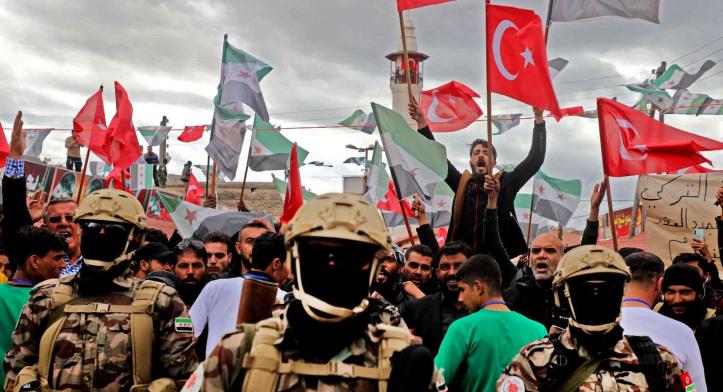
In early December 2024 Assad was summoned to Moscow and Erdogan was placed on notice to be ready with this army that had been bottled up, but preserved with Turkish protection in Idlib, against the Syrian government. Erdogan had persuaded Jolani to hold fire when he wanted an offensive against Aleppo in October 2024, which he had argued should be synchronised with a thrust to the east by pro-Turkish forces against the Kurdish militias. The offensive was held back until Hezbollah, decimated by Israel, concluded a ceasefire in mid-December. It was impolitic to take advantage of the situation whilst Hezbollah was in the field against Israel. The day Hezbollah conceded to Israel, the HTS offensive in Syria toward Aleppo began and three days later pro-Turkish Arab forces drove east along the border against the Kurdish armed occupation.
When Assad refused to co-operate in the way Putin required him to, he was fired. The Syrian President was a luxury Russia could not afford in the world crisis, when the existence of the Russian state has been placed in jeopardy by the support the West has provided to Kyiv.
Assad is facing much criticism from many quarters today. In truth, he did his best to stem what engulfed his country from 2011. He almost pulled it off, with the help of Russia, Iran and Hezbollah, but changing circumstances in the world finally did for him. He probably realised that his rule was unsustainable in the longer run. It could only uphold itself through force and repression and with the assistance of his foreign allies. It was a sectarian state – based on a sect of Islam, a small minority of the population (the Allawites, in alliance with Christian elements) against the majority, of around 75 per cent of the population.
There were long memories in Syria. Hafez Al-Assad had conducted probably the greatest single massacre of Arabs in the 20th Century, in Hama in 1982, when he killed in one week 40,000 Sunnis. The Damascus government was maintained by foreign forces who were unpopular with the majority of the Arab and Muslim worlds, being effectively extensions of Iranian Shia power. And these foreign forces were now in disarray after Israel had been given free rein by the West to attack them. Hezbollah was reportedly warned by Israel that they would be destroyed in the desert from the air if they made any attempt to come to aid Assad from the Shia areas of Iraq or Lebanon. They thought better of it once Putin pulled the plug on Assad.
Facts must be faced after October 7th and its aftermath. It is probably the case that Hamas and Hezbollah are being dropped by those who matter, as not conducive to the regional future. They are things of the past and have no place in the BRICs Eurasian development. There is no earthly reason why Russia, China or anyone else interested in Eurasian development should maintain or rejuvenate them, after their dusting by Israel.
Iran is going along with this course, after being persuaded by Putin of its wisdom and having seen it’s “Axis of Resistance” shield broken.
After the events of October 7th and Israel’s wars on multiple fronts aimed at destroying the “Axis of Resistance” the Iranian government is really faced with a stark choice. It must be evident to it that Israel, confident in Washington’s support to the end, is prepared to go to the absolute brink and maybe beyond with Iran. The Iranian government, therefore, is at a fork in the road. It could go out in a blaze of glory, taking Israel with it, or it has to back down and leave Hezbollah, Hamas and the Palestinians to their fate.
The US/Iranian alt-media commentator, Prof. Mohammad Marandi, who regularly appears on Western mainstream media, is maintaining that Iran is keeping its powder dry for one great attack on Israel – if push really does come to shove. Although he has been wrong on a lot of things, we cannot say that he is not right in this case. Israel is a reckless state that could easily leave Tehran no option but to respond to a war of annihilation launched against it. It could do this through a launching of a massive single attack using its reported substantial arsenal of ballistic missiles stored in deep underground bunkers. A large country with a big and scattered population could certainly survive such a war, whereas a response in kind would do for somewhere the size of Israel, with a population derived from the “flesh-pots of the West” as the Irish News once put it, with a liking for the comfortable Western life. Iranians, on the other hand, have nowhere else to go.
At the moment it appears that Tehran has taken the decision to retreat, on Putin’s advice, and to go on the defensive, after two decades of expanding its influence across the Arab world. It is presumably opting for a future of Eurasian development rather than no future at all, brought about by an extended conflict with Israel and the West, without it’s shield. Whether the Iranian government, in its current form, actually has a future, is another matter. Some say that this is a very opportune moment for regime change in Iran, with Tehran having lost such a lot of prestige. However, Iran is not made up of a small governing elite – it is based on a large theocracy which would be very difficult for anyone to obliterate. Iran may have to fight another day, if Israel forces it, but Tehran hopes that while Russia is there, and Iran is part of Eurasian development, it has a degree of protection. Despite Western misinformation to the contrary, Iran also appears to have excellent air defences that can only be penetrated with really extensive US assistance. Israel has only overcome defenceless people with no air defence. Washington, if there is any sense remaining there, will not want a war waged by Zionist fanatics that decimates the wider region.
Evidence of Iranian concern is that it has now accepted IAEA scrutiny of its nuclear facilities (presumably in order to not give Israel an opportunity to bomb them) in response to an ominous resolution by France, Britain, Germany, and the US stating that Tehran was not cooperating sufficiently with the IAEA. However, if it has sense it will continue to enrich as covertly as it can. After all, isn’t it regularly said these days in the West that if Kyiv had not been nuclear disarmed by Washington it might not be in its present position?
This is all very disappointing for the alt-media and the camp followers of the “axis of resistance” (a combination of pro-Russian, non-Russian Westerners and Syrian exile devotees of an unsupportable regime) who make their living on YouTube etc. and who sneer at the idea of Muslims controlling their own affairs. They are confident they are right in their gloomy predictions, but they offer no alternative to Syria remaining a battlefield for a number of powers and conflicts for eternity. Recent vlogs and writings reveal confusion at how to interpret events, who to blame for defeat and a dismissal of whole peoples who seem to have outlived their usefulness for the YouTuber anti-imperialists. They look completely bankrupt and have been defeated in the current conflict more thoroughly than those who have actually perished in the fighting. Shahid Bolsen is not inaccurate in describing them as assets of Zionism.
Their biggest failure, however, is their failure to understand their hero, Mr. Putin, or their deliberate misrepresenting of him to their followers.
As Andrew Korybko has written:
“It’s now known, after Russia didn’t lift a finger to save the Axis of Resistance, that they were never actually allies. Some of those that still can’t accept that they’ve been lied to by trusted Alt-Media influencers who duped them for self-interested reasons (clout, ideology, and/or soliciting donations) now speculate that Russia “betrayed” the Resistance and “sold out to the Zionists” even though Russia was never on either’s side. If they don’t soon shake off their cognitive dissonance, they’ll detach themselves further from reality.”
The argument that the alt-media advanced prior to October 7th was that Iran and its “Axis of Resistance” would do for Israel. This has proved to be a fantasy of epic proportions. Nasrallah, leader of Hezbollah, had told them, in response to threats from Tel Aviv to “return Lebanon to the Stone Age,” that “Israel is weaker than a spider web” and had confidently predicted victory over the Zionists.
But Israel is not a “spider web,” it is an Iron Wall.
Now the alt-media are advancing the view that the demise of Assad’s Syria means the demise of the “Axis of Resistance” and, therefore, the demise of the Palestinian cause. But if the fall of Syria is the end of the cause of Palestinian statehood the responsibility for that must go to Hamas and the October 7th operation which provided Israel with its great opportunity to settle accounts with Hezbollah, Iran and Syria – all in one go – with the fulsome support of the West and the neutrality of Russia.
That is the logic of the alt-media argument – but a logic that can never be stated outright. If that is denied then the only other point that can be conceivably made by them is that the “Axis of Resistance,” having assembled a formidable armoury and been presented with its moment of truth with Israel, shirked the fight. And that too is fatal to their pretensions.
In the opinion of the present writer, October 7th was generated purely out of the abominable treatment of the Palestinians by the Zionist state. It took the “Axis of Resistance,” primarily designed to protect the Iranian national interest, by surprise, and they were found wanting by the situation it created, which has predictably been used by the Zionists to advance their Iron Wall. Israel was much more prepared for responding to an event like October 7th, evidently having plans for just such an occasion, than the “Axis of Resistance.” It is evident that Israel knew what it was going to do after an event like this and it did it, without any hesitation, whereas the “Axis of Resistance” seemed to not know what to do or whether to do it. When certainty of purpose meets uncertainty of interest there is only one winner.
The US has claimed credit for the “overthrow” of Assad through having unconditionally supported Kyiv and Israel and thus depriving the Syrian government of its allies. Washington has, of course, maintained a very robust sanctions regime against the Syrian government which is much tighter than the one on Russia, and which made it very difficult for the Syrians to pay their army or fund reconstruction. The US has also allied with the Kurdish militias to seize the energy rich area of Syria that provided Damascus with most of its income.
The main focus of the West has been in presenting the fall of Assad as a defeat for Russia – but it has offered little evidence to support this argument. As Putin noted in his marathon Q&A session with the world’s press on 19 December, Russia’s military intervention actually succeeded in its goal of preventing the creation of an Afghan-like terrorist enclave in Syria. The groups that have seized power in Damascus, including those the West has designated as terrorist, have apparently changed their views since the Russian military intervention. If they are no longer terrorist and the West now wants to establish relations with them this can hardly be seen as a defeat for Russia, but should be seen as something of an achievement surely?
Despite what the alt-media say, it appears that Washington was taken by surprise more than anyone by events in December 2024. US intelligence had “predicted” Putin’s invasion of Ukraine (all the best prophets are those who carve out the future they themselves predict) but it was way behind the news with the fall of Assad. They are now attempting to manage the situation in their own interest.
Trump has signalled that Syria is not a US interest. The question with regard to America now is whether the Neo-Con element in Washington can be reined in by the new President or will they continue to instigate and manipulate conflict in the country using the very factional nature of Syrian politics to do so. These people, along with Israel, were the original manufacturers of Jihad/Salafism in the country. The notorious Jake Sullivan communication of 2/12/2012 to Secretary of State, Hillary Clinton had said “AQ (Al Qaeda) is on our side.” (Dept. of State, F-2014-20439, Doc. No. C05789138). The interview with former CIA chief, Graham Fuller, linked beneath this article confirms this to be the case.
It should be noted that this is the same Jake Sullivan who stated at a press conference in Tel Aviv, following a meeting with Binyamin Netanyahu: “What Israel is doing is trying to identify potential threats, both conventional and weapons of mass destruction, that could threaten Israel, and, frankly threaten others as well.”
This seems to confirm, from the horse’s mouth, that Israel, the US and Al Qaeda are on the same side in Syria and have been very much in the business of making the country unstable and unliveable in, merely for the purposes of disruption. And while there are people in the US who perhaps want the best for the Syrian people how are they going to face down Israel now that the Biden administration has encouraged its reckless and destructive behaviour across the region and hitched its trailer to the Zionist convoy?
As was stated at the beginning of this piece: President Bashar al Assad has gone but the problem of governing the state of Syria remains. So, what now for Syria?
It is particularly important that a new government establishes control over Syrian airspace against the Zionists and organises a state with actual sovereignty over its national territory that can defend against the aggression of Israel. The Israelis have been destroying all the military defence capabilities of Syria, which is a neighbouring sovereign state, and they have been doing this without any restraint. The Israeli Defence Minister has declared HTS as a greater threat than the Assad government. Netanyahu has begun occupying the whole of the Golan Heights and declared it to be permanently part of the Greater Israel. And he has promised a doubling of settlers there.
In defiance of international law and the UN Golan was recognised by President Trump in 2019 as part of Israel and President Biden in his references to it as “Northern Israel” has not changed that policy.
One presumes that Syria can only be made functional again if Erdogan is able and willing to work together with Putin in a collaborative effort to save the state. The present writer was never a supporter of Turkish intervention in Syria, but it is now the case that the region can probably only be stabilised by Turkiye coming toe to toe with Israel, in conjunction with support from Russia in stabilising the state. The crucial aspect of air defence is where Putin has leverage over both Turkiye and the Syrian rebels, who will be largely helpless against Israel without the Russian systems. This is Putin’s trump card if he plays it because he can exclude Israel from Syria if he chooses to do so – something he would not do for President Assad but which he may do now. That is why Putin is confident in retaining the Russian bases in Syria. It was thought that without Assad it would be difficult for Russia to maintain its Mediterranean bases. However, it may well now be in the common interest to persuade Russia to stay.
The pro-Russian alt-media has been particularly keen to accuse Erdogan of only opposing Israel in words and having “betrayed” Putin’s trust by opportunistically taking the chance of unseating Assad. However, in his recent Q&A session Putin took the opportunity to condemn Israel’s bombing of Syria and occupation of Golan, along with its illegal settlements in the West Bank, as well as its ongoing military operation in Gaza, while refraining from criticising Turkiye’s intervention in Syria. Instead, he explained that “Turkiye is doing everything to ensure its security on its southern borders as the situation in Syria develops.” He also said he entirely understood Turkiye’s actions which, Putin said, were aimed at returning refugees and “pushing back Kurdish formations on the border.”
It should be noted that Turkiye has a problem with armed formations of Kurdish militants on its borders and not Kurds as such. These YPG formations are armed and in alliance both with Israel and the US and are not at all popular with the local Kurdish population or indeed the Kurdish local authorities across the border in Iraq. The local Syrian Arabs and Turcoman see the Kurdish militias as an occupying force. It is also the case that Turks would want the Syrians to return home.
Much is made of Erdogan’s neo-Ottomanism. However, Turkiye is a national state and the Turks have been a nationalist people for a century now. The Ottoman Empire had the problem of been a heterogeneous state in the era of nationalisms, giving external powers the opportunity to disrupt it. Any Turkish advance into Syria would create Ottoman problems for the nation state of Turkiye and there would be no shortage of enemies or rivals who would exploit such a situation.
Putin regards it of little consequence that Turkiye is a NATO member and he has previously insisted that the most important factor in the situation is his excellent working relationship with Erdogan. Putin speaking at the Valdai Club’s annual meeting in 2022 said of the Turkish President:
“He is a competent and strong leader who is guided above all, and possibly exclusively, by the interests of Turkiye, its people and its economy… President Erdogan never lets anyone get a free ride or acts in the interests of third countries… There is a desire on both sides to reach agreements, and we usually do it. In this sense, President Erdogan is a consistent and reliable partner. This is probably his most important trait, that he is a reliable partner.”
This flatly contradicts how the alt-media depicts Erdogan and Turkiye on “behalf” of Moscow. In actuality Russia has a complex interdependence relationship with Turkiye at the present moment, which has been accentuated since the Western support for Kyiv and its sanctions on the country. The two states have become closely tied together through nuclear energy cooperation, the Turkish purchase of Russian S-400 air defence systems, natural gas, trade, the position of Azerbaijan and Istanbul’s honest attempt to mediate between Moscow and Kiev, to damage-limit of the war in Ukraine that the West wants to persist.
It has become apparent to the present writer, observing events in the South Caucasus in recent years, and reading between the lines of significant speeches from various statesmen, that something is afoot in relation to relations between Russia and the Turkic world. The pivot of this relationship, that is determined on Eurasian development on a most ambitious scale, lies in Azerbaijan. And Azerbaijan has very interesting relationships with Moscow and Tel Aviv (too complex to discuss here) apart from its Turkish brother to the west and Turkic family of states to the east, stretching along the Asian base of Russia all the way to China. That is a crucial chain of geopolitical interests far more important than the ebb and flow of local conflicts in the Middle East.
Russia and Turkiye have a number of things in common in relation to Israel that favour both states in the region. While neither sees the destruction of the Jewish State as desirable or possible, they (unlike the West) are critical of Israel’s behaviour (Turkiye more than Russia) and are supportive of the Palestinians right to a state. They have the potential to act as an “Axis of Protection” for the Palestinians rather than an “Axis of Resistance” against Israel. If Israel were a normal state it would see the value of this in relation to its long-term security. However, it is probable that Israel is much more comfortable with presenting a picture to the West of being assailed by an “Axis of Resistance” composed of various Islamic terrorist groups, together with Iran, out to wipe Jews from the face of the earth.
This represents a kind of symbiotic relationship between Zionist and the “Axis of Resistance” in which both have fed off each other, at the expense of others in the region – until one has been forced to destroy the other, after the events of October 7th.
Israel, if it knows what is good for it, needs both Turkiye and Russia in ways it has no need for Hezbollah and Iran. This is true for not only with regard to its future security but also in terms of its economic prospects. Its extravagant response to October 7th has badly damaged the Israeli economy for some time to come and despite Washington’s bail-outs Israel is much weaker than has been presented in the West, having over-extended its military forces, without defeating Hamas in over a year of assaulting the people of Gaza. On top of that Israel is increasingly volatile and reckless and has become a pariah with much of the world, with accusations of antisemitism against its critics showing desperation. It has also obliterated the West’s moral legitimacy and greatly undermined its soft power in the world. An Israel increasingly dependent on Western subvention may suffer if there is a government in Washington which no longer likes the cut of its jib.
Shahid Bolsen has suggested an ideal scenario for Syria of “Turkish leadership/Arab Gulf States bankroll” within a Muslim solution in the Muslim world. However, it is already clear that the Saudis are retreating in the face of US and Israeli power. It is reported that a main aspect of a hostage’s release/ceasefire deal between Hamas and Israel involves the Saudis dropping their demand for a Palestinian state and returning to something akin to the Abraham accords of Donald Trump. Trump has threatened to unleash hell on Gaza (presumably meaning he will assist the Israelis in doing so) if Hamas do not release the hostages and the pressure is on all to buckle under before his inauguration on January 20, 2025.
It is unfortunately unlikely that any Arab state will provide the leadership needed in reviving Syria or in protecting the Palestinians. They are followers of power rather than exponents of it, like Russia and Turkiye. They are needed for success, but their roles will be supporting.
One thing is certain, if Turkiye and Russia are unable to work together the likelihood is that Syria will crumble and be broken up into various spheres of influence, with Turkiye, Israel and perhaps the Kurdish militias (if they are not smashed by Turkiye and pro-Turkish forces) grabbing their shares. It is also unlikely that the various military factions will be able to cohere into a functional administration to the satisfaction of the general population, if left to their own devices.
It is difficult to be optimistic about the region’s immediate prospects. Not only is the weight of history against the rejuvenation of Syria as a state but powerful forces, in Washington and Israel, will be dead against it. As for the Palestinians, they face a grim future, confined and supervised by the Israeli Iron Wall, within newly constructed cantonised reservations in Gaza until, it is hoped, they vegetate away in conditions left unliveable, for as long as Israel can get away with it. At the same time those on the West Bank will be gradually eroded with an army of 10,000 armed settlers ready and willing to put them into Jordan when the signal is given.
The situation will, of course, always generate resistance, as it did on October 7th despite the best efforts of the Zionists to quell it by the extirpating of the population. Norman Finkelstein has made the point that organisations like Hamas and Hezbollah lack the breadth of vision to be effective against Israel. Their worldviews have been confined by being lifelong prisoners of Israel, either in their actual prisons or their Gazas etc. To outwit Israel it is apparent that one has to also outwit the West. To outwit Israel the situation has to be complicated politically for it, in the West and Eurasia. If the battle is confined to the military aspect and killing people Israel will always win as it has all the advantages and that is its nature.
What is desperately needed to end the cycle of destruction, for both Syria and the Palestinians, is an “Axis of Protection.”
An edited version of this article appears in The Irish Political Review, January 2025.
Postscript: Graham Fuller interview – A interesting take on Syria/Turkiye from a decade ago:
 Pat Walsh
Dear Dr. Walsh,
I have to respectfully disagree with the part in your article stating “it appears that Washington was taken by surprise more than anyone by events in December 2024“.
To the contrary, according to reports from the field, it appears that Washington not only knew in advance and had precise intelligence about the offensive led by Hayat Tahrir al-Sham (HTS), which toppled the Assad regime on Dec 8, but that it actively engaged in supporting it. I suggest reading The Telegraph article dated 18 December 2024 reported by Adrian Blomfield from Palmyra titled “US ‘prepared Syrian rebel group to help topple Bashar al-Assad’, Fighters funded and trained by America and Britain tell The Telegraph they had advance warning regime would be overthrown“:
https://www.telegraph.co.uk/world-news/2024/12/18/us-prepared-syrian-rebel-group-to-help-topple-bashar-assad/
And as you point out, “Hezbollah was reportedly warned by Israel that they would be destroyed in the desert from the air if they made any attempt to come to aid Assad from the Shia areas of Iraq or Lebanon“. All of which suggests prior knowledge, planning and coordination between Türkiye, the U.S. and Israel.
LikeLike
Hi, Enis I accept your point that there was some management of the situation. This kind of thing is natural. It even goes on between Moscow/Kiev and Washington in the background. It should also be remembered that the West is attempting to claim credit for the demise of Assad, when much of the background evidence suggests they were prepared to live with him, and have been as far back as 2014 as the Graham Fuller interview linked at the bottom reveals. What this article is arguing is that the alt-media view of a Washington/Ankara/Tel Aviv conspiracy is false. There are such things as temporary confluences of interest which often disappear quickly and powers then need to adjust to a new landscape on which they return to battle, against those they temporarily collaborate with. Syria has too many political variables and actors with differing agendas and interests within it for us to make predictions. The article is designed to show the complexity of issues. Thank you for your comment.
LikeLike