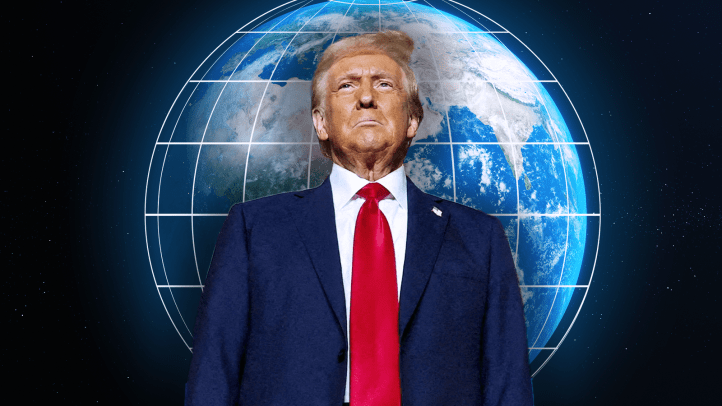
“The birth of a modern Middle East has been brought about by the people of the region themselves, the people that are right here, the people that have lived here all their lives, developing your own sovereign countries, pursuing your own unique visions and charting your own destinies in your own way… The gleaming marvels of Riyadh and Abu Dhabi were not created by the so-called ‘nation builders,’ neocons, or liberal non-profiteers like those who spent trillions and trillions of dollars failing to develop Baghdad, like so many other cities. The so-called nation builders wrecked far more nations than they built, and the interventionists were intervening in complex societies that they did not even understand themselves.” (President Trump on the US in the Muslim World during the era of the New World Order, Saudi Arabia, 14 May 2025.)
President George H. Bush announced the beginning of the New World Order on September 11th 1990 in a speech to Congress, ‘Towards a New World Order’. This was the unipolar moment that became the unipolar era of Pax Americana. It was when Fukuyama theorised the End of History. It was the moment of euphoria at the end of the Cold War, which in the West generated an illusion of harmony in the world. It is this New World Order that President Trump is now cancelling.
This illusion was broken by Samuel Huntington in The Clash of Civilizations. Huntington predicted that the world after the Cold War would be characterized by a multiplicity of ethnic and religious conflicts. It would not be the End of History but the resumption of it, after the Cold War ice age.
President Clinton, the progressive, expanded the New World Order project beyond the conservative Bush’s formulation. Clinton’s view was that Bush’s New World Order was too modest. In 1999 the US bombed Serbia, indicating that Washington was taking on the role of arbiter of world affairs, without bothering the UN. Any momentary notion of collective action was abandoned. Any thought of Russia as America’s junior partner in the New World Order was discarded and it was left outside, unwelcome. From then on, the UN was used by the US as cover for its New World Order.
The liberal rules based international order was proclaimed and the US decided who was and who was not bound by it or in breach of it, incurring sanctions or war. Europe took to the US New World Order enthusiastically so that its dependency and addiction to it means it can today hardly live without it.
The New World Order did not represent a clean break with the Cold War. As the recent BBC interview with former President Biden showed the Cold War warriors took their beliefs into the New World Order with them. The US Foreign Policy establishment turned the old Communist enemy into the “authoritarian” enemy. Churchillian history and misunderstandings of “appeasement” were carried over into the New World Order.
The anti “appeasement” narrative encouraged prolonged warmongering and demonised the making of settlements. It made Minsk I and II, Putin’s call for a European security functional settlement, and the Istanbul attempt to stop the Ukraine war in its infancy, impossible for the Western political class who absorbed the Churchillian version of history.
The US unipolar era turned disastrous because America, with unlimited freedom of action, lacked any interest to oppose it, that it might have to take account of, to make it behave realistically and responsibly within the world it dominated. The US went off on wild, reckless orgies of destruction in the Muslim world, mainly to demonstrate its unlimited power and who was the boss man of the world. In such circumstances its statesmen were prone to senseless blundering for 3 decades.
It is no surprise that reality should now come from a businessman, because the world of business involves assessing one’s interest, and risk, in situations of competition against real forces, in which advantage is gained or lost.
In the Cold War there were distinct spheres of influences divvied out to the two major blocs and they largely stuck to them to avoid world war 3. The New World Order abolished this sensible arrangement with the US bombing of Serbia and America began its hegemonic expansion. This involved a host of military interventions, from Afghanistan to Iraq, Libya, Syria etc. and the expansion of NATO in 3 phases in its Drang nach Osten up to Georgia and the Ukraine until it reached the borders of Russia.
The era of the New World Order has also produced in Europe, through its globalization and destructive military actions, the migration crisis that is in the process of restructuring its politics. It has generated as its nemesis Trump and the movement to the Right across Western societies.
*
The war in the Ukraine, beginning in 2014 with the US-induced Maidan coup, must now be seen as the pinnacle of the New World Order and where the US finally overreached.
Brzezinski in The Grand Chessboard (1997) identified the Ukraine as Russia’s weak spot which the US should prise away. He noted that the Ukraine was fundamental to the Russian world and intricately linked to it socially, politically and economically. It would be the crowning achievement of the New World Order and devastating to Russia if Washington managed this. Samuel Huntington noted the civilizational cleft that existed between the western and eastern parts of the Ukraine and predicted that if it did not balance its affairs it would inevitably break up between the more European west and the Russian east.
The Biden Presidency was the culmination of this, in which a very dangerous world conflict was provoked which could only have one result if it was carried through to a conclusion – world war 3. The Biden administration, although determined to keep the Ukrainians in the fight, baulked at the necessary escalation needed for victory. They settled for an attritional wearing down of Russia through the sacrifice of Ukrainian blood, encouraged by a recycling of American treasure.
Trump has decided that this war is wasteful of US treasure and a diversion from the main business in the world. He is not imbued with the Russia-hatred that the US liberals have; that the US foreign policy establishment have; that Britain and the European liberal elites have. He recognises that the multi-polar world has been born and he wants to make the US fit and able to contest its national interest within it. He does not want America going the way Britain did from 1914. Perhaps someone has told him about this and like a good practical businessman he has taken advice rather than wallowing in ideology – for which he has no time.
He is also aiming for a rapprochement with Russia for business reasons. Trump appears to believe that a deal with Russia could unlock the Ukraine imbroglio and with it the China and Iran problems.
Trump is attempting to conduct a US strategic withdrawal to salvage things for the US and leave the Ukrainians and Europe to pick up the pieces. The war in Ukraine was the defeat of the New World Order and Trump knows it. Trump does not want to replicate Biden in Ukraine, so his only option without a deal is to walk away and allow events to take their course. He is calculating that the Europeans will see sense after they fully understand their position. They will huff and puff, but they won’t want to blow their house down.
The US rebuilt modern Europe after it had destroyed itself fighting 2 world wars against itself. The EEC/EU project was greatly successful after the US knocked European heads together. However, Europe, frightened of the nationalisms that destroyed it in the past, seems to have nothing to cohere around but anti-Russia. The US contained this in service of Cold War requirements, and Europe itself nullified it when it entered into an energy bargain with Russia, but Ukraine has let it loose since.
Europa is rearming itself and intends to step into America’s shoes, as Kyiv’s armourer, treasury and moral crutch, encouraged through Sir Keir Starmer’s “coalition of the willing”. This phrase “coalition of the willing” was first used by George Bush as the rallying cry of the New World Order. Britain is experienced at constructing grand alliances in Europe to keep it busy in war, while Britain itself avoids commitment and makes hay elsewhere in the world. Of course, Europa does not want to step in the Ukrainians’ shoes and envisages maintaining them as the buffer against Russia as the glacis of Europe. Europa has a tradition of invading Russia, most recently under Nazi leadership. It embraced the New World Order fully and only wants to continue with it for as long as possible.
There is the sinister role of the British State in all of this. Unlike in America there is virtually no opposition to the war in Britain and the party consensus has made the BBC a totalitarian instrument of it. The consensus (rather like the one that existed around Northern Ireland) is enabling a dangerous meddling by the militarist elements in the British State, beyond democratic accountability.
Trump made the promise that he would end the Ukraine conflict in a day. However, the basic problem in Ukraine is that while Trump aims for a ceasefire, President Putin wants negotiations that address the root causes of the conflict, moving toward a resolution and functional settlement. A 30-day ceasefire is useless for Russia if it enables a respite for Kyiv while European arms continue to come in. If there is a truce agreed it will have to be on the basis that it will lead to some form of settlement.
Keith Kellogg attempted to sell the Korean frozen-conflict model to Putin, but Russia will not want to settle on such a basis. Hence the Russian counterproposal for the resumption of the Istanbul talks that Ukraine walked away from in 2022, to return to address the substantive issues. This called Zelensky’s bluff and resulted in him agreeing to deal in Istanbul, after Trump’s public support for the talks. But Zelensky is still playing media games rather than engaging with the problem Ukraine is now faced with.
The problem in stopping the war, as John Mearsheimer has pointed out, is that the West has made the Ukrainians an existential threat to Russia, and the Russians an existential threat to the Ukraine. There is, therefore, great difficulty in making a deal between them.
A deal is also difficult because even if Washington agreed to what the Russians wanted the deal would still have to be imposed on the Ukrainians. The Ukrainians want US guarantees – at a bare minimum, just to accept a frozen conflict. And that is the thing Trump doesn’t want to give them. And even if Trump could sideline Zelensky he would still have to deal with the Ukrainian Right to impose a settlement.
Trump may well find out that to get a settlement he will have to fully pull the plug on the Ukrainians, by starving them of American resources, and allow Russia to break them on the battlefield to the best of their ability over the next few months. He also needs to be clear to the Europeans that he is not for turning, and there is no hope for them in dragging things out for years. That, and not just the threat of it, may be the only way to end the conflict.
The core Russian demands, presumably, are no NATO in Ukraine; no European “peacekeepers”; and the recognition of Crimea, Luhansk, Donetsk, Zaporizhia and Kherson as Russian territory. Failing that the areas of Odessa, Mykolaiv, Dnipro and Kharkiv are up for grabs in the war.
*
The second aspect Trump is tackling is the economic sphere. Trump understands that America’s trade and fiscal deficits are unsustainable. He has realised that the US has created a system in which the rest of the world is producing so that Americans can consume. The nation that was so autonomous and overproductive after World War 2 has become deindustrialised and a consuming centre dependent on the rest of the world.
The West lost the war it picked with Russia in Ukraine because the US had become deindustrialised. If it had been the industrial powerhouse it formerly was Russia would have been overwhelmed. Trump correctly ignored the propaganda fog and saw this as not boding well for America in the future. But bringing manufacturing back to the US will be very difficult and low wage assembly work would have to be either done by migrants or it will have inflationary consequences for the US economy. It is high profiteering business like pharmaceuticals he needs to repatriate, after curbing its leeching on ordinary Americans.
Trump’s belief is that the world is free riding on the US. However, he also believes that the dollar is indispensable. The current economic order is dependent on a number of features: dollar cheapness, strong US consumption and profits invested in the United States. Trump is now trying to reset something that has been built up for decades.
The New World Order made the US the most secure place to invest money so the whole world’s money was attracted to America and Wall Street. It could not go into the productive economy because this was being offshored. As global monetary and military leader the US offered unparallel conditions for maximum financial security. But the great increase in stock market capitalisation was totally disproportionate to the real growth of the American economy and has become nothing more than an inflation of the rich’s wealth – causing problems for the standard of living of non-rich, ordinary Americans, who are now Trump’s base.
US problems are rentier capitalism and the concentration of capital in the financial sector, which has replaced real productive economy. It is a recycled dollar system designed to make quick profits rather than encourage reinvestment. The money is going into Wall Street and not into productive investment in the real economy. It is a big problem when the assets of Wall Street are the US economy. Trump’s advisors are Wall Streeters, but the US needs new roads, new ports, new refineries, and new railways.
Despite what the alt-media says nobody is trying to push de-dollarization and the collapse of the global economic system. De-dollarization is slowly happening and will occur gradually. The transition from the pound to the dollar occurred in the 1920s, although Bretton Woods didn’t happen until after World War 2. A similar thing is happening now because a parallel system is emerging, and it needs to be managed carefully.
The US is experiencing serious economic problems at present and Trump knows retrenchment is necessary. The US companies that left the shores of America to make profits enriched themselves whilst impoverishing large parts of America. They acted in the globalising interest of spreading American soft power but now they need to think of America, the nation, and need to be brought back, with their money.
It appeared Trump was thrashing about in his economic policy, but he is beginning to obtain results and a reset. The markets have settled, and cheap energy prices, produced by Saudi and Russian assistance in the oil market, may smooth the transition. What Trump is attempting is both necessary and worthwhile. Trump, of course, is not responsible for the hand he has been dealt and the mess he has to clear up. But he is also only in the game because of it. He is trying to clear up the mess before it’s too late.
But he is up against something that the US has not experienced before and that is an economic competitor that has grown too strong.
*
This brings us to China and the US “pivot to Asia.” I doubt Trump is attempting to destroy China or bring it to its knees. He probably knows that is impossible. it seems to me that Trump is simply trying to rebalance the US/China trade relationship in the hope that this will prevent China becoming a regional hegemon in the most important region of the world.
China skilfully availed of the US stratagem during the Cold War of separating it from the Soviet Union. With very favourable trade relations that gave it privileged access to the US market the Communist Party of China was able to transform the economy and increase Chinese power dramatically. The US, in economic determinist mode, believed that capitalist market relations, a globalised economy and increased prosperity would undermine communism and open up China for exploitation. It was proved very wrong.
In 1989 the students in Beijing demanded political reform before economic reform. They were inspired by a visit from Gorbachev and their slogan in Tiananmen Square was “China like the Soviet Union!” The Chinese Communist Party considered Gorbachev an idiot because he had things the wrong way round – economic reform could only proceed within political stability. The students were, therefore, dispersed by tanks before they helped turn China into the disaster that was Gorbachev’s USSR.
Events went China’s way. China hit a bonanza when Gorbachev and Yeltsin produced meltdown in the USSR, showing the wisdom of the Chinese path and the value of the Communist Party as an organiser of development in a stable system. Here was an independent communist system availing of a market relationship with the US and achieving a great leap forward. At the same time Russia, which unilaterally dissolved its communist party and rushed headlong into democracy and liberal market relations, descended into political chaos and social and economic collapse.
The US was slow to realise what it had facilitated. Huntington had correctly identified China as America’s future rival. Brzezinski’s grand chess board, while it envisaged a wiping out of Russia for its own good, recommended a conciliatory attitude to China, seeing it as a state whose future as a potential rival was a long way off.
However, if Washington did recognise the threat it did not know what to do. China had very quickly become a pillar of the globalised world on which increased Western prosperity was built. This had led to more stable economic conditions and class relations in the West, low inflation, low interest rates, property booms, cheaper labour and goods and the winning of elections by the liberal globalists. What to do?
There was talk in the US of a “pivot to Asia” since the days of Obama, but only Trump really attempted it, during his first term, and it did not go well. When Biden replaced Trump the Kyiv chickens came home to roost in the shape of a major war and the pivot was rendered impossible. All focus went on Russia, which was nothing of a threat to the US, compared to China. And the Biden policy brought Russia and China together again for the first time since Nixon had prised them apart – with the collusion of Mao, acting in the Chinese national interest.
In 1969 Mao had discussions with his generals concerned with the Soviet threat to Chinese national interests. The fear was that the US would engineer a USSR/China war, sitting on top of a mountain watching 2 tigers fight. He studied Stalin’s pact with Hitler and saw the US as Hitler. He proceeded to comprehensively outmanoeuvre the Americans and then Deng Xiaoping piggybacked on US capitalism to give the Chinese a bright future. What the US saw as a diplomatic victory has turned into a defeat and Biden proceeded to lose all the gains Nixon achieved.
Biden’s only policy – meant as the last hurrah of the New World Order – was a repeat of the Ukraine policy in relation to China. The plan seemed to be to provoke a Chinese military operation against Taiwan which the US could turn into a big war to cut the Chinese down to size. That would have been absolutely crazy, but the US Foreign Policy establishment began to concentrate their efforts on making it a reality – as they do.
This madcap project was fully in line with the way the New World Order was leading, and it was seen by Trump and his men as not only dangerous in the extreme but completely against the US national interest.
The US has under 5% of the world’s population and if you add in the G7 countries we’re talking about 20%. China and Brics on the other hand represent over 60% of the world’s population. One can easily see where the future lies, particularly with the inability of Western populations to reproduce themselves.
China threatens to dominate East Asia with its economy; technology that is superior to the West’s in many areas, particularly in the Green sector; its Eurasian Belt and Road and its military/naval expansion. It has just reached an important agreement with Azerbaijan which is a very significant strategic nodal point for Eurasian development. Incorporating Azerbaijan at the Baku, the eastern limit of the Roman Empire, puts China at the Gates of Europe.
The US/China situation may well develop into a new cold war because China has an interest in dominating its region and the US has an interest in preventing this.
We cannot expect anything else than the US under Trump will attempt to contain China. But the US cannot fully pivot east until it sorts out, or at least negates, the festering wound of Ukraine. Trump understands that Russia is no threat to the US and the US is wasting its efforts and resources in fighting Russia.
Trump probably realises that he has a tough job on his hands with China. China and Japan are the greatest creditors of the US and that is an important fact. This gives China a good hand against America, in Trump parlance.
During his first term, in May 2019, Trump’s men attempted to pivot toward confronting China to impose on it the Lighthouse deal. But after 2 years of negotiations Xi rejected it and walked away. This is detailed in the Josh Rogan book, Chaos Under Heaven. Rogan argues that the Americans, eager to finally get to grips with China, were shocked at how the Chinese had penetrated the West economically, socially and politically. Many politicians, institutions and businesses in the US, UK and particularly the EU, seemed to be in the pocket of the CPC. At the negotiations the Americans were gung-ho but divided and confused over strategy and could not make any impact against the Chinese wall. Rogan suggests that Trump was so overawed at what he found that he retreated into appeasement in dealing with Xi.
Confrontation went onto another plain with the outbreak of the pandemic and when Biden tried his luck, before Ukraine erupted, he was seen off quickly. Since then, China has been carefully preparing for a US trade war, while America has been otherwise engaged.
This background should allow people to understand the bizarre Tik Tok episode.
Trump is probably betting on China being unable to develop a consumer market due to lack of disposable income among its citizens, to replace the one he plans to deny it in America. However, the first Trump trade war forced China to diversify its export markets, especially in the Global South. Much of Trump’s new trade war is targeting China’s alternative trading partners and markets. But China seems confident it can play the long game better than Trump and America. It has a firm grip, with just under 40%, of the rare earth elements essential for US re-industrialisation and owns 90% of global processing capacity. These rare earths are essential for manufacturing everything from smartphones, semiconductors, electric vehicles, robotics, missiles and aircraft engines to artillery shells.
The joint statement released by the US and China after their trade meeting in Geneva last week was cause for optimism that a mutual reset is possible between the two powers. There will be a 90 day pause in the trade war in which the US reduces tariffs on China to 30%, down from 145%. China will reduce duties on US goods to 10%, down from 125%. Both countries will establish “a mechanism to continue discussions about economic and trade relations”, spearheaded by US Treasury Secretary Scott Bessent and China’s Vice premier. Future talks will be held in China or the United States, the statement adds, with talks taking place in the “spirit of mutual opening, continued communication, cooperation, and mutual respect.”
This is the way the multi-polar world should operate – through appeasement, in the old sense of the word.
*
One of the most dangerous things that Trump is forced to address is Israel. The US/Israel relationship was a subject that was left largely untouched by the New World Order and its promoters. There is a constancy in this relationship which only varies slightly between US administrations. The former Israeli Ambassador to the US, Mike Herzog, recently noted that “God had done the State of Israel a favour that Biden was the president” during the recent Israeli punitive campaign in Gaza. He revealed that the former administration had greatly assisted Israeli operations against the Palestinians, not only by providing money, resources and intelligence but in resisting the pressure for a ceasefire.
Israel’s hold on America is a bit of a mystery. But one thing about Trump is that he is certain he is bigger than Netanyahu and America is bigger than Israel. He has, so to speak, bigger fish to fry in the wider region, than Netanyahu and Israel, including lucrative business with the Gulf states. He wants the Gaza business wrapped up and Witkoff told hostages’ families that Netanyahu is an obstruction to the release of their loved ones and an impediment to peace. There are indications that the Israeli hostages could be released through negotiations between the US, the Gulf States and Hamas – something that is opposed by Netanyahu.
One thing is certain, there is only one person who can save Gaza from the Israelis and that man is President Trump. Whether he chooses to do so, or not, is an open question. But every day he hesitates more die.
The relative constancy of US/Israel relations vis a vis the Palestinians is outside the remit of the end to the New World Order, but the Israel/Iran conflict is very much of interest.
The US has no national interest in a war with Iran. It appears that Trump, Vance, Witkoff and Hegseth understand this. They do not see the “axis of evil” of the New World Order. There are a number of signs that Trump, while giving Israel moral support, is conducting a US policy that is independent of Israel’s. Trump began negotiations with the Houthis while they were targeting Israel, without reference to Netanyahu. The US is apparently also no longer demanding Saudi Arabia normalise ties with Israel as a condition for progress on civil nuclear cooperation talks.
Trump seems to be aware that Netanyahu is attempting to manipulate him, but it could be that the US President is now playing the Israeli Prime Minister, rather than vice versa. That is the growing fear in Israel and of great concern to the Daily Telegraph which has recently stated that it is “difficult not to regard Trump in his second incarnation as president as being as unreliable towards Israel and on Iran as he has been on Ukraine.” (Trump is stumbling into a catastrophic diplomatic error: The US president is repeating his earlier blunders in Europe in the Middle East).
Trump slapped Israel down in their threats against Turkiye in Syria. Turkiye in Syria may well turn out to be a much greater menace to Israel than Assad or Hezbollah ever did, and they are there as the culmination of US policy in the country. The Turks wish to rebuild Syria into a functional state and that is the last thing Israel wants. It wants to make disorder and instability of neighbours to act with impunity against them, and the great bogey Iran – and would prefer Assad and Hezbollah to have remained. Trump has now lifted sanctions on Syria and wants to help it become a functional state again, much to the chagrin of Netanyahu.
Erdogan is important to Trump’s agenda and he does not want Israeli interests subverting America’s policy in the region. Trump appears to want to make progress on his objectives in the Middle East without the obstruction posed by Israel. It is quite possible that Trump may override Israel on the rebuilding of Gaza, with the Saudis – but we can but hope on this! He, at least, provided a great boost to the Palestinian cause by exposing Israel’s ethnic cleansing objectives live from the White House, and America’s complicity in them, beside the smirking, nodding dog Netanyahu. This was in contrast to Biden, Harris and the Democrats who gave liberal cover for them.
But can Trump steer a steady course with regard to Israel and Iran?
It should be remembered that Trump was defeated at every turn in his first administration. He was beaten back by the Swamp on Russia through impeachment attempts and the US Courts. This time Trump, the outsider, has brought in other outsiders like Musk, Hegseth and Witkoff for his second round with the Swamp.
Rubio and Waltz are part of the Swamp, unfortunately, but at least Waltz has now been pushed out. Rubio is there for his ability and loyalty and willingness to subsume his instincts to the President’s objectives. That is important to a businessman. But his loyalty is probably conditional on success. Steve Witkoff is Trump’s right-hand man, and it is he who is trying to work out a deal with Iran. Witkoff handles the Russia, Iran and Israel portfolios for the President – which shows how much trust Trump has in him – but also how Trump is very dependent on a few good men. Witkoff is hated by Israel and the Daily Telegraph.
Israel has already used its influence to force firings in Hegseth’s team, which is worrying. There is a battle going on within Trump between his Israeli sympathies and Saudi Arabian business interests. Saudi is very important at this juncture and ironically it might help prevent a war on Iran.
It makes total sense for Trump to solve the Israel/Iran predicament diplomatically through Witkoff. The JCPOA allowed Iran to keep its enrichment capability but both Israel and the US hawks don’t want this. So how can an accommodation be reached?
An arms limitation agreement between Iran and Israel with the US as broker is not on the table. Therefore, the best that can be hoped for is a renegotiated JCPOA, in which Trump backtracks and allows Iran to keep its enrichment and reprocessing capability – but with more demanding restrictions on Iran that prevent nuclear weaponising and without sunset clauses.
This is, of course, is unacceptable to Israel and the hawks in America. So, at present Witkoff seems to be pursuing an agreement that Israel is fundamentally opposed to. Trump is indicating that he wants an end to Iranian enrichment because it has enough oil and does not need nuclear power. This may be a hardball negotiating position but if it isn’t there will be trouble ahead because Iran won’t want to give up its nuclear programme, which it sees as vital to future defence.
Steve Bannon says that Trump has no intention of making war on Iran. If the President does not get his deal Bannon suggests that Trump may employ a naval blockade on the Gulf, in order to cut Iran’s oil revenue off, and deprive its biggest customer, China, of a major source of energy. However, apart from the military risk such a policy would, in fact, make China more dependent on Russia and raise the price of oil on the world market.
At the present moment Trump seems to be using Israeli power to deal with the Middle East so as to facilitate a US settlement with Iran. The Israelis have handily cut down “the axis of resistance” through Iraq and Syria and on to Hezbollah. He is restrained, however, in this by Saudi money and the Turkish movement into Syria. But the major Israeli intention, aside from whittling away the Palestinians by one means or another, is to get the US into a war with Iran.
A US attack on Iran would be a very big risk for America. For one thing the US, for all its power, is unlikely to destroy Iran. It probably could only temporarily impede its enrichment and reprocessing capability. But what would be the economic effects of a big US attack on Iran? Iran could retaliate by blocking the Gulf, itself, and it has reputedly a huge and effective inventory of missiles, including hypersonics, which could be used to attack Israel, US aircraft carriers and interests in the area, or anyone else it chooses to target in response. A large successful attack would be the end of the Jewish state – since Israel is a small area that would be very unattractive after that for Western Jews to live in.
If Trump allows a major Israeli strike on Iran it would probably bring in the US and all hell could break loose. Trump’s wider work in the Middle East will then unravel and things will get out of hand very quickly. The US could blunder into a world war in a similar way that Britain blundered in 1914.
*
The big problem is that Trump is dealing with so much at the one time and that leaves him open to attack on several fronts by his enemies who lie in the long grass, both in the domestic sphere and internationally. His concentration is spread, and his focus is diluted. Everything is interdependent and failure in one place may well be contagious with everything quickly unravelling.
The world is changing as multi-polarity takes place and a complex web of state relationships develop. Trump will probably achieve the end of the New World Order – no matter what. It may, in fact, be that or no world at all.
A Talk given by Pat Walsh at Crusaders F.C., Seaview, Belfast on 16 May 2025
 Pat Walsh
Excellent.
LikeLike
Thank you Dr Walsh for this very informative and critically analysed article. It is difficult to live with so many uncertainties but this seems to be the current state of affairs.
It will be interesting to see if and how the Trump administration can rebuff Israeli – Netanyahu – opposition to its own complicated deals involving not just the Middle East but other countries too.
LikeLike