War is a catastrophic form of activity. In a war the concentrated power of violence of one state meets that of another. War is therefore a very fundamental kind of activity which has far reaching social consequences in the victorious as well as in the defeated society. Wars are usually ended by the defeat of one side on the battlefield by the other and a ceasefire on the lines established by the war. The settlement of wars resulting from the conflict of interests between states usually result in a new compromise between these states in the light of the balance of forces shown by the trial of martial combat.
So it has been in many centuries of history and so it has been in relation to the conflict over Karabakh between Azerbaijan and Armenia.
Vladimir Putin described the collapse of the Soviet Union as “the greatest geopolitical catastrophe of the century”. Whether one agrees with that or not it was certainly the case that a catastrophe resulted from the collapse of the Soviet Union in the Southern Caucasus. The stable political order which had been established in the 1920s and which had been maintained without serious question for over 60 years was suddenly thrown into flux. Conflict began when Armenian separatists in the Nagorno-Karabakh region of Azerbaijan were encouraged by a foolhardy attempt made by General Secretary Gorbachev, a believer in “Leninist democracy,” to revitalise the Soviet system by democratising it. In the process the last General Secretary of the USSR let loose all kinds of fundamental forces that had been repressed for good reason for generations. And when the USSR was liquidated in December 1991 the war was on for Karabakh.
The First Karabakh War was a catastrophe for the newly independent state of Azerbaijan. Nearly 20 per cent of its territory fell under foreign occupation; around 750,000 people became refugees in their own land; around 20,000 people were lost, many of them killed on freezing mountains in winter; large parts of the country were laid waste, with fine cities like Aghdam resembling Hiroshima after the Atom Bomb. The beautiful and historic lands of Karabakh and its surrounding districts were turned into a wasteland, with its great cultural capital of Shusha and other places vandalised and desecrated by the Armenian occupiers keen to erase the Azerbaijani presence, both in human and cultural forms.
A strong sense of victimhood was the result of this catastrophe. The sense of victimhood was compounded by the fact that Azerbaijan was subsequently failed by the international community and diplomacy. Four UN Security Council resolutions, and international law and justice were relegated to mere debating points by the international community. The world seemed impotent before flagrant aggression and gave the distinct impression that it just wanted Azerbaijan to lie down and accept its fate, as an unfortunate victim of past events. Very few thought Azerbaijan itself capable of righting the wrongs it had suffered.
But Azerbaijan did not accept its fate. It did not want to remain just another victim of history. And it was blessed with competent and able leadership at the vital moment. The state and economy were rescued and rebuilt by Heydar Aliyev, an experienced and able statesman of the Soviet era. And when President Heydar Aliyev passed away the reins of state were taken up by his son, President Ilham Aliyev, who continued his father’s work, bringing it to fruition and a successful conclusion.
In spite of building a strong, professional and well-trained army equipped with the latest weaponry and technology, Azerbaijan, over the course of nearly 3 decades, tried to find a resolution to the conflict through the structures of international diplomacy and peaceful means.
However, Armenia proved to be never seriously interested in the negotiation process and resolving the issue peacefully. Any meaningful attempts made were shot down by the powerful Karabakh Clan, the men who had won the first war, and who dominated Armenian politics ever since. Yerevan proved incapable of trading land for peace as the myths produced by the first war engendered a fatal over-confidence in which territorial ambitions trumped a realistic estimation of resources.
Ironically, it was the first Armenian leader from outside the Karabakh Clan, Nikol Pashinyan, who brought the second war on through his senseless political and military provocations in mid-2020 which confirmed the end of the prospect of a negotiated settlement. So, when Armenia launched another attack on Azerbaijan’s military and civilians on 27 September, the Azerbaijani army was ready and waiting to counter-attack, in a full war of liberation that would reverse the results of the first war, for both societies.
The long-prepared Armenian defences were breached in the first week of the war, and Fuzuli, Hadrut, Jabrayil, Zangilan and Qubadli were liberated over the following weeks. In only 44 days Shusha was retaken, and the occupiers defeated, and forced into surrender. The War was won. Bloodshed was kept to a minimum and Armenian civilian retreated, unmolested in their cars, so differently than was the fate of the Azerbaijanis who perished in massacres and treks across mountains during the first war.
This book explains and analyses the historical background and then these events in detail. Along with examining the course of military events it reveals how the 44 Day War was won diplomatically and politically.
It shows how the 2020 War was won by Azerbaijan because it had developed an effective state, vibrant economy and professional army with innovatory technology and sound strategy. Unlike Armenia, which had become a virtual dependency of Moscow, Azerbaijan had used its independence in a constructive manner and gained respect from Moscow based on good neighbourliness, political stability and increasing economic power. On the political level the Aliyev leadership was able to successfully read Moscow’s intentions with regard to the conflict and negotiate a controlled end to the war that both minimized bloodshed and preserved precious resources for reconstruction and future resettlement. This ultimately led onto the final, complete liberation within 3 years in September 2023.
It explains how the geopolitical picture was transformed by Turkiye’s moral and military support for Baku. President Erdogan provided full political backing and the Turkish and Azerbaijani armies conducted extensive pre-war joint military exercises. Advanced military technology and sophisticated robotic warfare systems, used effectively in Syria, were supplied to the Azerbaijani army by Ankara for the task in hand and the Turkish political and military assistance to Azerbaijan was crucial in the winning of the war.
A negotiated, collaborative effort emerged between Baku, Ankara and Moscow to manage the defeat of Armenia and an organised end to the occupation of most of Karabakh and surrounding areas, which were evacuated within weeks by the defeated forces.
Azerbaijan had succeeded in liberating the bulk of the occupied territories and restored its sovereignty over them. International law, which negotiation and international diplomacy had failed to impress on the Armenians, was successfully implemented on the battlefield by Azerbaijan’s armed forces.
Three years later, in September 2023, Azerbaijan was to succeed in completing the liberation of all its sovereign territories after a lightning campaign that broke the remnants of the occupation regime and forced its complete surrender.
The bulk of this book was written as a commentary during the 44 Day War itself and in the months following it, during late 2020/early 2021. It originated in an online blog written to explain what was happening in the region to a Western audience which only paid attention to the far-off obscure place called “Nagorno Karabakh” when trouble was reported there. The Western news was heavily influenced by the Armenian narrative and it gave a distorted view of the conflict to the European public.
Now that we reach the 5th anniversary of these historic events in the South Caucasus it has been updated to take the story up to the present day, including the aftermath of the 44 Days and the final completion of the liberation war.
Pat Walsh (November 2025)
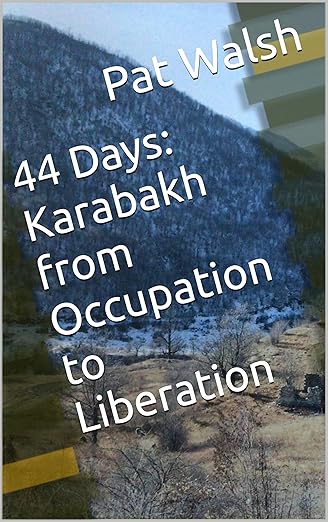
’44 Days: Karabakh from Occupation to Liberation’ by Pat Walsh is now available as an ebook from Amazon here. It will be available for purchase as a softback and hardback book from November 9th.
 Pat Walsh
Congratulations Pat. Hope to be ab
LikeLike
Congratulations on your new book Dr. Walsh. Cannot wait to buy it once available in hardback.
If interested, here is our latest article (in French but translation tools are available in browsers) on the Karabakh conflict: https://fatsr.org/le-conflit-du-karabakh-des-origines-a-nos-jours/
Kind regards,
Celâl Bayar
LikeLike
Thank you Celal. It is now available as a hardback, SoftBank and ebook from Amazon.
LikeLike