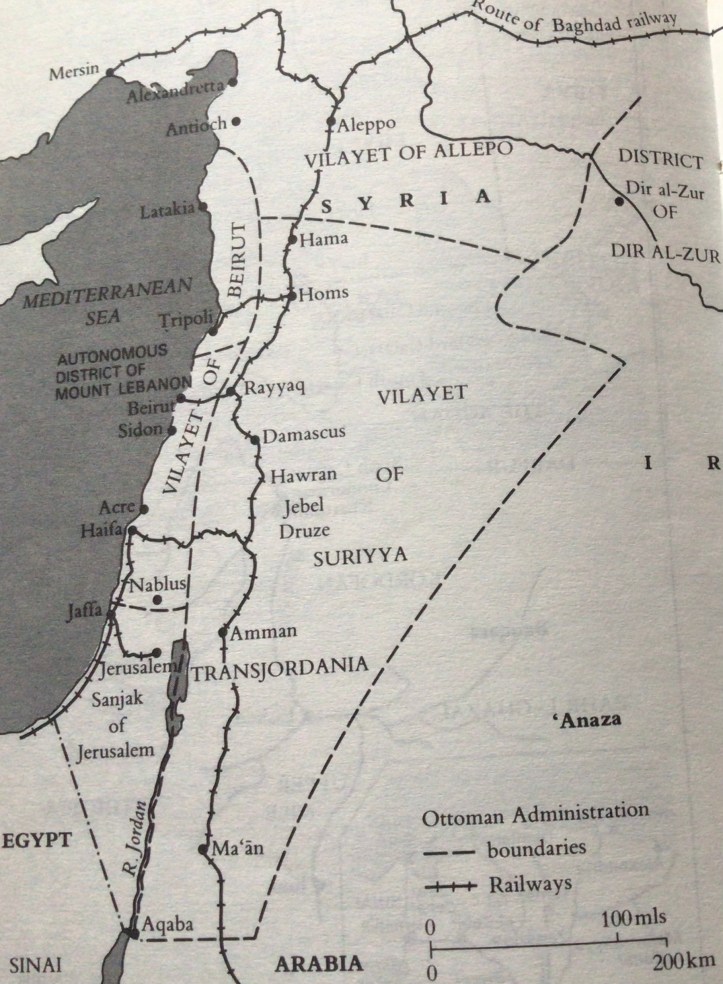
The conflict between Arab and Jew in the Middle East and most of the mess in Syria and the general region is a direct product of Britain’s Great War on the Ottoman Empire.
Britain, after declaring war on the Ottoman Empire in November 1914, as part of the Great War taken on against Germany, expected to make short work of the Turks. However, the major reverse suffered at Gallipoli in 1915 convinced the British that they required various regional allies to help them conquer the Ottomans. They had already acquired the Russians through a convention in 1907, and through them the Armenians and their irregular forces in the eastern parts of Ottoman territory. The Tsar was persuaded through an offer of his heart’s desire, Constantinople, which was made formal in a secret 1915 agreement by Sir Edward Grey after much diplomatic work done behind the scenes in the previous year.
However, having failed to defeat the Turks in the time expected and with the Russians and Armenians, England lured the Arabs into active participation in the war against the Muslim Ottoman State on the promise of a great Muslim Arab state after it. To achieve this the seeds of nationalism were sown amongst this people, which had, up until then, proved impervious to such things. And Syria/Lebanon/Palestine/Jordan, they were led to believe, would be part of the nationalist inheritance at the harvesting of victory.
However, at the same time Britain divided up the Arab lands, including Syria, with their allies in secret agreements, despite knowing that this would confront the new Arab nationalism which they were cultivating, after the War. While the McMahon correspondence and treaty with Shereef Hussein was being formulated, in which Britain agreed to establish a large Arab state in return for an Arab rising against the Ottomans, London began making secret treaties with the French (The Sykes/Picot Agreement of May 1916) which sought to divide up the Middle East amongst the Western Christian Powers after the Great War was won.
In 1917 Britain launched yet another project, on another set of promises, of a Jewish colony in Palestine, during a moment of great difficulty during its Great War. The object was to win over what it believed to be the considerable force of international Jewry to the failing Allied cause. To do this it announced the Balfour Declaration and Britain set about the process of large-scale Jewish colonization of Palestine under the auspices of the Mandate system of Versailles. The plan was not to establish an independent Jewish State but a Jewish colonial state of the British Empire.
So, having created an Arab nationalism in the region that was going to be confronted with Imperialist domination, England simultaneously made sure of its frustration by giving it a powerful alien rival nationalism to also conflict with.
It is sometimes said that the Arab world was the victim of a British double-cross. But it actually fell foul of a triple cross. And in the century or so from 1918 there has been a working out of what emerged from the activities of the British State between 1916 and 1918 in destroying the Empire of the Ottoman Turks.
Shereef Hussein knew nothing of the agreement that aimed to balkanise the region so that the Muslims could not operate a state that would amount to anything in the world. This plan of balkanisation was, of course, a most unsuitable way to administer the region because divisions within the Arab world were not national in any way. They were religious and cultural. Different religions and cultures were spread right across the region and could not be delineated by national boundaries or through nation states drawn out of the sand.
That was why the Ottoman structures worked – because they enabled different religious groups, clans and families with different cultures, ways of life and allegiances to live next to each other, with no lines in the sand to bother them.
When the lines in the sand were imposed on the Arabs they were forced to see themselves as nationalities, (but with no historical meaning) and to see others (who had the same history, religion or culture as themselves) as alien and a threat, because they were from without the newly imposed lines in the sand.
When the Bolsheviks took power in Russia in October 1917, they published the secret treaties with Britain and France from the Tsar’s Ministry of Foreign Affairs. Amongst those were the texts of the Sykes/Picot Agreement. Upon obtaining these the Turks forwarded copies to Hussein with an offer of forgive and forget and a separate peace, contained in a letter from Djemal Pasha.
The Ottomans gave the fullest publicity to the peace offer to Hussein and it raised doubts in the Sheriff’s mind as to the wisdom of his alliance with the perfidious British.When he contacted his allies he was told that the treaties were not concluded agreements but simply records of provisional exchanges and conversations from the early part of the Great War to avoid any nasty disagreements at the conclusion. The English assured Hussein that the Arab Revolt had altered the situation completely and had made the Sykes/Picot Agreement null and void. However, Hussein was in for another shock. One part of the territory he had been expecting in his Arab State, Palestine, had not only been earmarked for the European Powers but, unbeknown to the leader of the Arab Revolt, it was also meant to become a homeland for another people – who would be brought in to displace the Arabs already living there.
Faisal went to Paris to claim his dues as representative of one of the victorious Allies of the Great War. But, instead, he found himself under pressure to assent to the giving away of Palestine to Britain and the Zionists. The British Foreign Office wanted to present the French with a fait accompli at the Peace Conference by revealing an Arab/Zionist agreement that England should control Palestine. And to do this they needed Faisal’s signature. The British Prime Minister, Lloyd George, a noted trickster, employed a negotiating manoeuvre that he was to use against the Irish in the Treaty negotiations less than a year later. Faisal was persuaded by the British (including his old comrade, Colonel Lawrence) that they were his main hope, and if he did not give his consent to an agreement with the Zionists the French would tear up all agreements and disregard all promises made. The Arabs would be left with nothing for their sacrifices and Faisal would be blamed.
The Arab view was that Palestine was an Arab territory that was an integral part of Syria. Syria was a self-contained geographical unit with well-defined natural frontiers and an interdependent economy stretching from the coast to the interior. It had cultural and historical traditions of unity from before the times of the Crusades, stretching back to the 7th Century. But the Supreme Council decided that the only way of satisfying the designs of England and France was to divide Syria/Lebanon/Palestine between them. So, Faisal was placed in a dilemma.
He was then persuaded by the Zionists that they had no intention of working for a Judenstaat (Jewish State) if Palestine was cut off from the rest of Syria. They were only interested in furthering the mutual interest of all, Jew and Arab. There was no intention of an Iron Wall.
Faisal decided to consent to the agreement on the general condition that Britain fulfilled her pledges on Arab independence. With that Britain insisted that the Arabs take their place at the Peace Conference with two seats at it. Faisal believed he had secured Arab rights, with American backing, when President Wilson agreed to the King-Crane Commission to investigate the democratic wishes of the population in Syria. Faisal believed Britain’s backing of it also demonstrated that it intended to fulfil its pledges on Arab independence, as agreed. But the real reason for England’s support was the belief that the Commission’s report might prise the French out of Syria. A confident Faisal then returned to Damascus to take control of things, awaiting the Commissioners.
Colonel Lawrence favoured Faisal because he knew members of the tiny Arab nationalist movement that had developed underground in the cities of Syria and Iraq. Lawrence wanted to extend the Arab Revolt northwards to Damascus as a method of levering the French out and getting the area for Britain.
Until the end of the Great War the vast majority of Syrian notables had remained loyal Ottoman citizens. Syrians played little part in the Arab Revolt and very few engaged in anti-Ottoman activities, let alone a revolt. The vast majority of pre-War proponents of Arabist ideas cooperated with the Ottoman government during the conflict and it was only in mid-1919, when the realisation that the Ottoman Empire was really done for, that the Syrian notables gravitated to Arab nationalism, in preference to French hegemony, knowing the advantageous effect this would have on the Christian minorities in greater Syria against the Muslims.
Before the arrival of the Commissioners elections were held in Syria (including Lebanon and Palestine) and a representative General Syrian Congress met in Damascus in July 1919. It passed resolutions calling for: the recognition of an independent Syria (including Lebanon and Palestine) with Faisal as King, repudiation of Sykes/Picot and the Balfour Declaration and the proposed partition of Syria to create a Jewish State in Palestine; rejection of the tutelage of the Mandate system; and an independent Iraq.
However, in the meantime England withdrew its support from the King-Crane Commission when it decided to extend its investigations to the proposed British areas of influence, in Palestine and Mesopotamia. And President Wilson had to insist on its mission going ahead with American delegates alone.
The King-Crane Commission is the most objective and independent source of information on the situation in the area. In August 1919 it made its report. It recommended, for the good of all, a great Arab state consisting of Syria/Palestine/Lebanon, Mesopotamia, and Transjordan and advised the ending of any attempt to set up a Jewish State in the area. It suggested that the Mandate system be put in place, but for a strictly temporary period, so that the Mandated Powers did not use it as a cover for extending their Imperial ambitions. It found that if the Arabs had to come under any supervision they would prefer to come under an American Mandatory administration. It also recommended that only two mandated areas be established – for Iraq and for Syria (including Lebanon and Palestine). And it strongly advised that there should not be a separate Palestine.
The establishment of a state based on the Balfour Declaration, the Commission found, could not “be accomplished without the gravest trespass upon the civil and religious rights of existing non-Jewish communities in Palestine” and “the non-Jewish population of Palestine – nearly nine-tenths of the whole, are emphatically against the entire Zionist program.”
The Commissioners had started out predisposed to the Zionist idea, but in their conversations with the Zionists they found that they looked forward to a complete dispossession of the non-Jewish inhabitants by various schemes of purchase and to an Iron Wall. As a result, the Commissioners saw the Zionist ambition as a dangerous violation of the Allied War aims and recommended that the project be strictly curtailed.
However, the British and French suppressed the Report, seeing it as the wrong conclusion, and made sure it was kept secret, until after the United States had signed up to Versailles. The Commission’s Report suppressed, did not see the light of day for three years. By that time the Middle East had been reconstructed without the Americans in the way and in the way the Imperialists wanted it.
On 8th March 1920 the General Syrian Congress acting on the basis of the War propaganda declared the independence of Syria (including Lebanon and Palestine) as a sovereign State under Faisal as King. But the French and British refused to recognize it. On 25th April 1920, at San Remo, it was decided that the whole region was to be placed under Mandates with Syria broken up into three: A truncated ‘Syria,’ under France; Lebanon under France; and Palestine under Britain. Mesopotamia as a whole was given to Britain. The provisions were made public on the 5th of May.
The Mandates had been assigned, not by the League, but by the Supreme Council, composed of Britain, France and Italy. The San Remo Conference disregarded all the findings of the King-Crane Commission. Therefore, the Mandates merely represented a division of the spoils amongst the Imperialists, modified only in so far as was necessary to reconcile their conflicting claims, and those of the Zionists – with America out of the way.
The French Army then moved on Damascus to repress the General Syrian Congress. Despite the pledges England made to Hussein in the McMahon correspondence to uphold and maintain an Arab government in the Syrian interior British forces conveniently evacuated to leave the Arabs to their fate. Arab Resistance was quickly crushed with hundreds of deaths. The French invited Faisal to leave, which he did on 28th July 1920.
Some have blamed French intransigence and cultivated the impression that in all this the French acted more disreputably than the English. But the French made the point that they had made an agreement with Britain over the possession of the Middle East in 1916 and were not part, or indeed privy, to the separate Agreement Britain made with the Arabs around the same time. It was England who was double-dealing, bringing the Arabs into the Great War on false promises, to obtain possessions for Britain. The French acted in the straightforward and honest way of Imperialist practice. It was England who cheated the Arabs of what they had been led to believe they were fighting for.
One reason why the Arabs failed to get their state and the Jews got theirs is revealed in the report of one senior official in the India Office made during October 1914, as England planned to make war on the Ottoman Empire:
“The strength of our position vis a vis the Arabs has lain in their own divisions and in their hostility to Turkey. The substitution of an Arab confederacy might well result in the withdrawal from us of a loyalty that has been paid to us, less because we are loved, than because the Turks are hated. Moreover, Pan-Islam is a danger that must be steadily borne in mind, and it seems highly probable that eventually a consolidated Arabia would be a far greater danger, alike in Africa and Asia, than the Jewish freemasons who now control the Caliphate.” (Stuart A. Cohen, British Policy in Mesopotamia 1903-14, p.306)
Anti-Semitism and Zionism went hand-in-hand and were two sides of the same coin. Even if a Jew were to become an atheist, or did their upmost to integrate in Europe, he or she was never permitted to be anything other than a Jew. Jews were treated as a race, rather than a religion by the English anti-Semites, so it was perhaps unsurprising they bowed to being the “Jewish race” in a Jewish State. And becoming a race, rather than a religion, they were incapable of becoming like the indigenous Ottoman Jews. The Jews of the Balfour Declaration were bound to be nothing but a colonising Iron Wall in Palestine. And even if they believed in no God at all, they believed God had given them the Land of Israel.
The British anti-Semites regarded the Jews as a poison and they determined to drain that poison from elsewhere in the world and funnel it into Palestine through the Balfour Declaration.
The Arabs were of use to England as a political lever against the Turks and in the destruction of the Ottoman Empire. When the Arabs had helped destroy the Ottoman Empire a different situation arose. The important thing then was to prevent the Islamic peoples of the region from acquiring a new state that might give them power and influence over their destiny. And at the same time the objective of making the Jews into a nationalistic people was to prevent their future participation in dangerous conspiracy and internationalism, which the British saw them as doing, as a troublesome, non-national people. Furthermore, in 1921, the British rejected the proposal of incorporating Transjordan into Palestine because it would interfere with the Zionist project, preserving an unconquerable Muslim majority in the face of Jewish migration.
Before Britain had instigated the Arab Revolt there had been no nationalism of any consequence amongst Arabs that demanded nation-states of any kind. But having been encouraged to fight a war for their own state and been inspired by notions of nationality from their Imperial sponsors, it was hardly likely that they could be returned to their pre-Great War contentedness. The genie could not be so easily put back in the bottle!
The destruction of the Ottoman Empire was, therefore, a case of extreme political vandalism in which the traditional lives of Arabs, in which they had contentedly lived for centuries, among the indigenous Jewish and Christian populations, were disrupted for good. The functional Ottoman state, in which they existed was torn down, and they were forced into alien political structures and arrangements that made no sense to them and which were established merely to suit the Imperial purposes of Britain and France. When they objected to these arrangements by taking up arms, as some had against the Ottomans, and crossed the lines that were drawn for them in the desert, they were mown down by machine-guns and bombers.
It was argued by British Imperialists that the Arabs were not ready for self-government and had to be protected by Protecting Powers. But if that was truly the motivation of British policy why was it that the amount of self-government and independence given to the different Arab ‘nations’ was almost inversely proportional to their political development? Syria and Iraq were set up under direct foreign administration and the inland areas of Arabia and other backward Sheikdoms were granted the independent privilege of states.
Islam has undergone something of a renaissance lately – but it is not the type of rebirth that the West was expecting. The Muslims have been deprived of their own state for the best part of a century, a state in which they could have achieved an orderly and responsible development on their own terms. States tend to exert a moderating influence on peoples’ aspirations whereas the lack of structure tends people toward radicalism and fanaticism.
The Cold War gave the Arab states something of an opportunity to develop and cohere as they were courted by West and Soviet. But when it ended the West indulged in another round of wanton destruction from 2003 until? As a result there is a collection of balkanised fragments and client-states in the Muslim world that contain little good for the self-respect of one of the major cultures of the world. And Syria is one of them.
The response of some Muslims to the predicament they have found themselves in is really a consequence of the Imperial re-ordering of the Middle East that began with the Great War and the West‘s insistence in remodelling them on liberal principles for globalising purposes. And there is little doubt that those who have just captured Damascus and will now be expected to govern Syria have a worldview that leads right back to the British conduct of the Great War against the Ottoman Empire and the cheating of the Arabs after it.
Little surprise that they are not models of western liberal democracy.
It is because of all this that there is little to rejoice about in the fall of Assad’s Syria, despite its inadequacies and all the unwarranted pretensions made about it by the alt-media. It was just one more attempt to put order on something which was created with little thought for good government or the interests of those who lived there.
 Pat Walsh
Hello,
Now, though British seem to be so innocent. Ideas, like equal rights, green, reusable, recycle, rights for every kind of societal group, respect for any group holding pretty much any ideas, freedom of speech and all of that. Yet, just 100 years ago, there was such a duplicity on such a massive scale in a foreign policy, causing all these troubles nowadays. Are there such games happening between nations now as well, or it is now less cynical in its nature?
Thank you Toghrul
LikeLike