Available
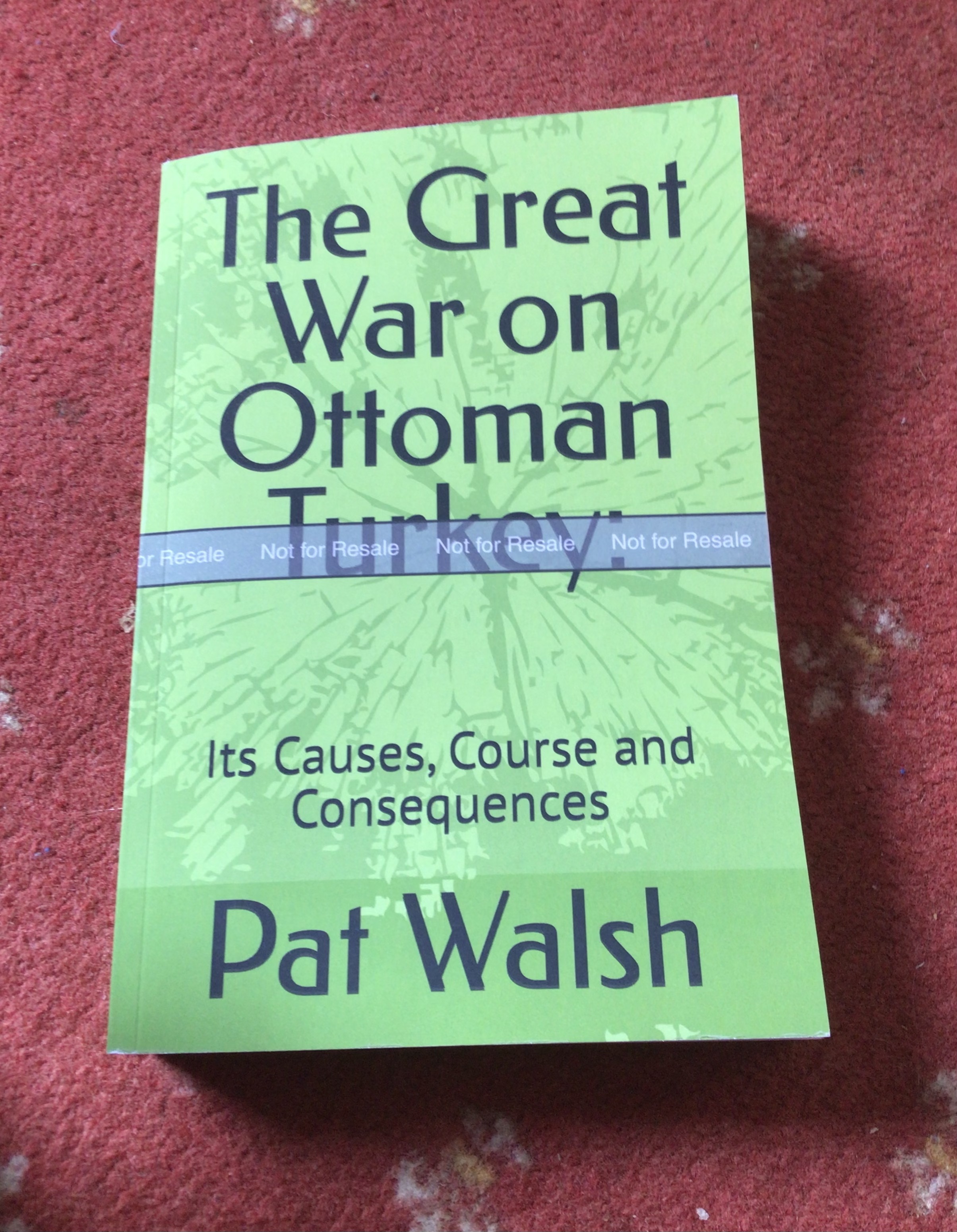
Now available from Amazon UK in e-book, softback and hardback editions.
A 436 page book of 10 chapters on the causes, course and consequences of one of the most consequential and catastrophic events in history – The Great War on Ottoman Turkey.
Contents
Introduction
Chapter I. Britain and the Ottoman Empire p.5
Chapter II. The Great War on the Ottoman Empire p.66
Chapter III. The Armenian Relocations p.115
Chapter IV. Britain and Greece p.158
Chapter V. Britain, America and the Turks p.191
Chapter VI. Remaking the Middle East p.229
Chapter VII. Conquest of Mesopotamia and the Making of Iraq p.301
Chapter VIII. Another Greek Tragedy p.354
Chapter IX. Chanak and Imperial Decline p.400
Chapter X. The Treaty of Lausanne p.420
Introduction:
The Great War on Ottoman Turkey was one of the most consequential events in modern history. The dismantling of the Ottoman State and what replaced it had far-reaching effects which are still working themselves out today. All the conflicts in the Middle East and many more are products of this event, which took place just over a century ago.
Although World War One is often described as having took place between August 1914 and November 1918, the Great War on Ottoman Turkey was a much longer event, stretching from the first Balkan War of September 1912 to the Treaty of Lausanne, signed in July 1923.
Its causes, course and consequences are the subject of this book.
It is not a history of the final years of the Ottoman Empire, but rather a history of the war that dismantled it.
Although there were a number of states and peoples engaged in the dismantling of Ottoman Turkey, including the Russians, French, Greeks, Balkan states and Armenians the main work was undertaken by Great Britain.
Britain’s intervention in the European war of July 1914, had the effect of making it into a Great War on Ottoman Turkey and a World War. Without this British intervention the Ottoman Empire might well have survived and many of its regions would not have been battlefields. There probably would have been no states of Israel, Iraq or Syria today or indeed some other states that currently exist.
The British intervention, because of the heightened intensity of British politics surrounding the Irish Home Rule crisis and divisions within the Liberal Government gave the war a different character from previous European wars. Previous British interventions in Europe had been limited Balance of Power wars waged to prevent the hegemony of any one European state, whilst accumulating territory for the expanding British Empire elsewhere in the world. This war was different because it was invested with a strong moral character, as a war of good over evil, Civilization against the Barbarian, giving it a catastrophic character that required it to be waged, no matter the cost, until evil was vanquished.
The main sources of evil for Liberal Britain were the Barbarians of the West – the Germans – and the Barbarians of the East – the Ottoman Turks. Fierce war propaganda was produced to demonize Germans and Turks and justify the taking of territory and dismantling of empires.
That is the context of the Great War that was fought on Ottoman Turkey and joined by the Russians and French – although both these Powers fought more openly for territorial gain and a share in the Ottoman spoils of war.
When declaring war on Ottoman Turkey in November 1914, in fulfilment of its understanding with Czarist Russia that they would share the Ottoman territories, along with Persia and other regions, between them, the British and Russians expected an easy win. The British moved up through Mesopotamia using its Indian Army whilst the Russians, with Armenian insurrectionists in tow, invaded from the Caucasus. Both Powers had characterised Ottoman Turkey as “the sick man of Europe”! But they both met with stubborn Ottoman resistance and suffered defeat after defeat – most spectacularly at Gallipoli and Kut.
During the years of hard fighting British plans for the former Ottoman territories changed fundamentally. The invasion of Mesopotamia began as a straightforward addition to the Indian Empire but by 1919 it was decided that the Middle East, instead of being governed Imperially, in the old way, should be broken up into a series of invented nation-states bound by treaties to Britain.
This was despite the fact that there were no nationalisms in the region waiting on establishing nations – as was the case elsewhere. Ottoman rule had never been nationalist, and therefore had not generated counter-nationalisms. People co-existed in a multi-religious and multi-ethnic state and realised that carving out nations in the European fashion would only bring killing. They had seen what had happened in the Balkans, where nationalism was more developed. Millions had died or been ethnically cleansed by the people who became dominant in an area.
But the British conjured up nationalist forces from the Armenians, Arabs, Jews and Greeks to assist their war efforts when the going began to get tough in 1916. The Russians were less guilty of this since they had little respect for nationalism. But the British, with an eye on US participation in the Great War, as a necessity of winning it after German resistance proved formidable, began to encourage it to muster up anti-Ottoman forces. And the tribal chiefs took it up because they had to if they wanted to maintain authority over their peoples in the new world that was dawning.
The Arabs had no sense of nationality and the other forces had territorial demands which did not have the population bases for realisation without the sustained power of the British Empire. As a consequence, only the Zionists made a success of it, riding on the strength of the British Empire and then exploiting the weakness of it a generation later to gain a state for the first time in two thousand years.
However, the Balfour Declaration of 1917 had the effect of returning the progressive Jews – capitalists and socialists – to their Biblical orientation. Jewish nationalism provoked Palestinian nationalism as a form of counter-nationalism to the Jewish colonial nationalism. For everyone else but the Zionists, there was a lingering sense of promises unkept and long-term resentment produced within the new nations and territories – storing up enduring trouble for the future.
That is the subject of this book.
Much of the material here was originally published by Athol Books in a 2009 book, Britain’s Great War on Turkey – from an Irish Perspective. That book was inspired by debates within Ireland over issues of independence and commemoration and the writing of history. It was a book largely written for an Irish audience but it became very popular with the Turkish community, because the facts of the matter were put out – something rare in Western publications. In the West, the true causes of the Great War on Ottoman Turkey are seldom explained and its consequences are largely left unstated. Many aspects of its course are distorted or are the subject of misinformation.
This book was a sequel to an earlier book, The Rise and Fall of Imperial Ireland, also published by Athol Books, which looked at how Ireland had been transformed by the Great War of 1914 from an Imperialist course to an independent state. The book on the War on Ottoman Turkey showed how these two things were connected. Ireland began the War as a source of soldiers to be thrown at Gallipoli, but by 1922 it was becoming inspired by the deeds of Mustafa Kemal and was heading in an entirely different direction.
The interest of a Turkish publisher in making a translation has resulted in this updated and modified version of the 2009 book in English. Some material from the original, concerning internal Irish politics, has been omitted and a good deal of extra material, written over the last 15 years on Ottoman Turkey and the Great War, has been used to expand the book and enhance it for an audience outside of Ireland. The substance of the original book has remained, along with its structure and general argument. This is the international edition.
There is a new chapter on the Armenian issue, examining in particular the relocations policy which shows it was German-inspired and only taken up reluctantly, and as a last resort, by the Ottomans; extra material on the Balkan Wars; the outbreak of the War on the Ottomans; the role of Tsarist Russia and the Bolsheviks in the Great War; how and why the British were forced to give way to America in the world; the conflict in the South Caucasus; and the development of the Zionist project out of the Balfour Declaration.
The use of extensive quotations from the time of the events are meant to take the reader back to the time, before different interpretations were put upon things by historians and others in the service of various states and modern causes. The reader discovers how things were seen at the time, by thoughtful people, and what statemen were attempting to actually do – before they failed and accounts were altered.
The story told is from a lost world of empires, before the Great War ushered in a global era of nationalisms and nation-states, which took hold of subsequent history and any thought about the past.
 Pat Walsh
Gre
LikeLike
Thank you Pat. I just ordered your new book, it should be delivered on May 6.
Have a great week-end,
Celâl
LikeLike
Thank you so much Celal. If you can leave a review later that would be great. The other crowd may come in soon, but they have to buy first.
LikeLike