The Guardian reported on May 4 that:
“The EU is sending a team of experts specialised in combating Russian propaganda and interference to Armenia, as it increases its support to the former Soviet republic in a tense political period.
In a highly symbolic sequence of events, EU leaders will hold their first summit with Armenia, after a pan-European gathering of about 45 leaders at the European Political Community summit in Yerevan.
The EU has been deepening links with Armenia as Russian influence has waned since the full-scale invasion of Ukraine that is seen as having diverted Moscow’s attention other countries it regards as its ‘near abroad’.”
The EU is, therefore, intent on expanding into Armenia and seems to be in the process of forming an EU/Ukraine/Armenia axis to widen the encircling of Russia.
Sir Keir Starmer is also involved, of course, bringing the UK back to Europe from Brexit – via the military door. This is after the recent British estrangement with Trump and the US, which have made clear in recent months that if they have a special relationship, Britain is not their special one.
Britain’s interest in this EU encircling manoeuvre is in buying itself into arms manufacturing contracts that will form part of a $105 billion “loan” to Ukraine from the EU. The EU “loan” to Kyiv is structured on the premise that the loan will be repaid by the bankrupt Ukrainians through reparations Russia will eventually pay to Ukraine following its defeat.
It could be described as “pie in the sky” – but Britain wants a slice of that pie, knowing full well that the EU will never see its money again.
The EU is a castle built on sand these days, but it is exhibiting dangerous behaviour again akin to what it did in Ukraine in 2013-14. Let off the US leash it reverts to type with regard to Russia.
The EU is now opening up a geopolitical division in the South Caucasus. Over the last few weeks President Aliyev of Azerbaijan has been working on bringing Zelensky and Putin together, aiming to get a peace conference in Baku, to end the disastrous war in Ukraine. President Trump – who has so far failed in this area – is probably in support of this, but he has more pressing business at present.
On the other hand, the Europeans are working in the other direction. They see their interest in keeping the war in Ukraine going, wishing to maintain the “Russian threat” and Kyiv acting as Europe’s shield – continuing to fight and die – so that Europeans don’t have to. Perish the thought!
The unelected EU leaders (Von der Leyen, Kallas etc.) know they are under pressure over declines in living standards, mass migration etc. and use the “Russian threat” to hold on to power against increasing opposition from populations and individual national states. The “Russian threat” appears to be the one thing holding the EU together since the end of goodness, peace and prosperity.
Europe is now intent on moving into Armenia, to extend its “defensive line” against the Russians – as it moved into Ukraine in 2013.
Europe is developing a militarised economy, turning its car plants into arms factories, under the prompting of the US desire to reduce its own spending on European defence and Trump’s demand that European states fund their own military spending. This is leading to an expansion of arms manufacturing, and particularly drone technology and production, in Europe.
It will be in the economic interest of Europe that war continues indefinitely or else there will be no customer for its new industrial products and the customer cannot pay its bills unless it wins. There may be a European military/industrial complex developing.
With regard to Armenia, The Guardian reports that:
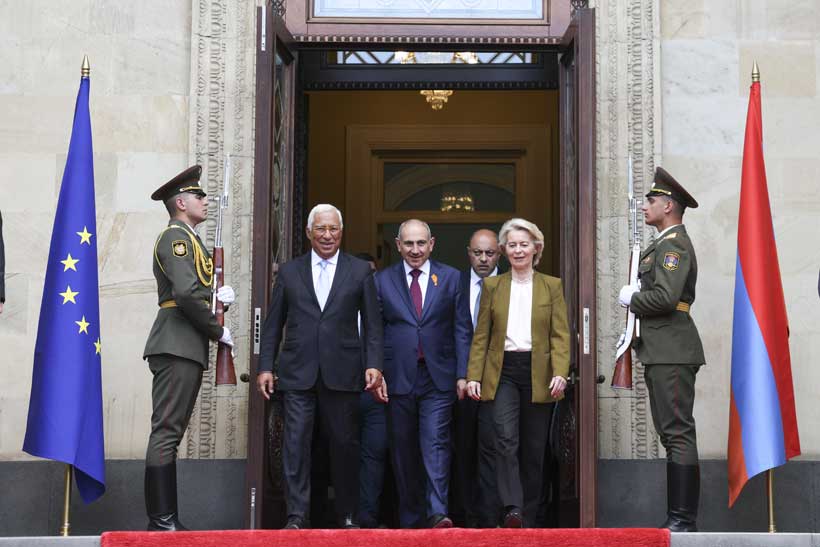
“Armenia’s prime minister, Nikol Pashinyan, and the EU leaders, Ursula von der Leyen and António Costa, are expected to formally welcome the concept of an EU mission to counter foreign interference in Armenia at the summit in Yerevan, where they will also discuss energy, transport and economic support. The EU is setting up a team of 20-30 civilian experts for a two-year mission based in Armenia aimed at improving the response to Russian cyber-attacks, information manipulation and interference, as well as countering illicit financial flows. The mission, which could be increased in headcount and duration, is expected to start work after parliamentary elections on 7 June… which are seen as pivotal in determining whether Armenia stays on a broadly pro-western path. The EU foreign policy chief, Kaja Kallas, said last month: “Armenians are facing massive disinformation campaigns and cyber-attacks. When Armenians go to the polls in June, they alone should choose their country’s future.”
Prime Minister Pashinyan faces elections in Armenia in June. He won the last ones in 2021 comfortably, right after the disastrous defeat to Azerbaijan in the Karabakh War of 2020. Losing war leaders do not usually triumph. But Pashinyan saw off “the Russian threat” that time with seeming ease.
The EU now pretends Pashinyan is under serious threat from Russia and “the Russian threat” and needs their assistance, as Kyiv did in 2013.
I would doubt that Guardian readers follow Armenian media. If they did, they would know the predictions that there is little chance of Pashinyan losing to the greatly divided myriad opposition – only part of it pro-Russian, and a very minor one at that. The major threat comes from pro-Western, more belligerent forces, which represent an opposition to his peace making with Baku. But he is content to go along with the EU pretence, since it will mean European money for him and he can promise future EU membership for Armenia, and all living happily ever after. More pie in the sky, to be sure.
The EU is acting opportunistically, attempting to get a foothold in Armenia, using the “Russian threat” to justify its advance. Where has that happened before?
Here is some more opportunism:
“A senior EU official described the EU-Armenia summit as a “critical milestone in our relationship” and “a symbol of Armenia, gradually, slowly, geographically reorienting towards the west” … Armenia was long Russia’s staunchest ally in the Caucasus, but disillusionment set in after Moscow failed to send military aid during the 2020 and 2023 Nagorno-Karabakh wars. Armenia’s 2018 Velvet Revolution, which emphasised democracy and the rule of law, also set the former Soviet republic on a different path to Russia, which slid deeper into authoritarianism.”
So, Russia let their traditional ally in the South Caucasus down and this is the EU’s chance!
The Armenian Velvet Revolution might have emphasized “democracy and the rule of law” at home but it soon reverted to revanchism in the occupied regions in Karabakh and beyond and took on the slogan of “new war for new territories” before being brought down to earth by the response from Azerbaijan.
Putin’s Russia did not intervene in the short April 2016 war between Armenia and Azerbaijan over Karabakh, long before the 2022 war in Ukraine, at a time when it was well able to throw its weight around. Putin, instead, took a scrupulously fair position based on international law that Karabakh and its seven Armenian-occupied regions were part of Azerbaijan, and universally recognised as part of Azerbaijan, and since Armenia, a member of the CSTO, was not being attacked, it did not deserve assistance from its ally. That principled position was partly responsible for undermining the old pro-Russian political elite in Yerevan which expected Moscow to come to its aid, and it helped Pashinyan to power.
But such a fact – greatly to the credit of Putin – would not be helpful to the EU narrative of a “Russian threat”.
The fact that Putin did not act for the Armenian occupation against Azerbaijan in 2016 or 2020, for his CSTO ally, tends to suggest that Russia (under current management) was prepared to live with neighbours who did not threaten them by declaring an intention to join NATO. Georgia and Ukraine, who went along with the proposed NATO expansion, were not tolerated.
The EU is therefore acting upon what it sees as Putin’s weakness or his adherence to international law!
Pashinyan was humbled in the defeat by Azerbaijan in 2020 and the mopping up of the remaining occupation rump in highland Karabakh in 2023. He was cut down to size in any ambitions he had proclaimed for “new wars for new territories.” He then became a realist peacemaker.
Armenian revanchists – many in the US and French diasporas – will now be looking with eager anticipation in the direction of the EU. As has been noted, Europe will have to sell their new industrial products to someone, beside Ukraine, to fund increased defence expenditure whilst maintaining social services. And that can be Armenia.
Behind the EU fanfare in Yerevan and support for peace in the region France and Armenia signed a declaration on strategic partnership on 5 May during French President Emmanuel Macron’s state visit. Under the declaration Armenia and France plan to “significantly expand and deepen relations in security by developing co-operation in the defence industry, strengthening co-operation in defence research and innovation, deepening co-operation within western organisations on regional and international security issues, and continuing dialogue between their military chiefs of staff.”
Despite any declarations of peace making for all there is little doubt that Armenia is the main objective of EU expansion in the South Caucasus region. Armenians are seen as Christian Europeans and there is a long tradition of European support for them. They have a colour revolution, non ex-Soviet leadership and an economy very open to European penetration. All these things mark them out from Azerbaijan with its impenetrable state-directed system and Georgia – which has reversed course after its 2008 mishap. Armenia also has a large Russian military base than the EU wishes to dismantle through popular pressure.
The Azerbaijan parliament announced the “suspension of cooperation with the European Parliament in all areas” on 1 May after the EU parliament adopted an offensive declaration with regard to the Azerbaijani liberation of Karabakh. It contained the inference of ethnic cleansing of Karabakh Armenians and used the Soviet term “Nagorno-Karabakh” to describe the region, when the Oblast ceased to exist in 1992 when the Armenians seized it along with 7 other provinces from Azerbaijan, drove 750,000 Muslims out and renamed it “Artsakh.”
And yet the EU insists on the Soviet term, that died with Armenian destruction of the Soviet settlement and USSR Constitution!
It should not be forgotten how the EU can prove a dangerous force in a region – for all its progressive sounding mission. In 2013 it attempted to destabilise Ukraine through an economic deal that greatly appealed to Western Ukrainian nationalists, but which would have decimated the economy of the eastern and Russian-speaking part. When the Kiev government rejected the deal, it sparked the Maidan.
Victoria Nuland and the CIA were appalled at the Europeans opening up the situation in Ukraine in the West’s favour, and then failing to follow through. She famously exclaimed “Fuck the EU!” and promptly organised the coup that succeeded in ousting the democratically elected government of Ukraine, which held the country together.
Thus, began the Ukrainian civil war which metamorphosed into the Ukraine/Russia war – another civil war of sorts – extravagantly supported by the West and now Europe, to the last Ukrainian.
Has the EU, in conjunction with Nikol Pashinyan, with good intentions or bad, blundered into another region and set Armenia on the same trajectory?

