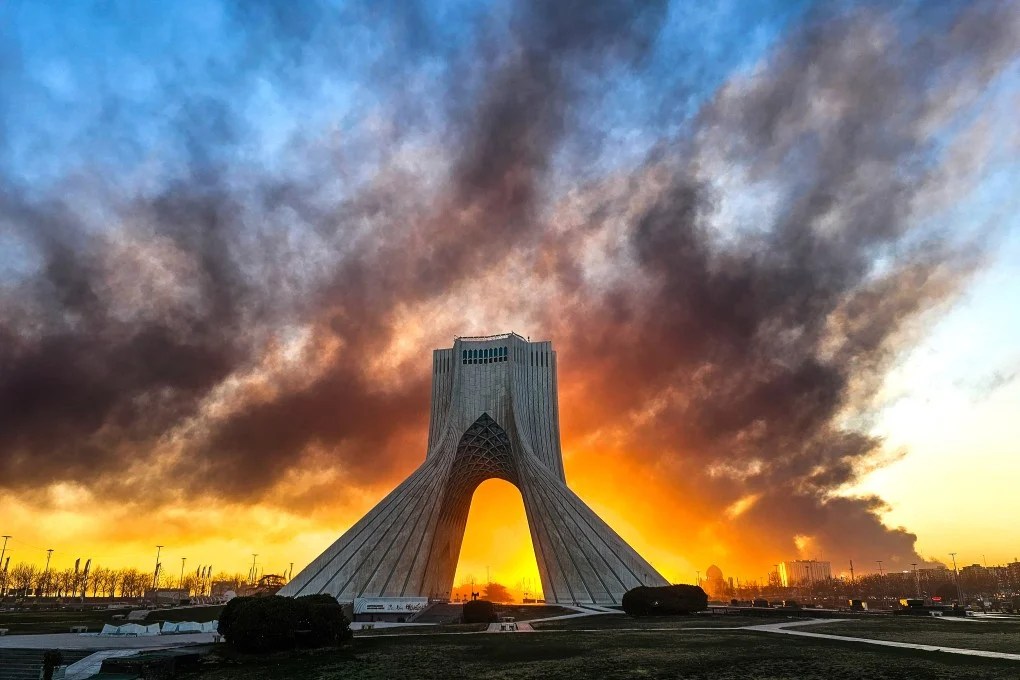
When the US President launched the war on Iran on 28 February – after the Israeli Prime Minister triggered him into action – this is how he described his war objectives.
“The United States military is undertaking a massive and ongoing operation to prevent this very wicked, radical dictatorship from threatening America and our core national security interests. We’re going to destroy their missiles and raze their missile industry to the ground. It will be totally again obliterated. We’re going to annihilate their navy. We’re going to ensure that the region’s terrorist proxies can no longer destabilize the region or the world and attack our forces, and no longer use their IEDs, or roadside bombs as they are sometimes called, to so gravely wound and kill thousands and thousands of people, including many Americans. And we will ensure that Iran does not obtain a nuclear weapon. It’s a very simple message. They will never have a nuclear weapon.
This regime will soon learn that no one should challenge the strength and might of the United States Armed Forces. I built and rebuilt our military in my first administration and there is no military on earth even close to its power, strength or sophistication… The lives of courageous American heroes may be lost, and we may have casualties. That often happens in war. But we’re doing this not for now. We’re doing this for the future. And it is a noble mission. We pray for every service member as they selflessly risk their lives to ensure that Americans and our children will never be threatened by a nuclear-armed Iran. We ask God to protect all of our heroes in harm’s way. And we trust that with his help, the men and women of the armed forces will prevail. We have the greatest in the world, and they will prevail.
To the members of the Islamic Revolutionary Guard, the armed forces and all of the police, I say tonight that you must lay down your weapons and have complete immunity. Or in the alternative, face certain death. So, lay down your arms. You will be treated fairly with total immunity, or you will face certain death.
Finally, to the great proud people of Iran, I say tonight that the hour of your freedom is at hand. Stay sheltered. Don’t leave your home. It’s very dangerous outside. Bombs will be dropping everywhere. When we are finished, take over your government. It will be yours to take. This will be probably your only chance for generations.
For many years, you have asked for America’s help. But you never got it. No president was willing to do what I am willing to do tonight. Now you have a president who is giving you what you want. So, let’s see how you respond. America is backing you with overwhelming strength and devastating force. Now is the time to seize control of your destiny, and to unleash the prosperous and glorious future that is close within your reach. This is the moment for action. Do not let it pass.”
It is clear now that Iran has won Round 3 of the contest with the US/Israel.
For a number of months now energy analysts have warned that July 1 was the important date when the West’s oil reserves would be depleted – and the markets would reflect the 20 per cent cut in supply fully. Western governments had begun planning for fuel rationing and 3 day working weeks in the Autumn. Some countries in Asia had already instituted measures along these lines.
The 20 per cent of global oil cut by the closing of the Straits of Hormuz meant a 75% fuel cut to the economy of Japan, 60% to that of India and 40% to China. Whatever, American Firsters said about the US being self-sufficient in oil, its consumers would be hammered by the effects of energy shortages on the global economy. Shortages and rampant inflation are not conducive to electoral prospects.
Some other factors would also have been brought to the attention of the US President – as he became open to listening for solutions to the hole he had dug for himself in “listening to Bibi.”
The situation that had developed out of Trump’s war on Iran was beginning to threaten the financial architecture that the US has built its global power and influence upon.
This architecture is built on dollar power. The US dollar has extraordinary value only because of the petrodollar system – the global practice of pricing and trading internationally traded crude oil in US dollars. It emerged in the 1970s following a strategic arrangement where major oil-producing nations—notably Saudi Arabia—agreed to sell their oil exclusively in dollars, while the US provided protection. Because oil is the world’s most crucial and heavily traded commodity, every country that needs to buy oil must first acquire US dollars. This creates an artificial, constant global constant demand for the US currency.
The system grants the United States enormous economic advantages, including lower borrowing costs and global currency dominance, sometimes referred to as “exorbitant privilege.”
Its circular flow allows the US to service its massive national debt of nearly 40 trillion dollars without the meltdown that would be faced by other states attempting similar.
It would also have been pointed out to Trump that the Gulf States, on whom the system also depend, are extraordinarily fragile. They could not exist without their de-salinization plants, providing clean water to lands largely without rivers, and air conditioning. They are very hot places and made of up to 90% migrant labour in some cases, doing the work Gulf Arabs are incapable or unwilling to do.
Any full-scale US war on Iran put the existence of these states in jeopardy.
So Trump had to either settle with Iran – or go all out. A long war of attrition against the country was not an option in the circumstances. It would bring him the worst of all worlds.
And it wasn’t just US energy reserves that had been depleted.
America entered the Iran war with the world’s largest weapons stockpile. But after seven weeks of bombing Iran, according to the Center for Strategic and International Studies (CSIS) report of April 21, 2026, 50% of all Patriot missiles were used up, 53% of ALL THAAD interceptors were used up; 850 Tomahawk missiles were used up; 45% of all Precision Strike Missiles were used up; 30% of SM-3s were gone.
Restocking of this inventory will now take 4 years. And the bill is estimated at 100 billion dollars. The US Army alone is requesting $20 billion just for replacements.
Meanwhile Kyiv is screaming that every Patriot fired at Iran is one fewer defending Kyiv and Zelensky is pleading for help from Europe.
US allies globally are being told to wait, because “we don’t have enough ourselves.”
At the start of the war, it was said that Iran only needed to survive to win. That was true. But Iran didn’t just survive the US/Israel onslaught. With its cheap drones and flexible command and warfare, Iran achieved much more than anyone expected of it – It disarmed America, destroyed most of its bases in the region and depleted its energy reserves.
That undoubtedly is a result!
This article will not analyse the imminent Memorandum of Understanding here. Reuters summarised it thus:
“When the U.S. and Iran sign their memorandum of understanding in Switzerland on Friday, the document will do something carefully limited: it will end the immediate fighting, reopen the Strait of Hormuz and lift the blockade on Iranian ports.
What it will not do is resolve the nuclear question, dismantle the sanctions architecture or repair frayed ties between Iran and its Gulf Arab neighbours. Those go into a 60-day negotiating window.”
There does actually seem little left to negotiate apart from the nuclear question, however.
It has been agreed already that the US will immediately waive its sanctions on Iranian crude oil etc. and at the end of the process that all sanctions against Iran (unilateral US and others) are to be lifted, and frozen Iranian assets are to be repatriated. The US has obviously given up on attempting to place restrictions on Iran’s missile development and on its military co-operation with Hezbollah, Hamas and the Houthis. The latest round has put paid to US and Israeli attempts at regime change for the immediate future.
As for the nuclear question, it can be taken for granted that Iran is going to insist on retaining uranium enrichment – and the US is unlikely to go back to war to force it to abandon uranium enrichment. No doubt Iran will agree to dilute the 60% enriched uranium, if it wasn’t turned to “dust” by Trump’s big bombs a year ago. In other words, as far as enrichment is concerned, Iran will end up with more or less the same capabilities as it had in the JCPOA, which Trump tore up in 2018 – an action which he recently claimed had prevented Iran from getting a nuclear weapon. He could, of course, have got a similar arrangement by negotiation a year ago without any of the 3 rounds with Iran.
While the nuclear issue seems to have been Trump’s cassus belli against Iran, it was not the issue which motivated Israel in procuring US power against the country.
As the fikr Institute note in an article, ‘𝐍𝐞𝐯𝐞𝐫 𝐀𝐛𝐨𝐮𝐭 𝐭𝐡𝐞 𝐁𝐨𝐦𝐛: 𝐖𝐡𝐚𝐭 𝐈𝐬𝐫𝐚𝐞𝐥 𝐀𝐜𝐭𝐮𝐚𝐥𝐥𝐲 𝐅𝐞𝐚𝐫𝐬, 𝐚𝐧𝐝 𝐖𝐡𝐲 𝐭𝐡𝐞 𝐃𝐞𝐚𝐥 𝐃𝐞𝐥𝐢𝐯𝐞𝐫𝐬 𝐈𝐭’:
“The Israeli establishment is not relieved by the end of the war but enraged by it, and the rage is the proof. A state that feared only a bomb would welcome a deal that constrains enrichment, as this one does. Instead, the reaction has been fury at the United States for leaving Iran intact and recovering. That makes no sense if the fear was only nuclear, because the deal addresses the nuclear question. It makes complete sense if the fear was always Iranian power in the broader sense, because on that question the deal is a defeat.
Israel went to war to prevent the rise of Iran. The strike meant to divide Iran actually united it. The war meant to impoverish Iran ends by enriching it. The campaign meant to show Israeli strength ended with Israel sidelined by its own patron and its generals calling it a historic failure. Every objective inverted. The public argument is about centrifuges. The private fear is about trajectory. And the trajectory, after this war and this deal, points the wrong way for Israel.
If the deal solves the nuclear question, why is Israel raging at it, unless the bomb was never really the thing it feared?”
At present the war looks to have been something that has spectacularly backfired for Netanyahu. Iran had taken the previous 2 rounds but the 3rd Round was a much more substantial contest and winning that round has had a greater strategic effect, no doubt. Trump, realising too late that he had been drawn into a losing game by Netanyahu, said to the Israeli leader “We are cutting our losses and we are out!”
There was not anti-Iran alliance out of the Abraham Accords. All 3 Gulf Arab states – Saudi Arabia, the UAE and Qatar – made side deals to be taken off Iran’s target list, reportedly involving large amounts of monetary tribute.
It has not only altered the balance of power in the Gulf region but may even have affected the relationship between the Washington and Tel Aviv tag team. We can but hope that questions of a fundamental character are now asked in the US about that relationship.
Meanwhile the streets of Hormoz will not go back to the status quo – that the Trump/Israel war on Iran disturbed. Iran now claims permanent sovereign control over the Gulf and is intent on levying a surcharge for future services to those transporting through it. It has become the gatekeeper of the Gulf.
At the same time, US Power depends on its ability to guarantee the “freedom of the Straits” as British power depended upon its ability to guarantee the “freedom of the Straits” at the Dardanelles.
The British failed to do this in 1922 with regard to Turkey and now it has been proved in war that the US cannot do this with Iran. These are the clearest signs of an overextending empire.
It is unfortunately possible, however, that the US/Israel tag team will be back at Iran in the Spring of 2027, after a period of rest and recuperation and the replenishing of energy and military reserves.
By then the mind of the US President might have moved on from Iran and he may not be of a mind to return for another round. But there are plenty of interests in Washington – including within the Democrat establishment – who will not let him forget the US has unfinished business with Iran.
It will be Israel, however, which has most to lose from a functional US/Iran deal and will seek to instigate another round.
Israel is not a signatory to the June Memorandum of Understanding and is in horror at it. Israel will not be a party to any peace deal.
Israel never honours any agreement or ceasefire, in any case, and it has not agreed to withdraw from Lebanon or provide any security guarantees for sovereign Lebanese territory. Israel continues to bomb Beirut or Southern Lebanon in order to clear areas of Muslims and make them uninhabitable. And this is a big provocation to Iran.
If Netanyahu is deprived of the US war on Iran he will undoubtedly seek compensation from Washington in other areas. Israel will probably attempt a full annexation and genocidal clearance of Gaza and the West Bank and expect a US blind eye to that. This will serve the purpose of advancing the expansion of Israel and eroding of the Palestinians while agitating Iran, which is unlikely to stand for this and may have to test the bounds of any deal to challenge it.
The US has to face down Israel in order to secure a peace deal – if it really wants it. A failure to do this will be the fatal flaw in any lasting deal.
Restraining Israel is not an option any longer. Israel wants to establish dominance over the region and that can only be achieved through destroying all the neighbours. The current deal is fatal to Israel. Trump knows Israel is undermining the deal already and it probably can blow the deal up whenever it chooses.
It is possible that Iran will now move directly to building a nuclear weapon as the only viable guarantor of their safety from implacable and totally deceitful enemies. Israel sees that development as an existential threat and would press this as an occasion for renewed US war on Iran. If the US does not agree with this it may pre-empt the issue by attacking itself. Even if Iran does not do this there will be constant Israeli propaganda suggesting it is.
All these factors make it likely that there will be another Israel/US round with Iran.
The pause itself is not a desire for peace. It was Trump’s desire for a breathing space which coincided with Iran deciding it should also do with a pause, having forcefully made its point and calculating it had probably attained its greatest bargaining power in relation to loss.
It is, therefore, unfortunately likely that the pause is to prepare for a final battle to come, for which both sides need to rebuild. That is the situation that confronts Iran, no matter what it may wish for in an ideal world.
The course and result of the last round, however, reveals that Russia, China and Iran are engaged in an informal alliance against the West. It is not formal, and it only acts defensively but each of the parties seem to be conscious of their own role in diminishing US hegemony – roughly, Russia/military, China/economy, Iran/strategic. The mutual consciousness of this resulted in Iran undoubtedly being helped in unspecified ways to resist by both Russia and China in Round 3.
The West knows this, but it cannot openly respond to the informal defensive alliance militarily or declare an open war. All the time “provocation” is kept within limits, – nothing that would spark open warfare – but it all chips away at US power and the petrodollar system. This may be the fundamental reason for Putin’s restraint in Ukraine.
A long game is being played to erode US hegemony and the latest developments in the Gulf have shown it is paying dividends despite, or because of, whatever Trump might do.


I agree it is likely that the pause in hostilities between Israel/U.S. and Iran is only temporary at best. A respite only until national elections are held in Israel on 27 October 2026 and midterm elections are held in the U.S. on 3 November 2026. To resume after “a period of rest and recuperation and the replenishing of energy and military reserves” as you point out. Even that hinges on whether Netanyahu continues to bomb Lebanon so as to maintain his image as a “wartime leader” leading up to the elections in his country. Otherwise, the writing is on the wall for Netanyahu to lose and possibly end up in an Israeli prison if found guilty of the corruption charges currently facing him in Israel.
A new survey published 9 June 2026 by the Israel Democracy Institute, found that 61 percent of Israelis believe Netanyahu should not run in the next Knesset election, compared with 35 percent who believe he should. And while overwhelming majorities of left-wing, center-left, and centrist respondents oppose another Netanyahu candidacy, a majority of center-right voters do as well, at 64 percent – Source: Israeli newspaper Haaretz, 9 June 2026 article titled “Most Israelis Don’t Want Netanyahu to Run in the Next Election, Poll Finds”.
Unfortunately, the leading candidates currently running against Netanyahu are not any different:
Yair Lapid: “… said Israeli territory could expand as far as Iraq. ‘Zionism is based on the Bible, our mandate over the land of Israel is biblical, the biblical borders of Israel are very clear,’ he said. ‘I believe our ownership deed over the land of Israel is the Bible, therefore the borders are the Bible’s borders’.” – Source: UK-based Middle East Eye, 24 February 2026 article titled “Yair Lapid backs ‘biblical’ borders for Israel”.
Naftali Bennett: “On the matter of the Land of Israel, we have to move from holding action to a decision. We have to mark the dream, and the dream is that Judea and Samaria (the West Bank) will be part of the sovereign State of Israel.” – Source: Israeli newspaper Haaretz, 6 October 2016 article titled “Bennett: We Must Act Now and ‘Give Our Lives’ for the Annexation of the West Bank”.
Two sides of the same expansionist “Greater Israel” coin.
LikeLike